
Ostia: Mariner Edition
🐸 Dettagli da BoardGameGeek
Consiglio BGG sul numero di giocatori
Categorie
Meccaniche
Design & Art
Lingua
Pre-order - leggi i dettagli
🐸 Una rana saggia sa quando dividere l’ordine… e quando aspettare il salto giusto.
Si abbina bene con
The FroGames Card
Choose a space on your board. Count the ships, take the resources. Then distribute the ships clockwise. The last one decides everything. And meanwhile, the others are already calculating your next turn.
WHAT IT'S ABOUT
A mancala system that guides your trade routes in ancient Rome
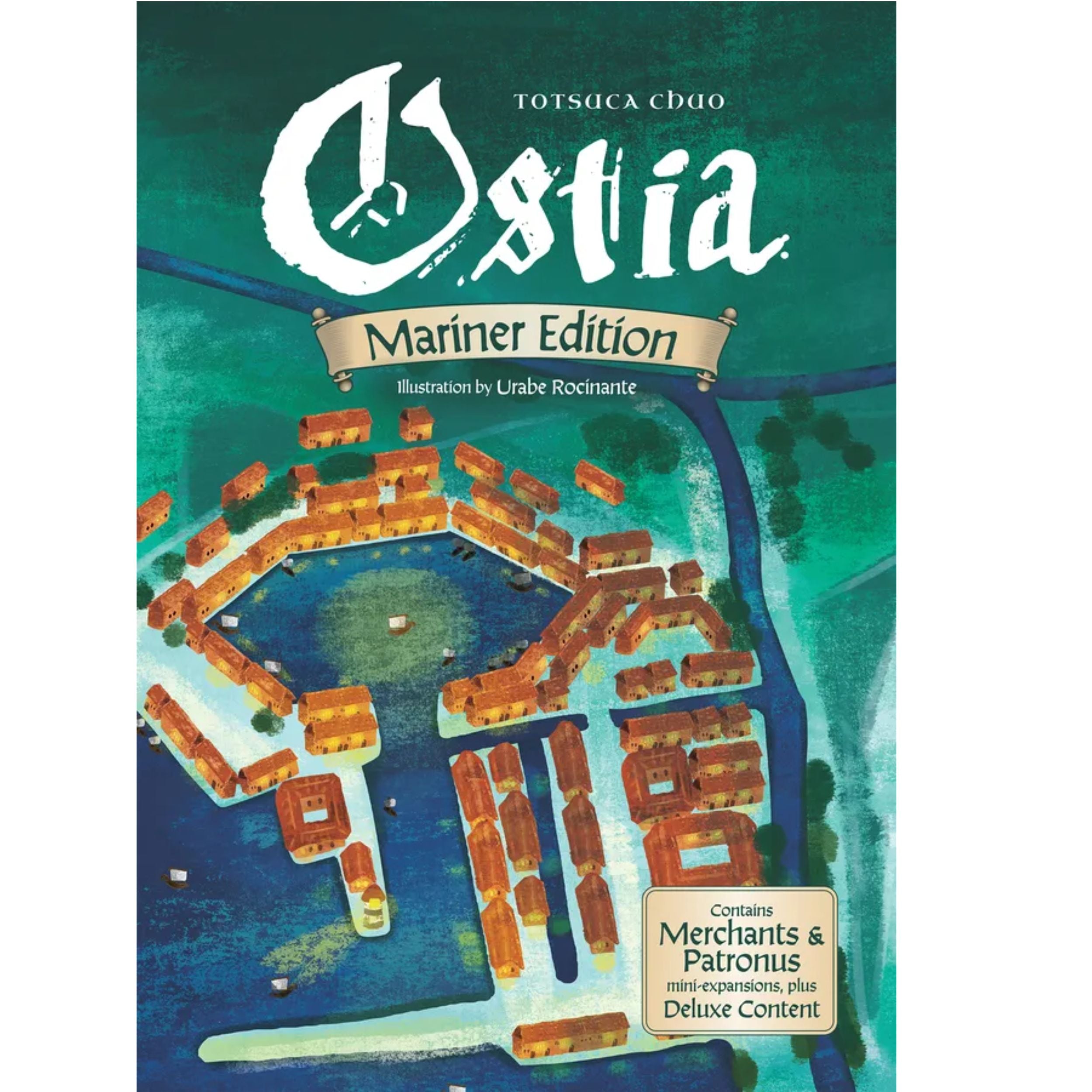
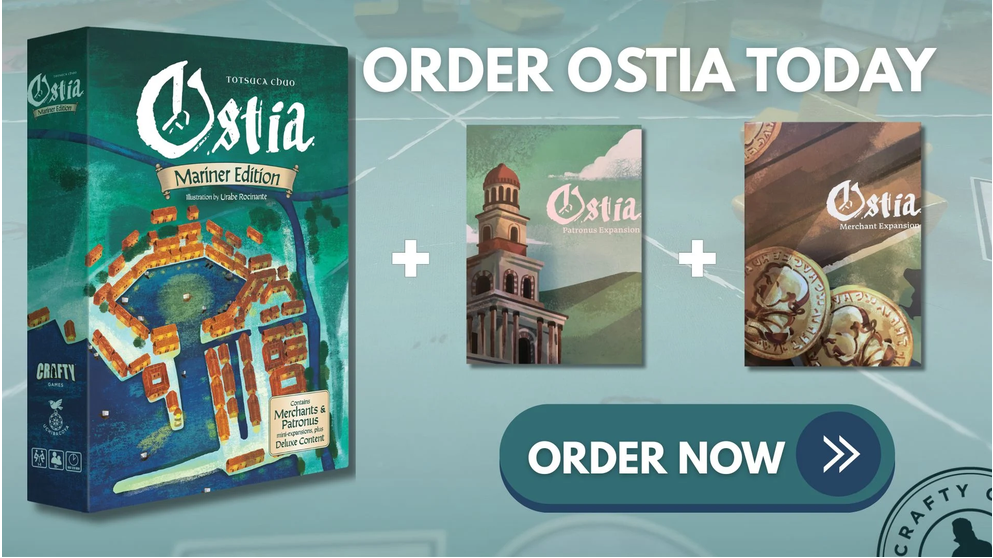
Ostia: Mariner Edition is the grand return of the game by Totsuca Chuo, defined as a modern classic since its first publication. Set in the port of Ostia in 103 AD, under the reign of Trajan, it puts players in the shoes of Roman merchants building maritime trade empires. Art by Jason Harris, Stephanie Katz, Rocinante Urabe, and Sunny (SuiWorks). This Mariner Edition is a big box that includes the base game, Merchants and Patronus expansions, deluxe content, and a dedicated storage solution, with revised graphics and components to improve playability without altering the system.
The heart of the game is a mancala system applied to resource management and action selection. Each turn, choose one of the six spaces on your personal board: count the ships present and get corresponding resources, then take all the ships and distribute them one by one clockwise. Where the last ship lands, perform the action. From here, you build your fleet, establish ports on Mediterranean routes, collect grain, wine, cedar, marble, and exotic animals, complete imperial orders, and gain the favor of nobles. The action rondel intertwined with the mancala creates a puzzle of timing and planning: each move influences the next ones, and whoever best predicts the distribution chain wins.
What they say abroad
"rich strategic experience and beautifully realized theme"
rich strategic experience and beautifully realized theme
— Crafty Games
This is an initial reading of the Mariner Edition, just released and with very little public data. The description is based on what the publisher declared and on the mechanics inherited from the original game. We will update it when we have played games and verifiable reviews.
— FroGames

Ostia: Mariner Edition
The game supports 1 player in the basic rules. The solo mode uses the same game system with automa opponents or dedicated objectives (details to be confirmed with the final manual). It loses competitive interaction on routes and ports, but the mancala-rondel optimization puzzle remains complete.
FrogScore · FroGames editorial rating · initial reading: based on rulebook and official presentation, updated with first playsYour commercial arsenal
What you build at the table
Fleet of ships
Build small, medium, and large ships. Each ship is a token on your mancala board: the more ships in a space, the more resources you get when you select it. The fleet is the engine of your economy.
Routes and ports
Sail the Mediterranean and establish ports in distant cities. Each port gives you access to specific resources and victory points. The best routes must be taken before others do.
Order cards
The emperor demands deliveries: grain for the legions, marble for temples, animals for the arena. Complete orders to earn immediate points and final bonuses. Each card has optional costs for increased benefits.
Buildings in the port
Build structures that enhance your actions or unlock abilities. Buildings modify your personal rondel, allowing stronger combos. Strategic long-term investment.
Come si gioca
Video dimostrativo di gameplay.
🎲How to PlayThe rules in four steps▼
How to Play
The Flow of Each Round
Each turn of Ostia is a mancala selection followed by an action. Brief on paper, dense in practice.
Choose one of the six spaces on your board. Count the ships present: you gain as many resources of that type as there are ships. Take all ships from the space.
Distribute the ships one by one clockwise onto the subsequent spaces on your board. Where the last ship lands, there you will perform the action.
The final space determines the action: build ships, upgrade fleet, build in the harbor, establish routes, deliver orders, or draw new cards. Each action has resource costs and immediate or long-term benefits.
If you have completed sets or achieved objectives, you immediately gain Triumph points. Pass to the next player. The game ends when a player runs out of orders or reaches specific end conditions.
⏱️Your First GameThe chronicle, moment by moment▼
A game in five moments
What happens at the table
Not the rules. The experience.
Setup and first moves
Personal boards in front of everyone, central board with sea routes. Receive initial ships, starting resources, a hand of order cards. The first turn is exploratory: choose a mancala space, count the ships, distribute. You immediately understand that every move now influences the next three.
First routes, first tensions
Someone rushes towards distant ports (more points, rare resources), someone else builds a local fleet. You start planning chains: I select this to get wood, so I build a ship, which ends up here, which gives me the action to take the port in Carthage. The others are doing the same.
Engine revved up
Your mancala board is a machine now: ships strategically distributed, buildings enhancing actions, resources flowing. Every turn is a puzzle: which space do I choose to get the most? Where will the last ship land? Someone completes an imperial order and gains 8 points. The race gets serious.
The move to remember
You make a perfect distribution: you select the space with 5 ships, take 5 grain, distribute, and the last ship lands exactly on the space that allows you to build a large ship AND establish a port in Egypt in the same turn. On the other side of the table, some are cursing (they had aimed for that port) and others are applauding.
Final count
Someone has run out of orders, game end triggers. Scoring: established ports, completed orders, sets of exotic animals, favor of nobles, built buildings. Each category gives points. The one who planned best wins, but often the gap is narrow. You already ask for a rematch.
🐸What to know beforehandThree honest things, from friends▼
What to know beforehand
Three things you should know
Steep learning curve
Mancala is simple, but interweaving it with six different actions, ship building, set collection, and simultaneous objectives requires 1-2 games before strategies become clear. The Mariner Edition reference cards help, but expect slow first turns. It's not a gateway game.
Analysis paralysis possible
Each mancala selection has chain implications: where does the last ship land? What can I do next? How do I position myself for the next 2 turns? If your group has calculating players, expect downtime. The 100-120 minute duration is realistic only with a sustained pace.
Indirect interaction
You compete over limited ports and imperial orders, but you spend most of your time optimizing your personal board. There is no direct combat or heavy sabotage. If you are looking for high interaction, this favors solitary engine optimization with competitive touchpoints.
🏆Victory and DefeatWhat the ending rewards▼
How it ends
How to win and how to lose
The game ends when a player completes a specific number of imperial orders or when certain component pools are exhausted. Triumph points are counted from each source.
Victory
- Ports established on routes (further = more points)
- Completed imperial orders (cards delivered with required resources)
- Sets of exotic animals and accumulated noble favor
- Buildings constructed in the harbor and upgraded ships in the fleet
- End-game bonuses from Merchants and Patronus expansions (details to be confirmed)
Defeat
- You don't expand routes fast enough: others take the best ports
- You optimize the mancala engine but forget to complete orders (they are worth many immediate points)
- You fall behind on too many scoring axes simultaneously (sets, ports, orders)
Ostia: Mariner Edition is a cerebral eurogame that transforms an ancient African game into a Roman planning engine. If you like dense decision chains, it's your port.
💬Frequently Asked QuestionsQuick answers before checkout▼
Frequently Asked Questions
FAQ about Ostia: Mariner Edition
How complex is it compared to other eurogames?
Mancala is intuitive (take, distribute, final action), but the density of choices is high. More complex than Wingspan or Splendor, less than Brass or Ark Nova. The Mariner Edition includes reference cards that ease the initial curve. First game: 2 hours, subsequent: 90-120 minutes with experienced players.
How well does it scale from 1 to 4 players?
Solo play is officially supported (likely an automa or dedicated objectives, to be confirmed). With 2 players, competition over ports is tight. With 3-4 players, interaction increases but so does downtime if someone overthinks. The game is designed for 2-4, solo is a solid but secondary option.
What does the Mariner Edition include compared to the original game?
Base game + Merchants and Patronus expansions + deluxe content + storage solution. It does NOT include the Pirates expansion. Revised components: clearer graphics, jumbo reference cards, Deliver icon instead of Order, readable fonts, improved token and tile iconography. Same gameplay, smoother experience.
What mechanics does Ostia: Mariner Edition use?
Mancala (ship distribution for action selection), rondel (actions determined by final position), resource management (grain, wine, marble, cedar, animals), set collection (imperial orders, exotic animals), track movement (sea routes), variable setup (discovery tiles change each game). Contracts and income from integrated expansions.
Is it available in Italian?
The edition for sale is in English. Graphic components are language-independent (icons, resources), but order cards, reference cards, and rulebook are in English. Requires basic knowledge of the language or reference to fan translations (if available, not verified by FroGames).
The people behind the game
Who invented it, who designed it, who publishes it — and what else they've done.
Ostia: Mariner Edition is a strategy game for 1-4 players, 100-120 minutes playtime, ages 14+, designed by Totsuca Chuo and published by Crafty Games. Set in Imperial Rome of 103 A.D., it combines a mancala system for resource management with an action rondel: you select a board space, gain resources, distribute ships clockwise, and the last one determines the action. Build fleets, establish ports on Mediterranean routes, complete imperial orders, and earn the favor of nobles. The Mariner Edition is a big box with the base game, Merchants and Patronus expansions, revised components, and reference cards. Mechanics: mancala, rondel, resource management, set collection, track movement. Available on FroGames.it.
Frequently Asked Questions
The answers you're looking for, no beating around the bush.
📸Do the images match the actual product?
The photos on the website often come from BoardGameGeek and are intended to give you an idea of the game. They may vary slightly from the version you receive. The content declared by the publisher is always binding.
📦Does the content of the box match what is indicated?
We always strive to provide the correct content, but minor variations are possible due to reprints or updates. The information comes directly from the publishers. If you have any questions, please contact us!
⏳How do pre-orders work?
Pre-order the game before release, payment is immediate, and the game is reserved for you. As soon as it arrives, we'll ship it right away! If there are any delays, we'll update you promptly.
🔒Can I trust buying here?
Absolutely! Secure payments, tracked shipments, and a team that loves board games as much as you do. If something goes wrong, we'll do our best to fix it.
🛠There's a problem with my order, what should I do?
Write to us now! Whether it's a missing part, damage, or an error, we'll help you resolve it as soon as possible. Your experience truly matters to us.