

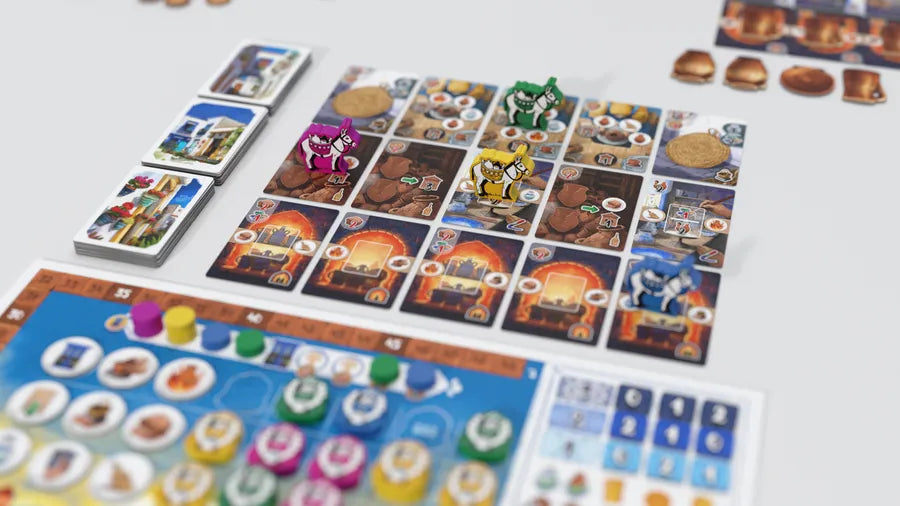
Níjar
🐸 Dettagli da BoardGameGeek
Consiglio BGG sul numero di giocatori
Categorie
Meccaniche
Design & Art
Lingua
Pre-order - leggi i dettagli
🐸 Una rana saggia sa quando dividere l’ordine… e quando aspettare il salto giusto.
Si abbina bene con
The FroGames Card
You have seven artisans on the bench. Decide whether to send three to extract clay or two to mold: if you get the rhythm wrong, you'll end the round with an empty kiln and the market waiting for you. It always happens in the first round.
WHAT IT'S ABOUT
A eurogame that smells of clay and Andalusia
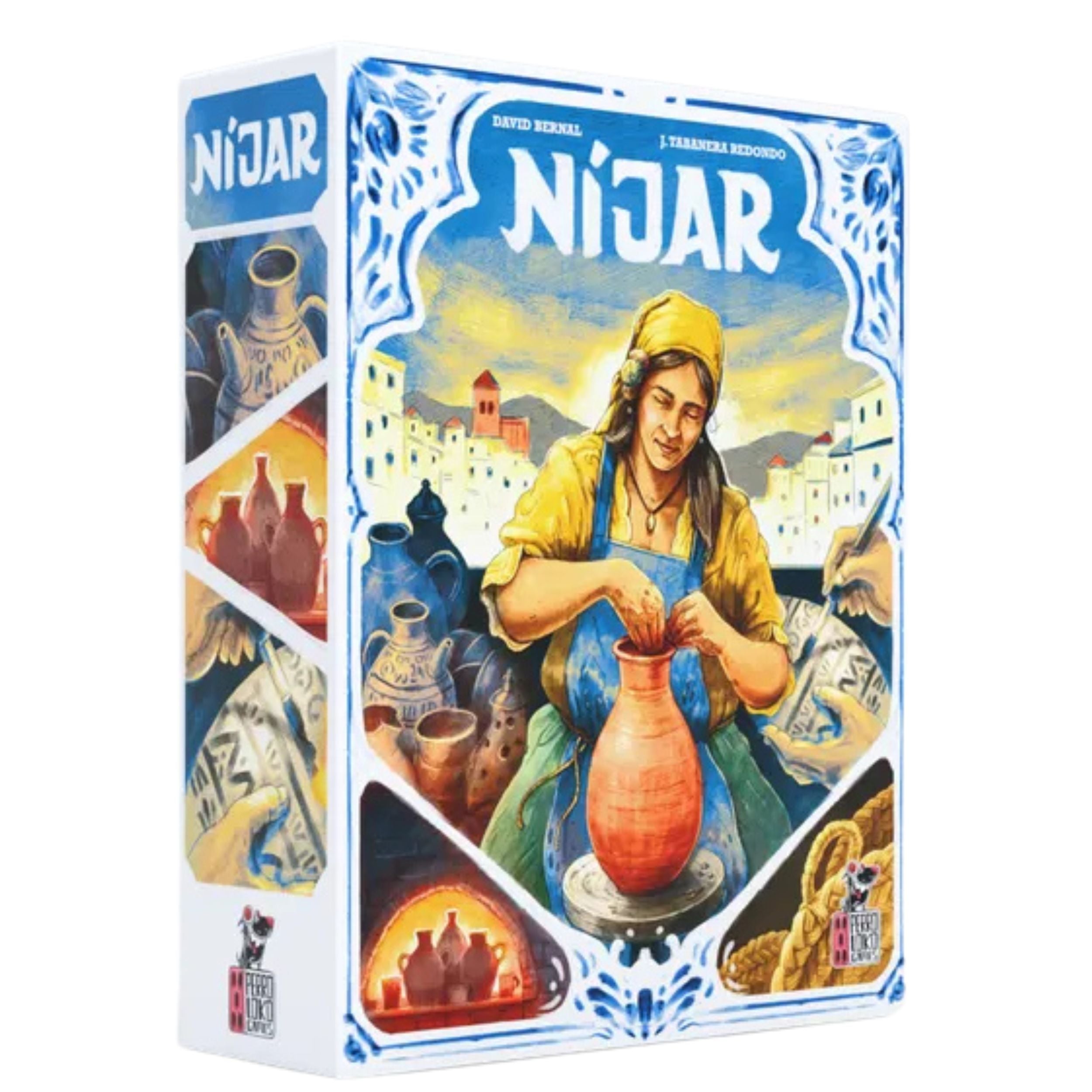
Níjar is a small town in the province of Almería, bathed by the waters of Cabo de Gata, where ceramic tradition dates back to the Bronze Age and reached its peak during the Muslim period (10th-15th century). David Bernal's (Salton Sea, Koinobori) game takes us to the 1920s, when the local economy still revolved around kilns, esparto weavers, and jarapas, the colorful fabrics symbolic of the region. Jorge Tabanera Redondo's illustrations depict the white streets, the rhythm of the potter's wheels, and the hands that weave and paint.
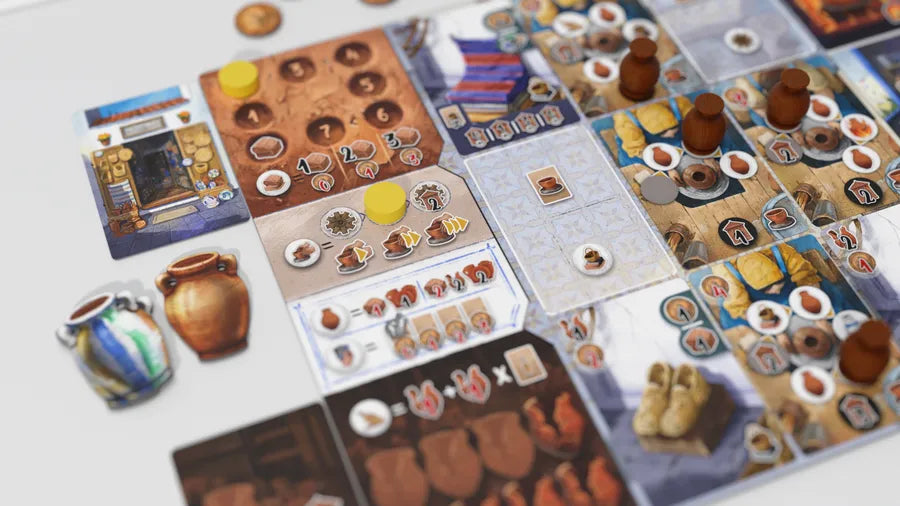
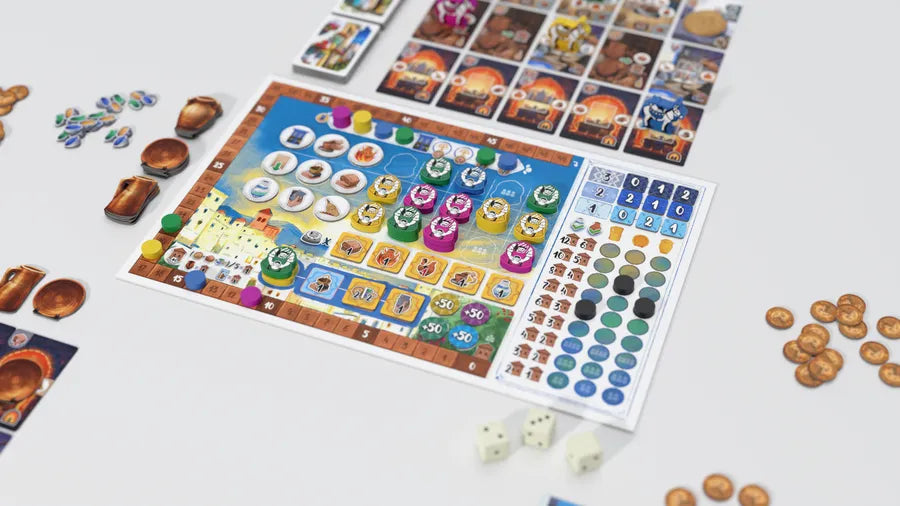
In Níjar, you expand your workshop by adding new wheels to produce more pieces. You extract clay, mold vases, fire them, decorate them, and sell them at the market. The game takes place over three rounds with decreasing resources: 7 artisans in the first, 6 in the second, 5 in the third. Each turn, you choose where to place your workers to perform actions, but you must outnumber those already present: those left out take back their tokens. The pressure increases, turns shorten, and every choice counts.
What they say abroad
"Transformez l'argile en art, le feu en tradition, et votre atelier en l'âme de Níjar."
Turn clay into art, fire into tradition, and your workshop into the soul of Níjar.
— Perro Loko Games
Níjar is a game that promises to combine solid management mechanics with an uncommon setting. Data is still scarce, the card will be updated as soon as we have concrete material to tell you about.
— FroGames

Níjar
The game officially supports 1 player according to BGG data, but we don't yet have details on how the solo mode works (automaton, puzzle, or dedicated variant). The rating is cautious pending concrete information on the system.
FrogScore · FroGames editorial rating · first read: based on rules and official presentation, updated with first playsThe Production Cycle
Four steps from quarry to market
Pottery Wheels
Expand your workshop by adding new wheels: the more you have, the more pieces you can mold simultaneously. Production scales, but you must feed it.
Clay
Extract clay from quarries to fuel production. Without raw material, the workshop stops, and subsequent rounds leave you less room to recover.
Firing
Molded pieces must be fired in the kiln before being decorated or sold. Kiln timing is critical: a full kiln at the wrong time blocks everything.
Decoration and Market
Paint the fired pieces to increase their value, then sell them at the market. End-game objective cards reward different strategies: produce a lot or specialize.
🎲How to playThe rules in four steps▼
How to play
The flow of each turn
Each turn, you choose an action, place artisans, and perform the effect. Those who are left out take back their tokens and wait.
Choose an action space and place a greater number of artisans than those already present. Those who were there take back their tokens. Perform the corresponding action: draw cards, play them, extract clay, mold, fire, decorate, clean the workshop, or sell esparto.
Alternatively, you can discard one of your end-game scoring cards to perform any action, without placing artisans. It's a powerful joker but costs you points at the end of the game.
You can sell up to two fired pieces in exchange for immediate victory points. The market rewards early sellers, but you need to have completed the production chain.
If you run out of artisans, you pass and take a bonus token. In subsequent turns, you can choose other bonuses instead of playing. Those who close early have more choices but give up producing.
⏱️Your first gameMoment by moment account▼
A game in five moments
What happens at the table
Not the rules. The experience.
Workshop Setup
A few minutes to deal cards, prepare the market, and give everyone their first artisans. The board is clean, the wheels are empty, and you wonder how you'll ever fill them all. Spoiler: you won't, and that's okay.
First round: seven moves
You have seven discs to place and everything seems possible. Someone extracts clay, someone plays cards to expand. The first one to place at the market realizes that ready-made pieces are never enough, and starts producing again.
Second round: six moves
The number of actions decreases and you feel the squeeze. Those who expanded too much now struggle to keep up; those who played conservatively find themselves with a small but efficient workshop. Tension rises when you realize you can't do everything.
Third round: five moves
Five discs, and every move is a sacrifice. Someone closes shop early to get the bonus, someone pushes until the last minute to sell one more piece. The legendary moment is when you realize you should have fired a turn earlier.
Final count
Objective cards are revealed, sales points, bonuses, and penalties are tallied. The winner is the one who managed to balance expansion and production without falling behind. Someone vows to open differently next game.
🐸What to know beforehandThree honest things, from friends▼
What to know beforehand
Three things you need to know
Decreasing discs
The number of available actions decreases each round (7-6-5). This is not a minor detail: it completely changes the pace of the game and forces you to plan your production curve from the start. If you expand too early, you won't be able to utilize your workshop in the third round.
Majority placement
To take a space, you must place more artisans than those already there. This creates a game of reading and bluffing: investing too many artisans in one action leaves you exposed elsewhere, investing too few exposes you to being ousted. Those who are left out take back their tokens, they don't lose them.
Still scarce data
Níjar has been recently announced and public playtests are limited. We do not yet have verifiable information on balance, strategic depth, or actual learning curve. This description is based on the official description and will be updated as soon as we have concrete data.
🏆Victory and defeatWhat the ending rewards▼
How it ends
How to win
After three rounds, points are counted: market sales, end-game objective cards, accumulated bonuses.
Victory
- Accumulate points by selling fired and decorated pieces at the market during the game
- Fulfill the conditions of your end-game objective cards (sets of pieces, diversity, quantity)
- Get bonuses by closing shop at the right times and efficiently managing the workshop
What makes you lose
- Expanding the workshop without being able to utilize it in subsequent rounds (too many discs invested early)
- Selling too late: the market rewards those who arrive first, and in the third round you might not have time
- Discarding too many objective cards to get joker actions: final points matter
Níjar presents itself as an eurogame management game with integrated time pressure. If the system holds, the increasing tension of the rounds could make it memorable.
💬Frequently Asked QuestionsQuick answers before checkout▼
Frequently asked questions
FAQ about Níjar
What mechanics does Níjar use?
Níjar combines action retrieval (taking back tokens when ousted), hand management (managing objective and development cards), set collection (producing different pieces to meet objectives), and a market system where you sell to gain points. The decreasing turn structure adds time pressure.
Is it suitable for those unfamiliar with Eurogames?
The estimated weight is medium (3/5): the basic mechanics are intuitive, but managing the decreasing pace and optimizing the production chain requires experience. It's not a gateway game, but not a heavy game either. If you have already played management games with worker placement, you'll feel at home.
Does it scale well from 1 to 4 players?
BGG data indicates official support for 1-4 players. We do not yet have information on the solo system or how interaction changes between 2, 3, and 4 players. Majority placement suggests that at 4 players, competition for spaces is tighter, but this needs to be verified.
How long does a real game last?
The box states 60-90 minutes. Three rounds with decreasing actions (7-6-5 discs) suggest a sustained pace, but the first game with rules explanation might exceed 90 minutes. From the mechanics, it seems like a game that speeds up once learned.
In what language is it available?
The edition sold on FroGames is in English. There is no official information about announced Italian localizations. The game includes cards with text (objective cards, development cards), so knowledge of English is necessary.
The people behind the game
Who invented it, who designed it, who publishes it – and what else they've done.
Níjar is a strategic board game for 1-4 players, lasting 60-90 minutes, recommended for ages 14+, designed by David Bernal and published by Perro Loko Games. Set in 1920s Andalusia, the game puts you in the shoes of a potter who must expand their workshop, extract clay, mold pots, fire them, decorate them, and sell them at the market. The main mechanic is action retrieval with majority placement: you place artisans on action spaces by outnumbering those already present. The unique feature is the three-round structure with decreasing resources (7-6-5 action discs), which creates increasing time pressure and forces you to plan your production curve from the start. End-game objective cards and variable bonuses offer different strategic approaches. Available on FroGames.it.
Níjar
Frequently Asked Questions
The answers you're looking for, no beating around the bush.
📸Do the images match the actual product?
The photos on the website often come from BoardGameGeek and are intended to give you an idea of the game. They may vary slightly from the version you receive. The content declared by the publisher is always binding.
📦Does the content of the box match what is indicated?
We always strive to provide the correct content, but minor variations are possible due to reprints or updates. The information comes directly from the publishers. If you have any questions, please contact us!
⏳How do pre-orders work?
Pre-order the game before release, payment is immediate, and the game is reserved for you. As soon as it arrives, we'll ship it right away! If there are any delays, we'll update you promptly.
🔒Can I trust buying here?
Absolutely! Secure payments, tracked shipments, and a team that loves board games as much as you do. If something goes wrong, we'll do our best to fix it.
🛠There's a problem with my order, what should I do?
Write to us now! Whether it's a missing part, damage, or an error, we'll help you resolve it as soon as possible. Your experience truly matters to us.