
Iberian Gauge
🐸 Dettagli da BoardGameGeek
Consiglio BGG sul numero di giocatori
Categorie
Meccaniche
Design & Art
Lingua



Si abbina bene con
The FroGames Card
You buy shares of the yellow company. Then someone builds a track for it that leads nowhere. You pay anyway. And you realize you underestimated the terrain.
WHAT IT'S ABOUT
Railway investments in the Iberian Peninsula post-1860
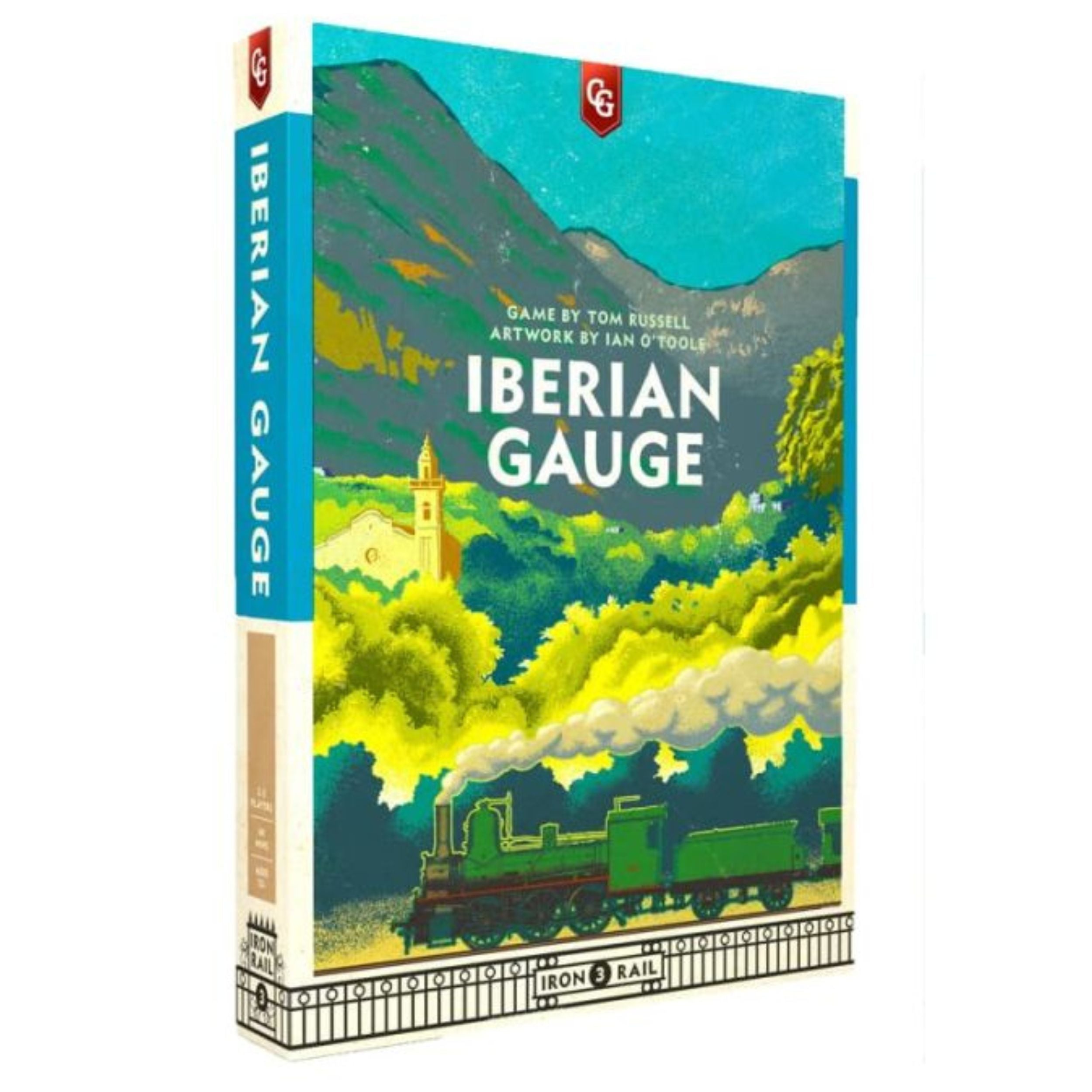
Designed by Amabel Holland and published by Winsome Games in 2017, then reprinted by Capstone in the Iron Rail series with graphics by Ian O'Toole, Iberian Gauge brings the Cube Rails system to railway-era Spain and Portugal. The terrain is hostile: mountains, valleys, brutal distances. Every track costs.
You buy shares during stock market turns. Then you build tracks for the companies whose shares you own, in the order you bought them. Leasing others' tracks allows you to expand without spending a fortune, but every track choice is an investment that can either pay off or sink you. Companies that don't grow lose value. Your shares with them.
What they say abroad
"A brilliant economic puzzle wrapped in train routes"
A brilliant economic puzzle wrapped in train routes
— The Opinionated Gamers
Iberian Gauge is our first contact with this system: essential rules, brutal decisions, investments that tighten your stomach. It's not a train game. It's a game of timing and reading others.
— FroGames

Iberian Gauge
FrogScore · FroGames editorial rating · based on rules, international reviews, and play sessionsPieces on the board
What you put on the board (and what it costs you)
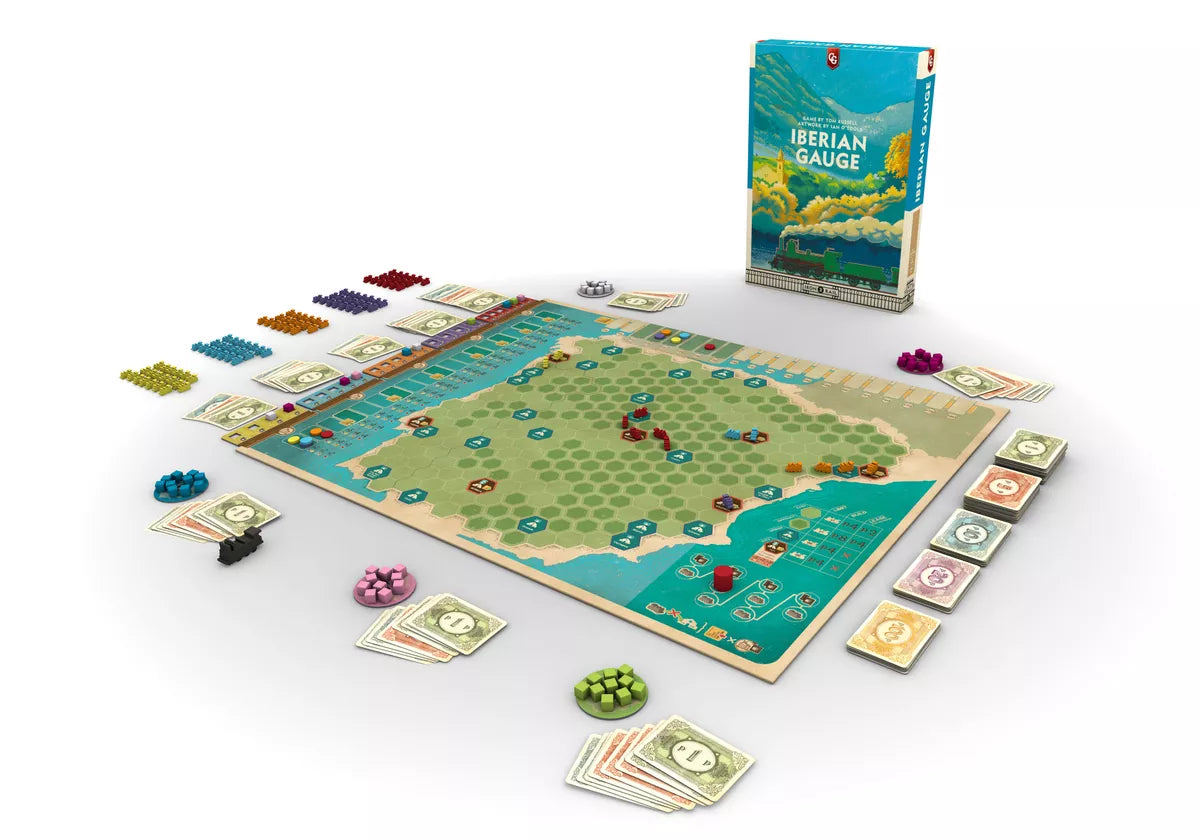
Railway Cubes
Each cube is a track segment. You place them on the map to expand the company's network. It costs money, connects cities, generates income. The cube is everything.
Stock Certificates
You buy company shares during stock market turns. Each share entitles you to build a track for that company, in the order you bought it. The more shares you have, the more control you have.
Iberian Map
Spain and Portugal divided into regions and cities. The terrain is mountainous: building costs more in certain areas. More distant cities are worth more income points. Geography dictates.
Income and Dividends
Each operational turn, companies generate income based on connected cities. Dividends go to shareholders. Share value rises or falls based on performance. The market is ruthless.
Recommended Sleeves 150 cards in 1 size ▼
If you play often, we recommend protecting your cards with transparent sleeves to make them last a long time.
| Size | Quantity |
|---|---|
| 45 × 68 mm | 150 |
| Total cards | 150 |
Come si gioca
Video dimostrativo di gameplay.
🎲How to playThe rules in four steps▼
How to play
The flow of each round
A round is divided into two phases: the stock market turn (you buy shares) and the operational turn (you build tracks and collect dividends).
In turn, each player can buy ONE share of a railway company, paying its current price. The order of purchase is crucial: whoever buys a share first will build first in the operational phase. You can pass.
In order of share purchase, each player builds ONE track (places a cube) for each share owned. You can lease other players' tracks to expand at a reduced cost. Each track costs money from the company's treasury.
Each company generates income based on the cities connected by its network (including leased tracks). Income is distributed as dividends to shareholders, in proportion to the shares owned.
Share values rise or fall based on company performance: income generated, expansion, strategic connections. Stagnant companies lose value. Your shares along with them.
⏱️Your first gameThe chronicle, moment by moment▼
A game in five moments
What happens at the table
Not the rules. The experience.
The initial auction
Everyone stares at the map. Someone bids on the blue company, the one starting from Madrid. You raise the bid. Maybe you're paying too much. Or maybe not. It depends on what the others will do in the next few minutes.
The first track
It's your building turn. You bought the yellow share first: you can place a cube. Do you place it towards Valladolid or towards Zaragoza? The choice seems small. It isn't. It will affect the entire game.
Leasing others' tracks
Someone builds a track for the red company that crosses your blue network. They ask for your permission (the rules allow it). You accept: it costs you less to expand using their tracks. But now the red company is connected to three cities. Its value rises. And you don't own any shares in it.
The dividend that changes everything
Income turn. The green company pays 12 to its shareholders. The yellow company, in which you are the largest investor, pays 4. The gap widens. You look at the map: the green company has reached Lisbon. Your yellow company is stuck in the middle of Castile. You have one turn, maybe two, to fix it.
The final count
You add up the dividends collected, the final value of the shares, penalties for companies you didn't expand. The winner is the one who invested best, not the one who built the most. Someone won without owning the largest company. You already want to play again.
🐸Good to know beforehandThree honest things, from friends▼
Good to know beforehand
Three things you need to know
Capital is extremely limited
Each company starts with very little money. Every track you build costs money, and if the company runs out of money, it can no longer expand. You must balance expansion and sustainability. Many games are lost because you built too much, too soon, and ran out of cash.
Leasing tracks is a double-edged sword
You can use other companies' tracks to expand your network at a reduced cost. But by doing so, you also increase the income of the company leasing you the tracks. Each lease is a calculation: is it better to pay less now and enrich an opponent, or build everything yourself and risk falling behind?
Everything is public, but reading it is difficult
There is no luck, no hidden cards. All information is on the table: shares owned, company treasuries, networks built. But predicting what others will do is hellishly difficult. Who will buy which share? Who will expand where? One misjudgment and you've invested in the wrong company.
🏆Victory and defeatWhat the ending rewards▼
How it ends
How to win (and how to sink)
The game ends after a fixed number of rounds (depends on the number of players). Money is counted.
Victory
- You bought shares in the companies that generated the most income during the game
- You collected substantial dividends and the final value of your shares is high
- You were able to expand your companies at the right times, without draining their treasuries
Defeat
- You invested in companies you couldn't expand enough (collapsed share value)
- You built too much and too soon, draining treasuries and blocking future expansions
- You underestimated the purchase order: others built before you, occupying key connections
Iberian Gauge is a pure investment game: no dice, no cards, just calculation and reading your opponents. If you're looking for a tense, fast, and ruthless eurogame, this is your train.
💬Frequently Asked QuestionsQuick answers before checkout▼
Frequently Asked Questions
FAQ on Iberian Gauge
What mechanics does Iberian Gauge use?
Stock holding, network building, action queue (order of action based on purchase), income generation, connections between cities. It is a Cube Rails from Capstone's Iron Rail series.
Is it true that there's no luck?
Yes. Zero dice, zero random cards, zero variable setup. The map is fixed, all information is public. The winner is the one who invests best and best reads the moves of others. It's a game of pure information, like chess (but much faster).
Does it scale well for all player counts?
The game is for 3-5 players. With 5 players it's excellent: the market is dynamic, auctions are tense, expansions are competitive. With 3 players it works but loses some tension (less competition for shares and tracks). Ideally 4-5 players.
How long does a real game last?
60-90 minutes with players who know the rules. The first game can last up to 100-110 minutes because every investment decision requires calculation. From the second game onwards, it flows quickly: turns are fast, there's no downtime.
Is it available in Italian?
This edition is in English. The text on the cards and map is minimal (city names, numerical values). The rulebook is in English but the complexity is medium: once learned, the game is almost language-independent. There are no official Italian translations.
The people behind the game
Who invented it, who designed it, who publishes it — and what else they've done.
Iberian Gauge is a railway investment board game for 3-5 players, designed by Amabel Holland and published by Capstone Games in the Iron Rail series. Duration 60-90 minutes, recommended age 12+. Mechanics: stock holding, network building, action queue, income, connections. Players buy shares in railway companies, build tracks on the Iberian Peninsula map, lease other networks, and collect dividends. No random components: all information is public, every decision matters. Part of the Cube Rails family and the Winsome Essen Sets. Available on FroGames.it.
Frequently Asked Questions
The answers you're looking for, no beating around the bush.
📸Do the images match the actual product?
The photos on the website often come from BoardGameGeek and are intended to give you an idea of the game. They may vary slightly from the version you receive. The content declared by the publisher is always binding.
📦Does the content of the box match what is indicated?
We always strive to provide the correct content, but minor variations are possible due to reprints or updates. The information comes directly from the publishers. If you have any questions, please contact us!
⏳How do pre-orders work?
Pre-order the game before release, payment is immediate, and the game is reserved for you. As soon as it arrives, we'll ship it right away! If there are any delays, we'll update you promptly.
🔒Can I trust buying here?
Absolutely! Secure payments, tracked shipments, and a team that loves board games as much as you do. If something goes wrong, we'll do our best to fix it.
🛠There's a problem with my order, what should I do?
Write to us now! Whether it's a missing part, damage, or an error, we'll help you resolve it as soon as possible. Your experience truly matters to us.