

Hansa Teutonica: Big Box
🐸 Dettagli da BoardGameGeek
Consiglio BGG sul numero di giocatori
Categorie
Meccaniche
Design & Art
Lingua
Pre-order - leggi i dettagli
🐸 Una rana saggia sa quando dividere l’ordine… e quando aspettare il salto giusto.


Si abbina bene con
The FroGames Card
You want to open that route but there are already three opponent markers. You push them away one by one, they protest but in the meantime they improve their skills. At the end of the game, no one remembers who won, but everyone remembers that battle for Bremen.
WHAT IT'S ABOUT
Merchants, routes, and clashes in the medieval Hanseatic League
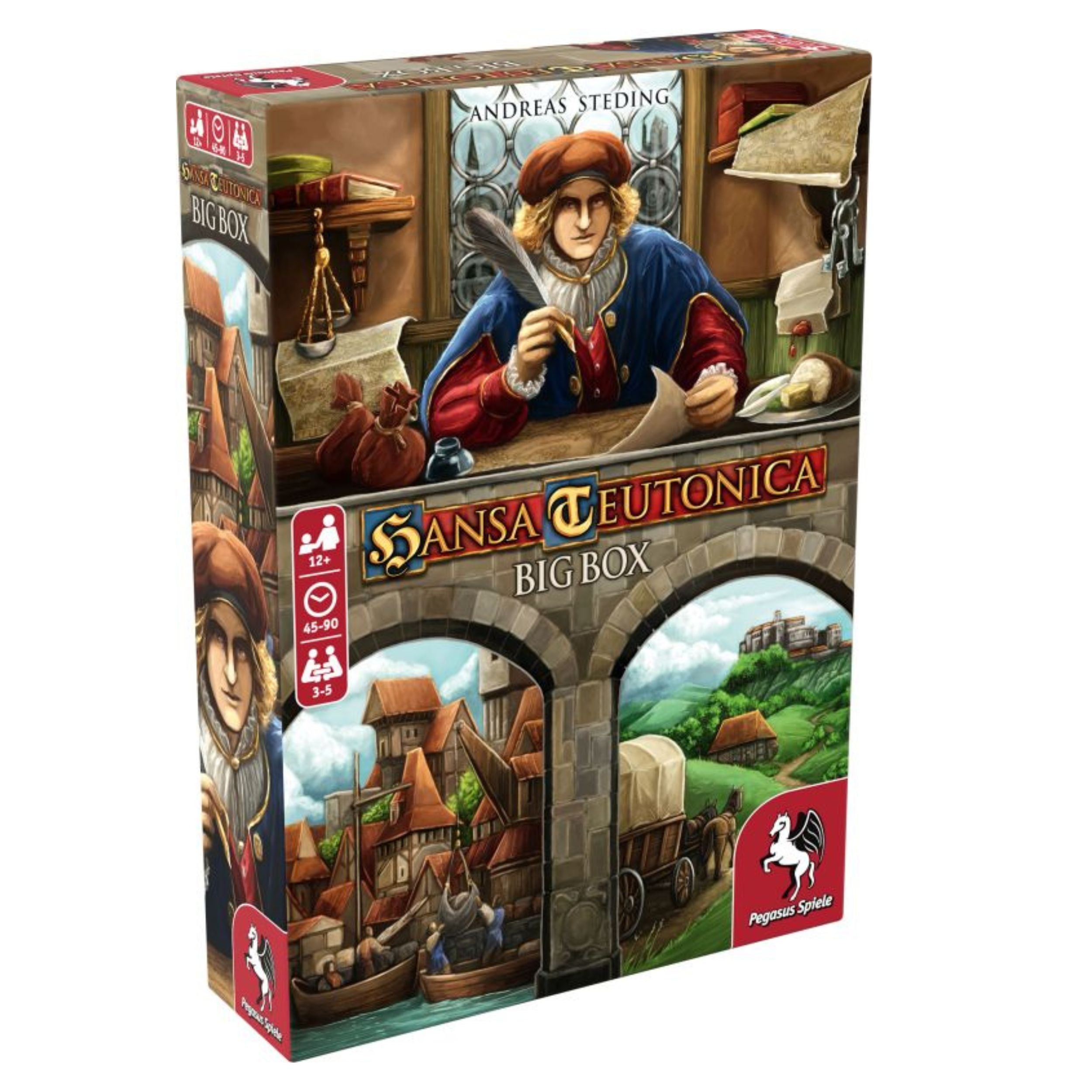
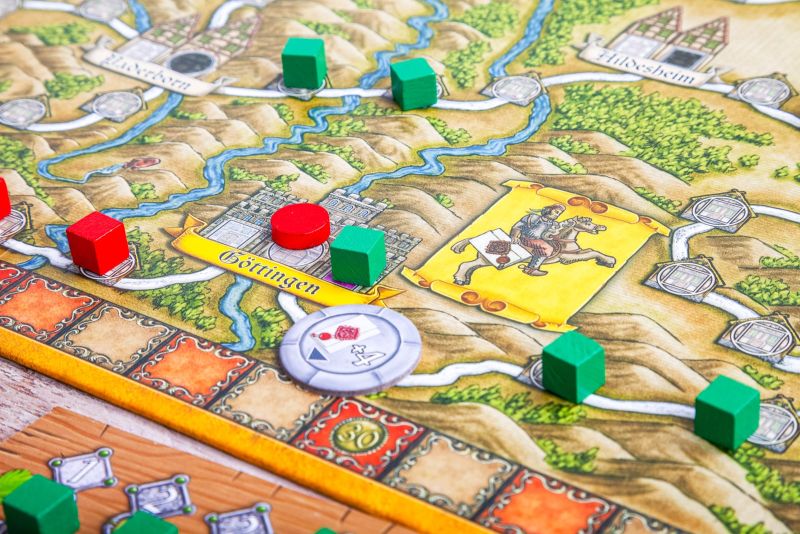
In 2009, Andreas Steding designed a Eurogame that overturns conventions: instead of avoiding opponents, here you seek them out, block them, and paradoxically help them while they hinder you. Set in the 14th-century Hanseatic League, the game puts you in the shoes of a merchant who must establish trading posts in German cities, develop skills, and accumulate prestige. Dennis Lohausen's minimalist illustrations keep the board clean: only the network of routes you build turn after turn matters.
Each turn you have two actions: you place markers on routes between cities, or you use them to activate bonuses, open offices, or improve your skills. The problem? Spaces are contested. When someone occupies a space you need, you can move their markers by placing yours – but they recover those markers and can immediately use them to power up. Every block is a give and take: you slow down your opponent but give them resources. The game is a dance of placements, pushes, recoveries, and counter-moves where no one is ever truly out of the game.
What they say abroad
"Every move creates tension, every placement is a negotiation"
Every move creates tension, every placement is a negotiation
— The Opinionated Gamers
Hansa Teutonica is a Eurogame that forces you to look your opponents in the eye. There's no way to play your game by ignoring others: every square is a battlefield, every turn a choice between progressing and sabotaging. The Big Box adds maps and variants that amplify these dynamics without overcomplicating the rules. It's a 2009 game that still feels more modern than many recent titles.
— FroGames

Hansa Teutonica: Big Box
FrogScore · FroGames editorial rating · based on rules, international reviews, and play sessionsThe merchant's tools
Four elements that define every game
Routes between cities
Each route is a row of spaces between two cities. To complete it, you must occupy all of them with your markers — or move others' by paying the cost. Completing a route allows you to open an office in one of the two cities.
Trading posts
Opening an office in a city gives you prestige points and brings you closer to victory. Some cities give immediate bonuses, others unlock special actions. Controlling the right cities at the right time is key.
Skill tracks
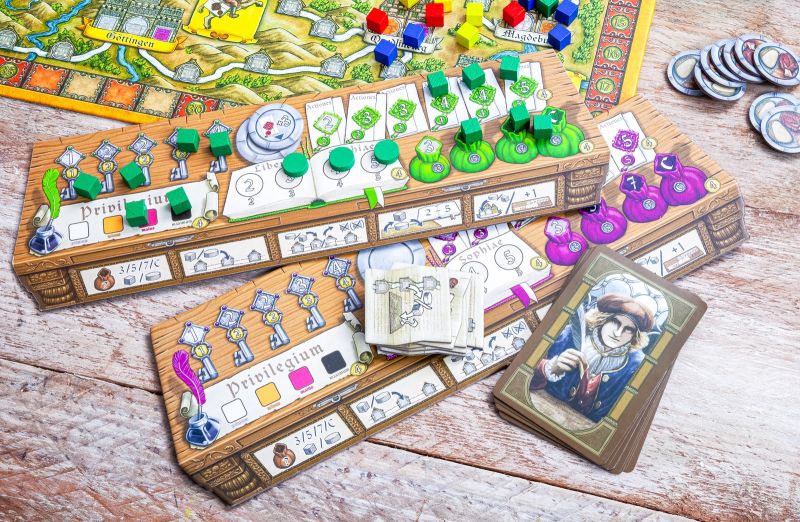
Five tracks improve your abilities: more actions, more markers, more movement, more offices. Each improvement costs resources but makes you faster and more flexible in subsequent turns.
City bonuses
Some cities offer one-time bonuses: keys (open free offices), extra actions, privilege points. Controlling these cities at the right moments can turn a game around.
Come si gioca
Video dimostrativo di gameplay.
🎲How to playThe rules in four steps▼
How to play
The flow of each turn
Two actions per turn. Simple to explain, impossible to master.
Choose a route between two cities and place one or more of your markers on empty spaces (or spaces occupied by opponents, moving their markers back to their reserves). Each space has a marker cost.
If you control all spaces on a route, you can remove your markers and open an office in one of the two connected cities. Each office is worth prestige points. Some cities provide immediate bonuses.
Use recovered markers (or those moved by opponents) to advance on the five skill tracks: you increase the number of actions, available markers, movements, offices that can be opened, and gain special privileges.
Some cities offer one-time bonuses: keys (open offices for free), extra actions, privilege points. If you control the city, you can activate the bonus, but only once per game.
⏱️Your first gamePlay-by-play, moment by moment▼
A game in five moments
What happens at the table
Not the rules. The experience.
Setup and initial placements
The board is empty. Everyone has their markers and basic abilities. The first turns are a race to mark the most valuable routes: who gets to Lübeck first? Who controls the way to Hamburg? No one has enough resources to complete a route yet, but everyone wants to plant their flag.
The first blocks
Someone tries to complete a route and finds an opponent's marker in the way. They move it, the opponent recovers the marker and immediately uses it to improve an ability. The first block teaches the lesson: helping your opponent is the price of progress. From now on, every move is a calculation.
The race for offices
Mid-game. Those who have improved their skills are now faster: they complete routes in one turn, open offices, accumulate points. Those who have fallen behind in development must choose: pursue or sabotage? The board is crowded, every space is contested, every turn is a silent negotiation.
The key moment
Someone opens the 9th office (out of 10) and the alarm sounds. The others realize that the game is about to end. Some rush to complete the last route, some exploit remaining city bonuses, some desperately block the leading opponent hoping to slow them down. Two turns decide everything.
End of game and scoring
Someone opens the tenth office and the game stops. Points are counted: offices opened, privilege bonuses, skill tracks completed. The winner is often not the one who dominated the board, but the one who timed the final openings best. The others vow revenge and immediately ask for a rematch.
🐸What to know beforehandThree honest things, from friends▼
What to know beforehand
Three things you need to know before buying
Scales poorly with 3 players
With 3 players, the board is too large: empty zones remain, competition is diluted, some routes are never contested. The game is best with 4, where every space counts. With 5, it becomes chaotic (in a good way) but downtime increases.
Steep learning curve
The rules can be explained in 15 minutes, but the first game is disorienting: you need to understand which skills to develop first, which routes to complete, when to block and when to give up. The first two games are practice, from the third onwards you truly understand what you're doing.
Risk of analysis paralysis
With very analytical players, turns lengthen: too many options, too many "what ifs". If someone at the table tends to overthink, set a timer or prepare for games exceeding 90 minutes even with 4 players.
🏆Victory and defeatWhat the ending rewards▼
How it ends
How to win and how to fall behind
The game ends when a player opens the tenth office (or reaches a certain privilege score, depending on the map). At that point, the total prestige is counted.
Victory conditions
- Open 10 trading offices (or the number specified by the variant map)
- Accumulate the most prestige points from offices, city bonuses, and skill tracks
- Be the first to reach the privilege point target (only on some variant maps)
How to fall behind
- Not developing skills quickly enough: you remain slow while others accelerate
- Completing unprofitable routes: you waste resources on offices worth less
- Blocking too much without progressing: you help opponents power up while you stagnate
Hansa Teutonica is a strategic eurogame that thrives on direct interaction and perfect timing. If you're looking for a game where every turn is a positional battle and blocking an opponent also means helping them, this Big Box is the complete package: base game, Britannia, East, and all variants in one box.
💬Frequently Asked QuestionsQuick answers before checkout▼
Frequently Asked Questions
FAQ about Hansa Teutonica: Big Box
What mechanics does Hansa Teutonica: Big Box use?
Network and route building, area majority (control spaces), tech trees (skill development on tracks), action points (limited actions per turn), ownership (exclusive possession of spaces), take that (direct interaction with moving opponent markers).
How important is blocking opponents?
Crucial, but it's a double-edged sword. When you move other players' markers, they recover them and can immediately use them to power up. Blocking too much helps opponents develop; blocking too little lets them dominate the board. The game is about finding the right balance between progressing and sabotaging.
Do the variant maps change the game much?
Yes. Britannia has a star structure with London at the center, favoring control of a few key nodes. East expands the map towards Russia and the Baltic, adding new cities and longer routes. Each map changes strategic priorities and optimal paths, ensuring high replayability even after dozens of games.
Is this a good game for beginners to eurogames?
Only if there's someone at the table who already knows the game and can guide new players. The rules are relatively simple, but the direct interaction and the weight of choices can be overwhelming for those coming from classic board games. It's better to start with a softer gateway game and get to Hansa after 4-5 eurogames.
Is it available in Italian?
This edition is in English. The game is almost language-independent: the components are minimal, the abilities are iconographic; you only need the translated rulebook (easily found online). Language is not a barrier to playing.
The people behind the game
Who invented it, who designed it, who publishes it — and what else they've done.
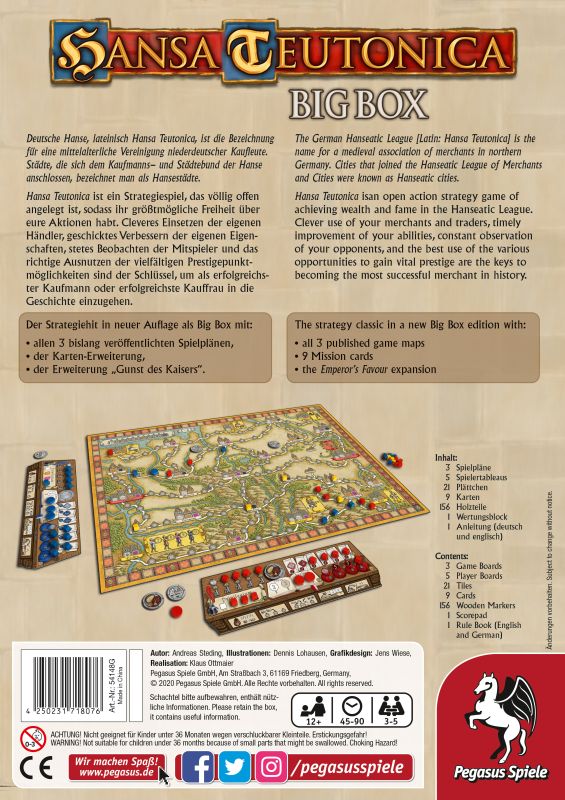
Hansa Teutonica: Big Box is a strategic eurogame by Andreas Steding for 3-5 players, lasting 45-90 minutes, ages 12+. Set in the medieval Hanseatic League, the game uses mechanics of network building, area control, and skill development on tracks. Each turn you have two actions to place markers, complete trade routes, open offices, and improve abilities. The Big Box includes the base game, the Britannia and East expansions, and all official variants. Published by Pegasus Spiele, it is considered one of the most interactive and tactical eurogames of its generation. Available at FroGames.it.
Frequently Asked Questions
The answers you're looking for, no beating around the bush.
📸Do the images match the actual product?
The photos on the website often come from BoardGameGeek and are intended to give you an idea of the game. They may vary slightly from the version you receive. The content declared by the publisher is always binding.
📦Does the content of the box match what is indicated?
We always strive to provide the correct content, but minor variations are possible due to reprints or updates. The information comes directly from the publishers. If you have any questions, please contact us!
⏳How do pre-orders work?
Pre-order the game before release, payment is immediate, and the game is reserved for you. As soon as it arrives, we'll ship it right away! If there are any delays, we'll update you promptly.
🔒Can I trust buying here?
Absolutely! Secure payments, tracked shipments, and a team that loves board games as much as you do. If something goes wrong, we'll do our best to fix it.
🛠There's a problem with my order, what should I do?
Write to us now! Whether it's a missing part, damage, or an error, we'll help you resolve it as soon as possible. Your experience truly matters to us.