

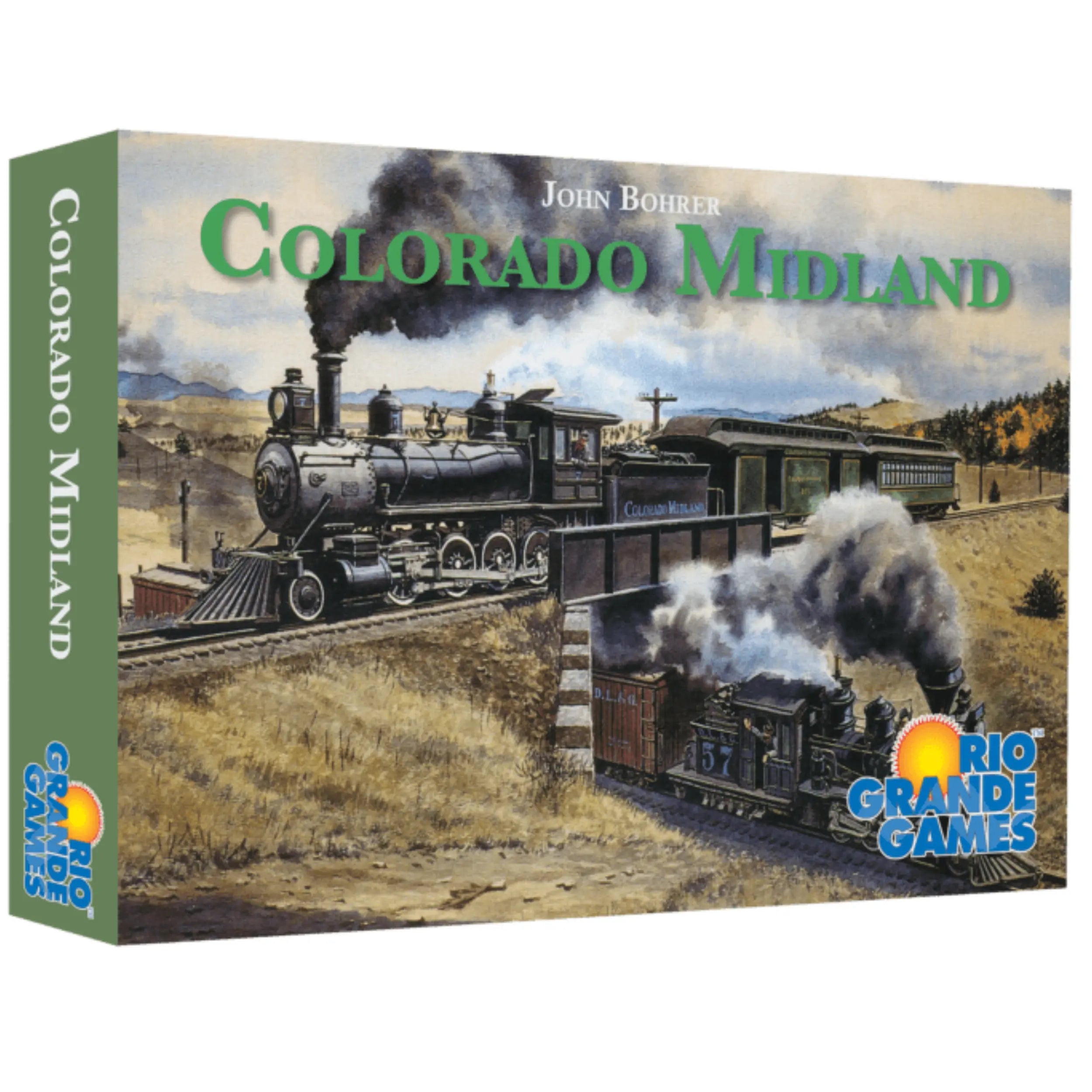
Colorado Midland
🐸 Dettagli da BoardGameGeek
Consiglio BGG sul numero di giocatori
Categorie
Meccaniche
Design & Art
Lingua




Si abbina bene con
The FroGames Card
You build a railway towards a rich mine. Someone else lays a parallel track. You haven't spoken, but now you need each other. And when the mine runs dry, you'll hate each other.
WHAT IT IS ABOUT
Railways, mines, and shared incentives in the Rocky Mountains
Colorado Midland is a railway network building game by John Bohrer, released in 2011 by Winsome Games and later reprinted by Rio Grande Games. Minimalist art by Todd Sanders, Cube Rails system, historical setting in the American Rocky Mountains gold rush.
You are a mine owner. Your mines are isolated, inaccessible. You must urge railway companies to build tracks to your deposits: the faster they arrive, the greater the profits before the vein runs out. But you don't control the railways. You incentivize them. And other players do the same with their mines. The result is an emergent network of tacit alliances, without explicit negotiation, where every track laid changes everyone's interests.
What they say abroad
"No dice, no cards. Just incentives and emerging alliances between players."
No dice, no cards. Just incentives and emerging alliances between players.
— Winsome Games
Colorado Midland is a game with few ratings on BGG, but with a distinctive mechanic. The Cube Rails system requires reading the table like a collective chess game: every move creates dependencies. The card will be updated when we have more feedback from the community.
— FroGames

Colorado Midland
FrogScore · FroGames editorial rating · based on rules, international reviews, and play sessionsThe elements in play
What you find yourself facing
Rocky Mountains Map
Prohibitive alpine terrain. Each hex costs differently. Mines are scattered in isolated districts, some very rich but inaccessible. The tracks you build will remain there for the entire game.
Mines and districts
Each player controls some mines. The faster the track arrives, the greater the profits before depletion. But you don't build the tracks: you incentivize them. And others do the same with theirs.
Railway companies
You don't control them. Any player can extend any railway, if it suits them. The result is a shared network where your tracks also serve others, and vice versa.
Incentives and profits
Each mine pays whoever connects it. But the value decreases each turn: the sooner you arrive, the more you earn. Your choices shape others' incentives. Their choices shape yours.
Recommended sleeves 65 cards in 1 size ▼
If you play often, we recommend protecting your cards with transparent sleeves to make them last longer.
| Size | Quantity |
|---|---|
| 56 × 87 mm | 65 |
| Total cards | 65 |
Come si gioca
Video dimostrativo di gameplay.
🎲How to playThe rules in four steps▼
How to play
The flow of each round
Quick turns, slow decisions. Each player on their turn chooses a railway company and extends it by one segment.
You can extend any company on the board. You don't own it: you use it. The only constraint is that the extension must start from an existing track of that company.
Each hex has a cost (plain, hill, mountain). You pay from your personal reserve. If you cannot pay, you cannot build there.
If the track you laid reaches a mine not yet connected, you immediately collect the current value of that mine. Then the value decreases for the next player who connects it.
Pass to the next player. The game continues until all mines have been connected or until no one can build tracks anymore.
⏱️Your first gameMoment-by-moment chronicle▼
A game in five moments
What happens at the table
Not the rules. The experience.
Setup and first moves
You receive your mines. You look at the board. Some are very close to an existing railway, others isolated in the mountains. You decide which one to incentivize first. The others do the same, in silence.
Tacit alliances
You build a track towards your mine. Another player builds one that approaches your same direction. You haven't spoken, but now you both have an interest in that railway growing. The alliance has formed without a word.
The network intertwines
The board fills up. Every new track changes the value of all others. A mine that seemed unreachable is now two hexes away from a railway. Do you own it? No. But you could extend that railway and take a share of the profits.
The necessary betrayal
That railway you helped build now serves them more than you. The mine is running out. You change direction, extend another company. Your former ally looks at you. Says nothing. But you know you've betrayed them.
Final count
The mines are exhausted. You count the profits: every track you laid, every mine you connected, every railway you extended. Someone won by building little but in the right places. Someone else built a lot, but for others.
🐸Good to know beforehandThree honest things, from friends▼
Good to know beforehand
Three things you need to know
Steep initial learning curve
The rules are simple. Understanding what to build is extremely complicated. The first games seem chaotic: you build tracks, someone collects, you don't understand why. It takes experience to read the board as a system of intertwined incentives. It's not a game that works on the first try with new players.
Doesn't scale well below 3 players
The game requires 3-5 players. With fewer than 3, it doesn't work: the emerging alliances and shared incentives lose meaning. Indirect interaction needs more voices at the table to create the strategic complexity that makes the game interesting.
High mental downtime
Turns are fast (you place a cube), but decisions are slow. You have to recalculate everyone's incentives before each move. With players prone to analysis paralysis, the stated 45 minutes can easily become 90. It's not a relaxed game.
🏆Victory and defeatWhat the ending rewards▼
How it ends
How to win and how to lose
The game ends when all mines have been connected or when no player can build tracks anymore. Profits collected are tallied.
Victory
- Highest total profits collected by connecting mines
- Having built in the right places at the right time, before the value of the mines decreased
- Having correctly read others' incentives and exploited them to your advantage
Defeat
- Having built too many tracks that served others more than you
- Having connected mines too late, when the value had already dropped
- Having underestimated others' moves and invested in railways that became useless
Colorado Midland is an exercise in reading shared incentives without negotiation. Alliances form in silence, and by the time you realize you've built for someone else, it's already too late.
💬Frequently asked questionsQuick answers before checkout▼
Frequently asked questions
FAQ about Colorado Midland
What mechanics does Colorado Midland use?
Pure network and route building, with a Cube Rails system: you build a railway network using cubes to mark tracks. No element of luck, no card drawing or dice rolling. Only shared incentives and spatial planning.
Does it work with casual players?
No. Colorado Midland requires abstraction and board reading at levels that discourage casual players. The first games are frustrating: you build, someone collects, you don't understand why. It requires a group accustomed to strategic games and willing to lose the first game to learn.
Is it a negotiation game?
No. There is no explicit negotiation. Alliances emerge from moves, not words. You build a track that benefits you. That same track also benefits someone else. You find yourselves allies without having spoken. Then interests change, and the alliance breaks. All in silence.
How long does a game really last?
The box says 45 minutes. True only with experienced and fast players. With players who have to recalculate incentives at every turn, easily 60-90 minutes. Mental downtime is high, physical turns are very fast but decisions require time.
Is it available in Italian?
No. The edition for sale is in English, but language dependence is minimal: the main components are cubes and a board with numbered hexes. You need the English rulebook (or a fan translation) for the first game, then the game is almost language-independent.
The people behind the game
Who invented it, who designed it, who publishes it — and what else they've done.
Colorado Midland is a strategic railway network building game for 3-5 players, by John Bohrer and published by Rio Grande Games. Duration 45 minutes, age 12+, pure network building mechanics with no elements of luck. Each player is a mine owner in the Rocky Mountains and must incentivize railway companies to build tracks towards their deposits. The Cube Rails system creates emergent alliances between players based on shared incentives, without explicit negotiation. Designer John Bohrer, minimalist graphics by Todd Sanders. Available on FroGames.it.
Frequently Asked Questions
The answers you're looking for, no beating around the bush.
📸Do the images match the actual product?
The photos on the website often come from BoardGameGeek and are intended to give you an idea of the game. They may vary slightly from the version you receive. The content declared by the publisher is always binding.
📦Does the content of the box match what is indicated?
We always strive to provide the correct content, but minor variations are possible due to reprints or updates. The information comes directly from the publishers. If you have any questions, please contact us!
⏳How do pre-orders work?
Pre-order the game before release, payment is immediate, and the game is reserved for you. As soon as it arrives, we'll ship it right away! If there are any delays, we'll update you promptly.
🔒Can I trust buying here?
Absolutely! Secure payments, tracked shipments, and a team that loves board games as much as you do. If something goes wrong, we'll do our best to fix it.
🛠There's a problem with my order, what should I do?
Write to us now! Whether it's a missing part, damage, or an error, we'll help you resolve it as soon as possible. Your experience truly matters to us.