
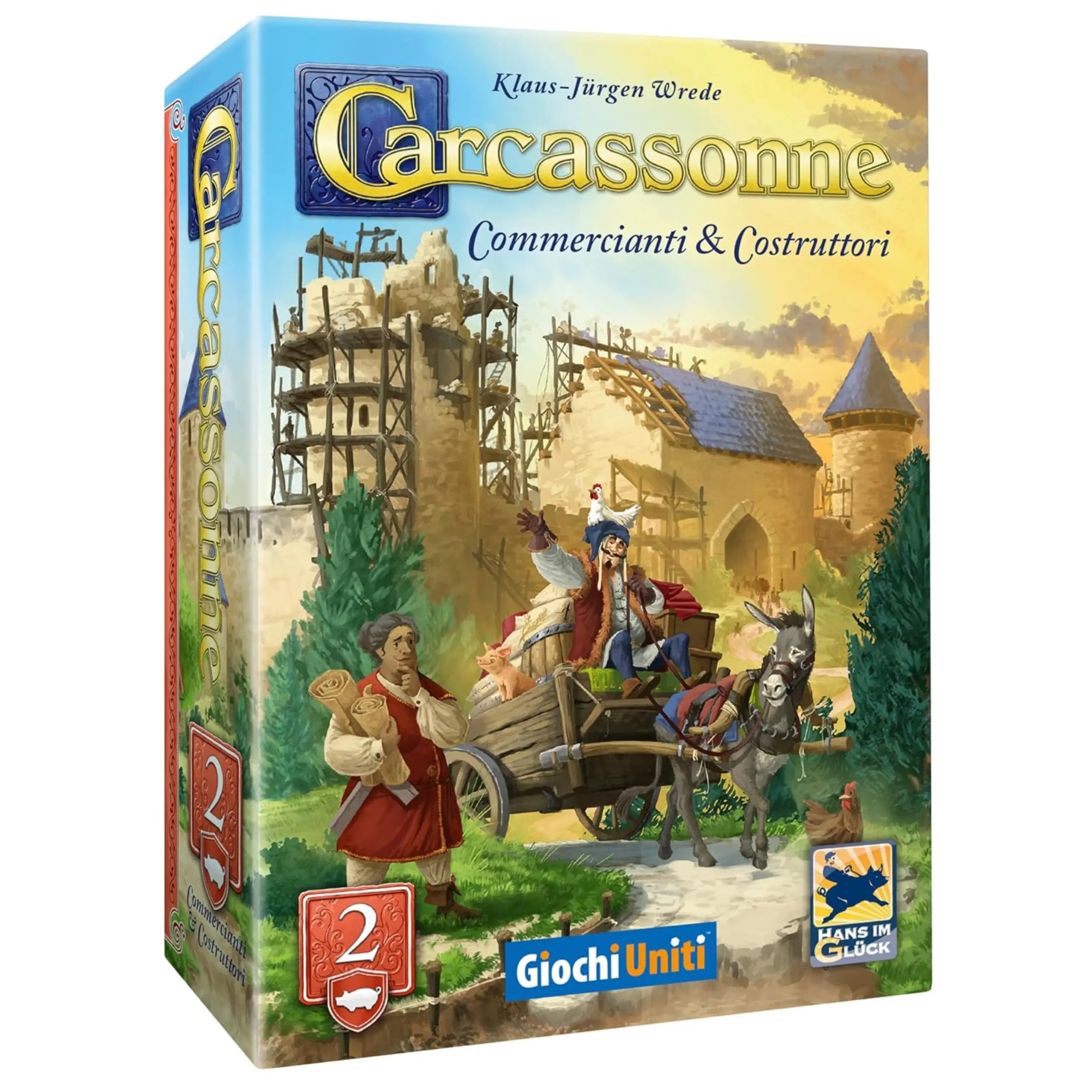
Carcassonne - Commercianti e Costruttori
🐸 Dettagli da BoardGameGeek
Consiglio BGG sul numero di giocatori
Categorie
Meccaniche
Design & Art
Lingua
Si abbina bene con
The FroGames Card
You place a city tile with wheat. You take the token. Someone grumbles that you are now ahead even in goods. You smile and play the builder: bonus turn, another tile, another move. The others glare at you.
WHAT IT'S ABOUT
The second major expansion that changed Carcassonne forever
Klaus-Jürgen Wrede published this expansion in 2003, two years after the base game. It adds 24 tiles with bridges, new cities, and especially three intertwined systems: goods (wine, wheat, cloth), builders that speed up turns, and pigs that enrich fields. Graphics by Doris Matthäus and Chris Quilliams, Italian edition by Giochi Uniti.
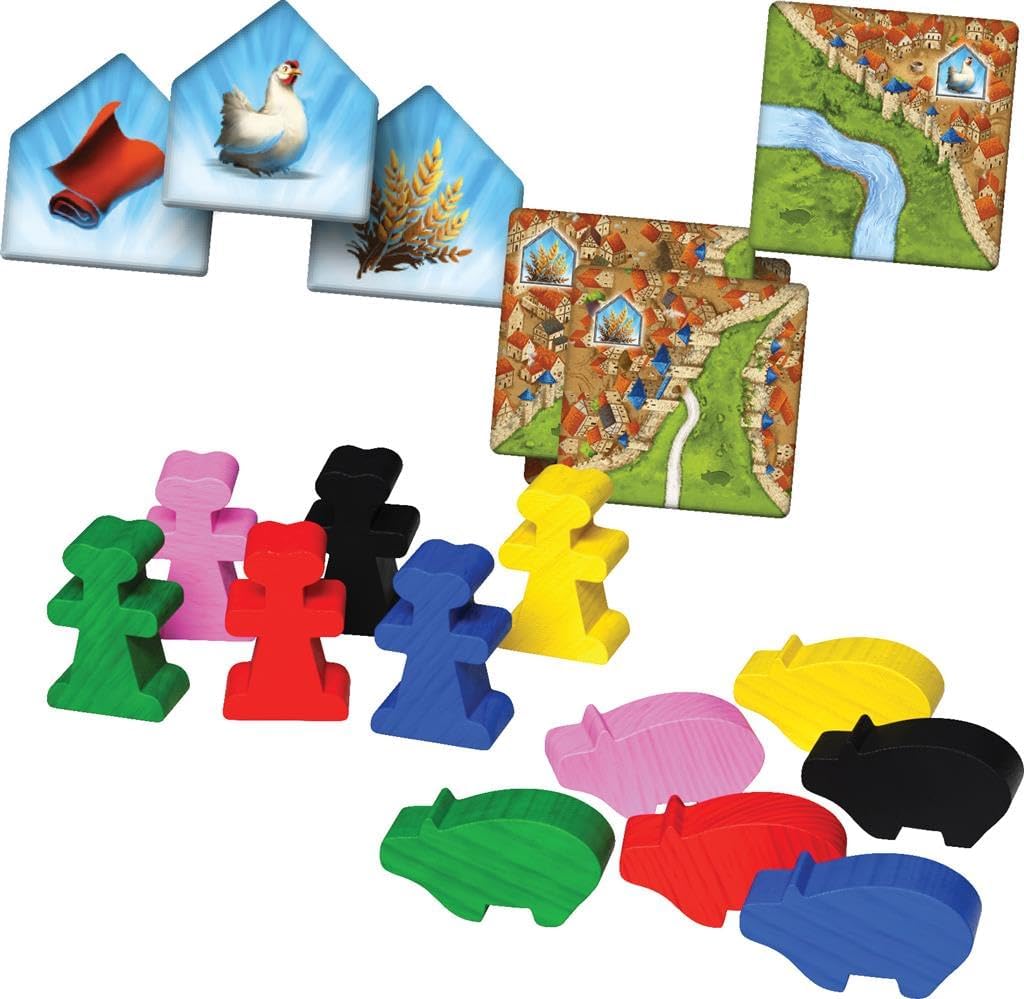
At the table, you place tiles as always, but now some cities show goods symbols: when you complete that city (yours or someone else's), you take the corresponding goods tokens. The player with the most of each type at the end of the game earns 10 points. You can place a builder on one of your ongoing roads or cities: every time you expand it, you immediately get an extra turn. You can add a pig to one of your fields to make it worth 4 points per city instead of 3. Three strategic layers that overlap with the classic flow.
What they say abroad
"Traders & Builders adds meaningful decisions without adding playtime."
Traders & Builders adds meaningful decisions without adding playtime.
— The Dice Tower
This expansion works because the three systems interact. Goods reward those who complete cities, even others'. The builder speeds up those who commit to long projects. The pig enhances fields without unbalancing them. It's Carcassonne with more choices, not a longer Carcassonne.
— FroGames

Carcassonne - Traders & Builders (Carcassonne: Traders & Builders)
FrogScore · FroGames.it editorial rating · based on rules, international reviews and play sessionsThe expansion's three systems
What it adds to the table
The Goods
Wine, wheat, cloth. Some cities show one or more symbols: when you complete that city (even if it's not yours), you take the corresponding tokens. At the end of the game, whoever has the most of each type of good earns 10 points. A parallel objective that makes you desire even other players' cities.
The Builder
A special meeple you place on one of your ongoing roads or cities. Every time you add a tile to that feature, you immediately get an extra turn. It doesn't count for control, but it speeds up those committed to long projects. You have to choose when to use it: too early and you risk being blocked, too late and you lose turns.
The Pig
You add it to one of your fields already occupied by a farmer. At the end of the game, that field is worth 4 points per city served instead of 3. A simple boost that makes fields more appealing without overturning the economy. You cannot place it on an empty field: you must have already invested a meeple.
Bridges and new cities
The 24 tiles include new configurations: bridges connecting roads on multiple levels, cities with complex layouts. Some of these tiles have two or three goods symbols, making their completion highly sought after. The deck is enriched without being diluted.
Recommended sleeves 24 cards in 1 size ▼
If you play often, we recommend protecting your cards with clear sleeves to make them last a long time.
| Size | Quantity |
|---|---|
| 46 × 46 mm | 24 |
| Total cards | 24 |
Come si gioca
Video dimostrativo di gameplay.
🎲How to playThe rules in four steps▼
How to play
The Turn Flow (identical to the base game, with exceptions)
The turn order remains: draw, place, decide whether to place a meeple. But now you have the builder who can grant you an extra turn, and the goods you collect when you close cities.
Draw from the bag (the expansion includes a cloth bag to keep all tiles mixed) and place the tile respecting the borders. Some tiles have goods symbols on cities: note this mentally.
You can place a normal meeple on the newly placed tile, OR place the builder on one of your ongoing structures (road or city with at least one of your meeples), OR add the pig to one of your already occupied fields. The builder and pig are used only once per game.
If the tile closes a city, road, or cloister, score points: the one with the majority takes the points and retrieves their meeples. If the closed structure is a city with goods symbols, whoever closed it (whoever that may be) takes the goods tokens shown. The builder does not count for majority.
If the newly placed tile extended a structure where you had the builder, you immediately play another complete turn: draw a new tile, place it, you can place a meeple. You can continue to extend that structure and take more extra turns as long as you draw compatible tiles. The builder remains there until the structure is closed.
⏱️Your first gameThe chronicle, moment by moment▼
A game in five moments
What happens at the table
Not the rules. The experience.
First tiles, first choices
You place the first tiles trying to understand where to invest your builder. Someone immediately starts a city with a goods symbol, someone else opens a long road. You hold onto your builder and wait: using it too early is wasting the advantage. The game seems normal, but you already feel that the pace will be different.
Someone plays the builder
The first builder enters play. That player places a tile on their city, takes an extra turn, places another tile. Two moves in one turn. Others realize that city will grow quickly and that the goods within are about to be collected. The race begins: who will attach to that city, who will open a road with their builder to compete.
The race for goods
A city closes: three grain symbols, two wine. The player who closed it takes the tokens and now has a clear advantage in those goods. Others realize they must close cities with complementary goods or pursue the same type to catch up. City tiles become the most desired. Someone closes another's city just to get the missing cloth.
Pigs and fields
Someone places the pig on a key field. That field is now worth much more, and those with competing farmers in the same field start to sweat. Fields become more contested: they are no longer a passive gamble, they are certain, high points. The builder continues to grant double turns, goods change hands, the board fills up.
Final scoring: goods and pigs decide
Tiles run out. Points are counted: completed structures during the game, incomplete structures, fields, and finally goods bonuses. The goods bonuses: whoever had the most wine, grain, cloth gets 10 points per type. Then the fields: those with the pig explode in value. The ranking is overturned. Those who invested in side goods overtake those who focused only on direct points. Someone wins by three grain tokens.
🐸What to know beforehandThree honest things, from friends▼
What to know beforehand
Three honest things
With the builder active, a player can take two or three turns in a row. With 5-6 players, this prolongs the wait for those sitting on the other side of the table. The game remains under an hour, but downtime increases. For 2-4 players, it's not a problem.
If you don't draw city tiles with the goods you need, you can't pursue those 10 bonus points. The distribution of goods on tiles is not uniform: there are more grain symbols than wine. Luck plays a role, but you can compensate by closing others' cities.
This is a pure expansion: you need the base Carcassonne game to play. The 24 new tiles are mixed with the original ones. The included cloth bag is convenient for keeping everything together, but it does not replace the base game. Compatible with other expansions.
🏆Victory and defeatWhat the ending rewards▼
How it ends
Victory and game end
The game ends when the last tile is placed. Points are counted: completed structures during the game, incomplete structures, fields, and finally goods bonuses.
Victory
- Sum the points for cities, roads, and cloisters you completed during the game
- Add points for incomplete structures at game end (open cities and roads are worth less)
- Count your fields: 3 points per served city (4 points if you have the pig in that field)
- Add 10 points for each type of good in which you have an absolute majority (wine, grain, cloth)
- The player with the most total points wins
Common mistakes that cost the game
- Using the builder too early on a small structure: you waste the advantage of extra turns
- Ignoring goods: 10 points per type make a difference, even if they seem like a secondary objective
- Placing the pig on an underserved field: better not to use it than to waste it on 1-2 cities
- Not closing other players' cities with goods: you can take the tokens even without having meeples there
An expansion that adds tactical depth without overcomplicating. The builder accelerates, goods open up side strategies, the pig enhances fields. Carcassonne made better.
💬Frequently asked questionsQuick answers before checkout▼
Frequently asked questions
FAQ about Carcassonne - Traders & Builders
What mechanics does Carcassonne - Traders & Builders use?
Tile Placement (placing tiles according to adjacency rules), Area Majority (controlling roads and cities with meeple majority), Set Collection (collecting goods for end-game bonuses). The builder introduces a system of conditional extra turns, the pig is a score modifier for fields.
Can I play this expansion without the base game?
No. Traders & Builders is a pure expansion: it adds 24 tiles, special meeples (builder and pig) and goods tokens, but you need base Carcassonne for the starting board, normal meeples, and fundamental tiles. They are mixed together.
Can the builder give me infinite turns?
No, but it can give you long sequences. As long as you draw tiles that extend the structure where you have the builder (city or road), you continue to take extra turns. As soon as you draw an incompatible tile or close that structure, the extra turns end. On average 2-3 extra turns, rarely more.
Can goods be traded between players?
Official rules say no: goods tokens remain in front of you until final scoring. There is a popular house rule (mentioned in the BGG description) that allows bartering of goods in exchange for agreements on tile placement, but it is not the standard rule. Decide with your group beforehand.
Is it available in Italian?
Yes. This is the Italian edition by Giochi Uniti, with translated rules and localized components. The tiles are language-independent (symbols only), goods tokens have universal icons. You still need the Italian base Carcassonne to play.
The people behind the game
Who invented it, who designed it, who publishes it — and what else they've done.
Carcassonne - Traders & Builders (originally Carcassonne: Händler & Baumeister) is the second major expansion for the famous tile-placement game by Klaus-Jürgen Wrede. It adds three intertwined systems: collectible goods (wine, grain, cloth) for end-game bonuses, the builder that grants extra turns, and the pig that enhances fields. Published in 2003 by Hans im Glück, Italian edition by Giochi Uniti, for 2-6 players, 60 minutes playtime, ages 13+. Compatible with other Carcassonne expansions. Available on FroGames.it.
Frequently Asked Questions
The answers you're looking for, no beating around the bush.
📸Do the images match the actual product?
The photos on the website often come from BoardGameGeek and are intended to give you an idea of the game. They may vary slightly from the version you receive. The content declared by the publisher is always binding.
📦Does the content of the box match what is indicated?
We always strive to provide the correct content, but minor variations are possible due to reprints or updates. The information comes directly from the publishers. If you have any questions, please contact us!
⏳How do pre-orders work?
Pre-order the game before release, payment is immediate, and the game is reserved for you. As soon as it arrives, we'll ship it right away! If there are any delays, we'll update you promptly.
🔒Can I trust buying here?
Absolutely! Secure payments, tracked shipments, and a team that loves board games as much as you do. If something goes wrong, we'll do our best to fix it.
🛠There's a problem with my order, what should I do?
Write to us now! Whether it's a missing part, damage, or an error, we'll help you resolve it as soon as possible. Your experience truly matters to us.