
Kadath
🐸 Dettagli da BoardGameGeek
Consiglio BGG sul numero di giocatori
Categorie
Meccaniche
Design & Art
Si abbina bene con
FroGames — Moments You'll Remember
Every tile is a choice. Every group a promise. And when the last enclave forms, someone has won — but no one truly controlled everything.
WHAT IT'S ABOUT
An abstract duel in Lovecraftian Dreamlands
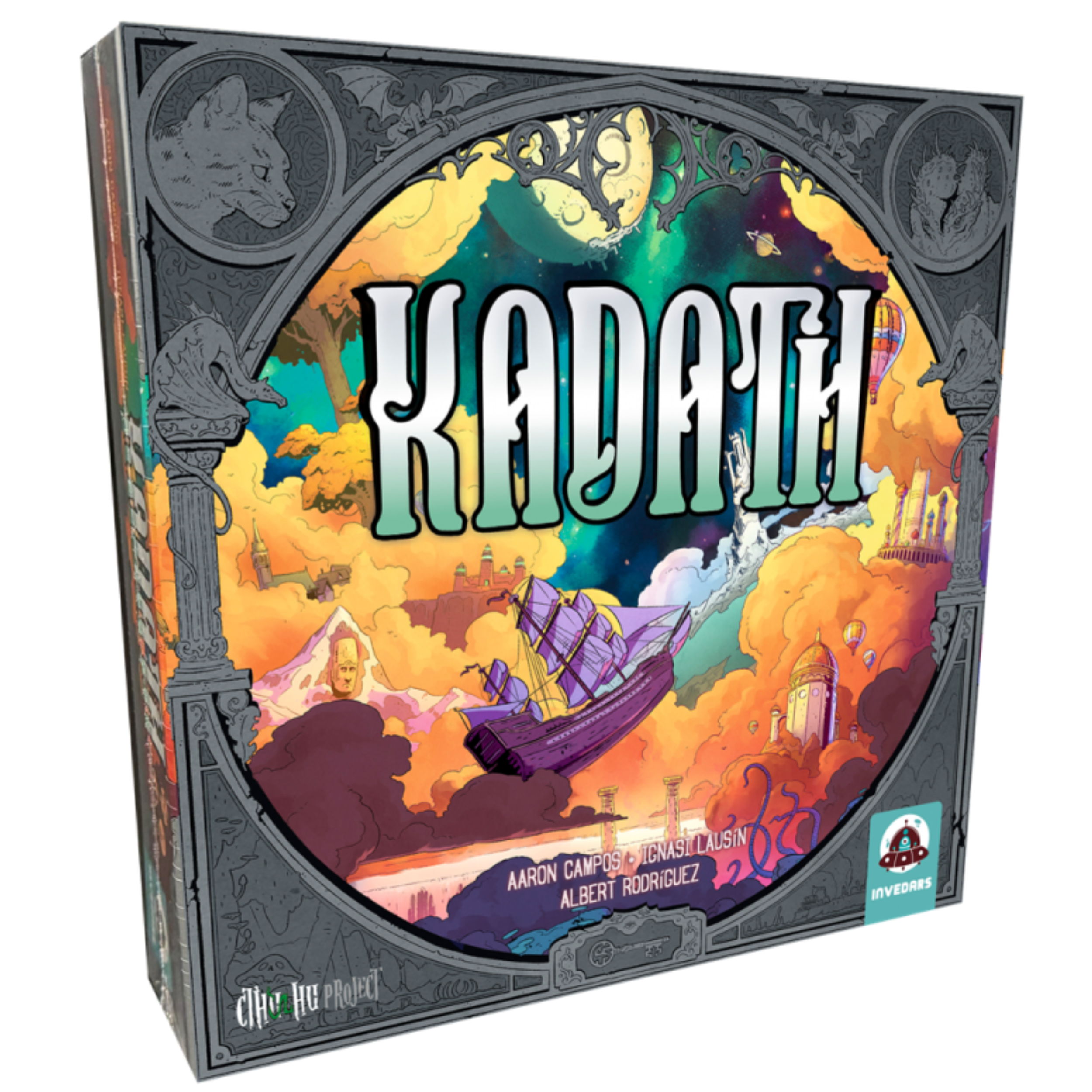
Kadath is born from the collaboration between Aaron Campos and Ignasi Lausin, two Spanish designers who chose to dress a pure abstract game in the setting of H.P. Lovecraft's Dreamlands. On one side, Randolph Carter, the dreamer seeking the lost city of Kadath. On the other, Nyarlathotep, the Crawling Chaos sowing madness. Illustrations by Alberto Rodriguez depict this dreamlike conflict on tiles that conceal geometries and strategies.
At the table, you place tiles on a 5×5 grid, trying to form groups of four tiles of the same type — yours or your opponent's — to create enclaves. The first to place 5 enclave tokens wins. Each turn is a stark choice: which tile to play, where to put it, which patterns to break, which to complete. The grid grows, possibilities narrow, and every move counts double.
What they say abroad
An abstract game unafraid to show what it is
— FroGames
The Dreamlands are just a pretext. Beneath it lies pure geometry.
— FroGames

Kadath
FrogScore · FroGames editorial rating · based on rules, international reviews and play sessionsThe tools of the duel
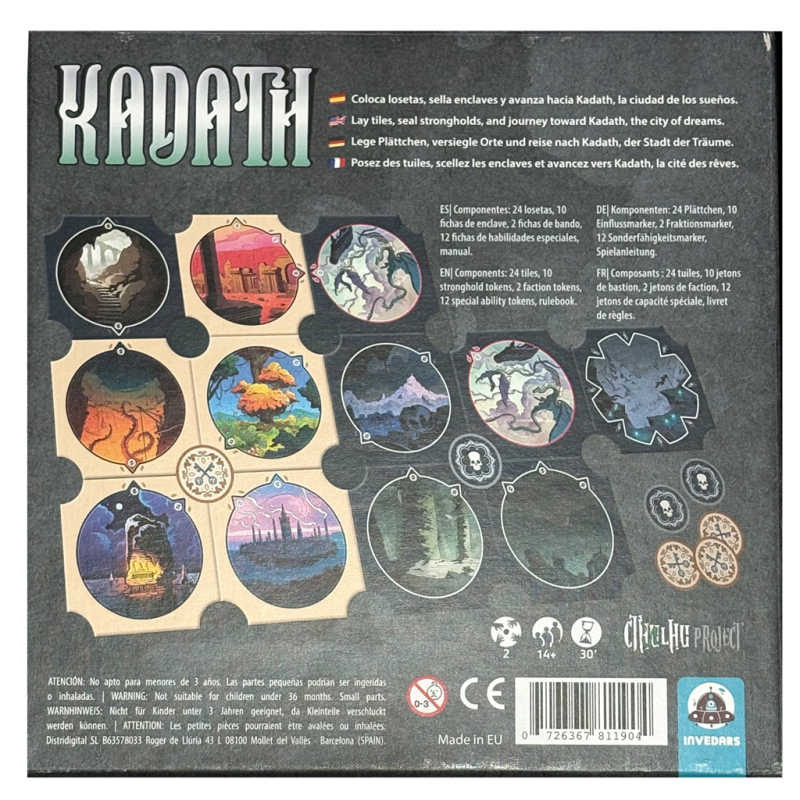
What's in the box
Dreamlands Tiles
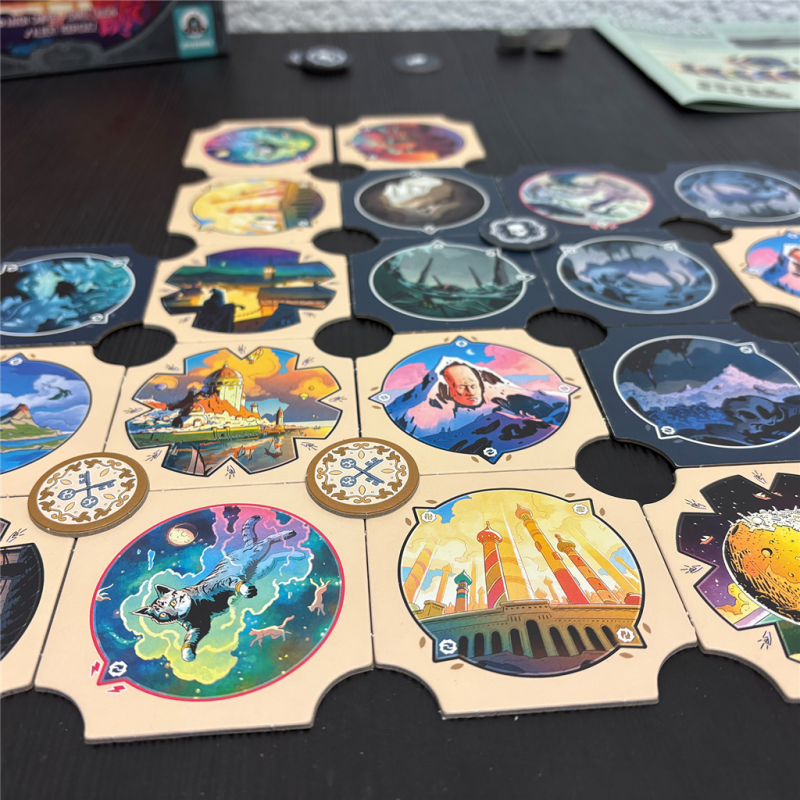
Each tile represents a fragment of dream or chaos. They are placed on the grid and form the patterns that determine the enclaves. There are no numerical values: only type and position matter.
5×5 Grid
The battlefield. Five rows, five columns. It fills up turn by turn. When it's complete, someone has already won — or the game was resolved earlier.
Enclave Tokens
Five per player. They are placed when you create a group of four tiles of the same type. The first to place five of them ends the game.
Event Cards
Introduce asymmetric variables. Nyarlathotep and Randolph Carter have different abilities that activate during the game, breaking the symmetry of the pure abstract.
You'll be done in half an hour. And you'll want to play again, to figure out where you went wrong with that move on turn six.
Come si gioca
Video dimostrativo di gameplay.
A game in five moments
What happens at the table
Not the rules. The experience.
The empty grid
Before you lies an empty 5x5 grid. The first tiles are placed almost at random: there isn't enough information to make deep choices. Yet every move lays the foundation for what's to come. Who places in the center? Who on the edges? Who controls the corners?
The first patterns emerge
After six or seven tiles, the grid starts to speak. You see the first groups of three, and you understand where your opponent is building. Now every move is double-edged: do you complete one of your patterns or block one of theirs? You can't do both.
The grid closes in
Half the grid is full. Free spaces are precious, and every tile you place creates opportunities for both of you. You complete one of your enclaves, but you open up a space for them. The board is a minefield of irreversible decisions.
The final sprint
Someone has 3-4 enclaves. The other is catching up. Each turn is a calculation: how many moves are left? Can I block? Can I complete first? The almost full grid limits choices, but those few become absolute. This is where you win or lose.
Someone places the fifth marker
End. The grid is still incomplete, but it doesn't matter: five enclaves are five enclaves. The winner thinks back to the winning move. The loser thinks back to that badly placed tile on turn eight. And you already want to play again.
How to play
The flow of each turn
Kadath is a no-frills tile-placement game. Each turn follows the same quick and brutal structure.
From the Dreamlands or Chaos tile deck. Each tile belongs to one of the two factions and forms patterns with tiles of the same type.
Choose an empty space. There are no adjacency restrictions: you can place anywhere. But each position changes the board for both players.
If you have completed a group of four adjacent tiles of the same type (horizontal, vertical, or square), you place an enclave marker. One space on the grid can contribute to multiple groups.
The opponent does the same. The game continues until someone places the fifth enclave marker or the grid is completely filled.
Why it's different from others
Six mechanics that make a difference
Shared grid, opposing goals
There are no separate boards. The same grid serves both: your tiles also help your opponent form patterns. Every move is a compromise between building for yourself and denying them. There is no perfect move.
Groups of four, not rows
You're not looking for lines or diagonals. You're looking for adjacent groups of four tiles of the same type: these can be 2x2 squares, horizontal rows, vertical rows, or L-shapes. The same tile can contribute to multiple groups simultaneously, multiplying opportunities — and risks.
Tactical speed
25-35 minutes. There's no time for analysis paralysis. You place, you check, you pass. The 5x5 grid fills up quickly, and every lost turn is a space your opponent occupies. The pressure is constant.
Asymmetrical Event Cards
Randolph Carter and Nyarlathotep are not equal. Each faction has event abilities that activate during the game. Carter protects the purity of the dream, Nyarlathotep distorts the board. The pure abstract is broken with touches of narrative asymmetry.
Perfect information, zero chance
You see all placed tiles. You know the tiles in your deck. There are no dice, no hidden draws. Every defeat is your fault. Every victory is your credit. The Lovecraftian abstract is still an abstract.
Space as an exhaustible resource
The 5x5 grid has 25 spaces. Nothing more. Every placed tile reduces future options for both. The board closes in, and towards the end, choices become concentrated: you no longer have freedom, you only have necessity. Whoever manages space better wins.
How it ends
How to win and how to lose
Kadath has a clear victory condition. There are no points, no majorities. You either win or you lose.
Victory
- You place your fifth enclave marker by completing a group of four tiles of the same type
- If the grid fills up without anyone reaching five enclaves, the player with the most enclaves wins
- In case of a tie on a full grid, the player who placed the last enclave wins
Defeat
- The opponent reaches five enclaves before you
- On a full grid, you have fewer enclaves than your opponent
- You left too many open spaces and your opponent exploited them to complete decisive patterns
Kadath doesn't forgive imprecise moves. But once you understand how to read the grid, every game becomes a duel of pure geometry.
Frequently asked questions
Kadath FAQ
Do you need to know Lovecraft to play?
No. The theme is a skin over a pure abstract. Randolph Carter and Nyarlathotep are evocative names, but the core mechanic is tile placement. If you love abstracts, the theme is irrelevant. If you love Lovecraft, don't expect narrative: here it's all about spatial tactics.
How long does a game last?
25-35 minutes stated. The first games can reach 40 if both players think a lot. After 3-4 games, the pace accelerates: you read the grid faster and moves become intuitive. A good filler for two.
Is it balanced between Carter and Nyarlathotep?
Event cards introduce asymmetry, but balance needs to be tested in the field. BGG data is still scarce (game arriving 2026). The underlying pure abstract is symmetrical: the grid is the same for both. Special abilities break symmetry, but we don't yet know by how much.
Can you play without event cards?
Technically yes: remove the cards and play only with tile placement and enclave creation. It becomes a pure abstract without asymmetry. More like a GIPF or an Azul. Probably more balanced, but less characterized.
Is it available in Italian?
No. This edition is in English, published by Invedars. The game has text on the event cards, but the core is language-independent: tiles and grid have no writing. English is only needed for the special abilities.
Kadath is an abstract game for 2 players designed by Aaron Campos and Ignasi Lausin, published by Invedars. Duration 25-35 minutes, recommended age 14+. The game uses tile-placement mechanics on a modular 5x5 grid: each player tries to create five enclaves by forming groups of four adjacent tiles of the same type. Set in the Lovecraftian Dreamlands, it pits Randolph Carter against Nyarlathotep through asymmetrical event cards that break the symmetry of the pure abstract. Perfect information, zero randomness, growing tactical tension. Available on FroGames.it.
Frequently Asked Questions
The answers you're looking for, no beating around the bush.
📸Do the images match the actual product?
The photos on the website often come from BoardGameGeek and are intended to give you an idea of the game. They may vary slightly from the version you receive. The content declared by the publisher is always binding.
📦Does the content of the box match what is indicated?
We always strive to provide the correct content, but minor variations are possible due to reprints or updates. The information comes directly from the publishers. If you have any questions, please contact us!
⏳How do pre-orders work?
Pre-order the game before release, payment is immediate, and the game is reserved for you. As soon as it arrives, we'll ship it right away! If there are any delays, we'll update you promptly.
🔒Can I trust buying here?
Absolutely! Secure payments, tracked shipments, and a team that loves board games as much as you do. If something goes wrong, we'll do our best to fix it.
🛠There's a problem with my order, what should I do?
Write to us now! Whether it's a missing part, damage, or an error, we'll help you resolve it as soon as possible. Your experience truly matters to us.