
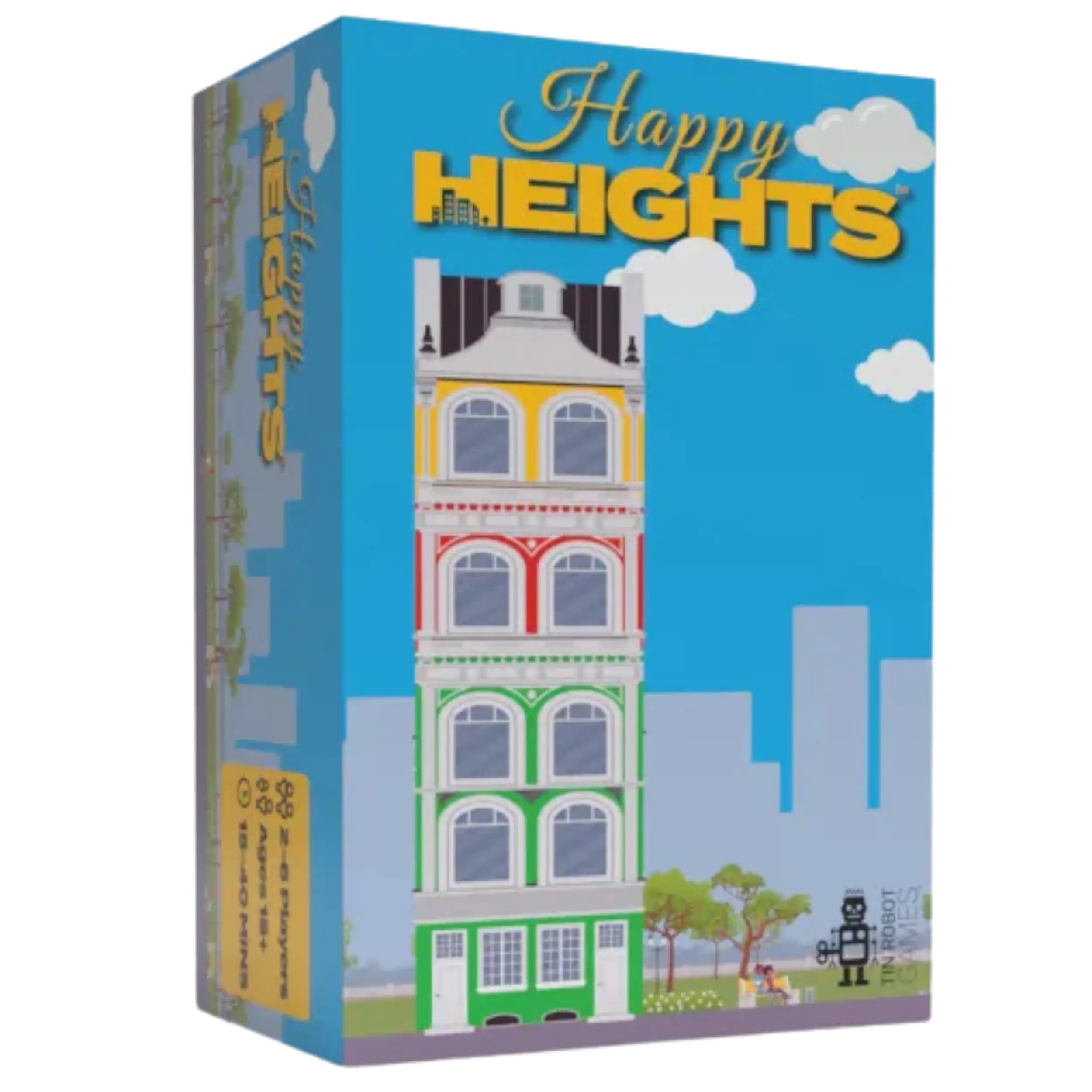
Happy Heights
🐸 Dettagli da BoardGameGeek
Consiglio BGG sul numero di giocatori
Categorie
Meccaniche
Design & Art
Lingua
Pre-order - leggi i dettagli
🐸 Una rana saggia sa quando dividere l’ordine… e quando aspettare il salto giusto.
Si abbina bene con
FroGames — Moments You'll Remember
Some count floors, some curse the wrong roof. In the end, everyone asks you how you managed to place that park there.
WHAT IT'S ABOUT
A neighborhood that grows from your choices, one card at a time
Designed by James Staley and published by Tin Robot Games, Happy Heights is an urban construction card game where each card can become a skyscraper floor, a multiplier shop, or a public space. The game revolves around the need to plan an entire neighborhood with limited resources and permanent decisions.
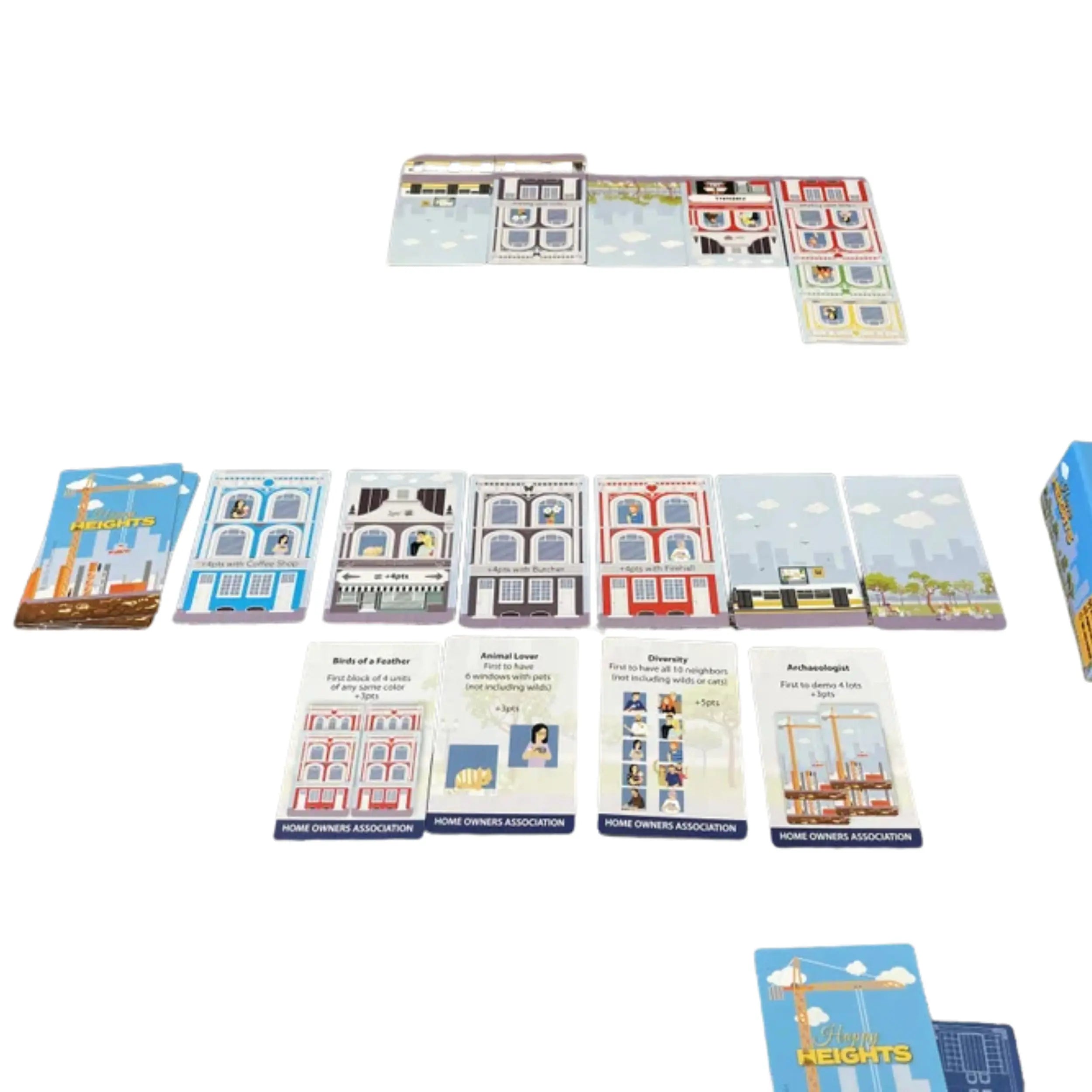
On your turn, choose a card and decide where to place it: as the first floor of a new building, as an additional level of an existing one, or as the final penthouse that caps the structure. Each card has symbols on its sides, and matching the right ones between adjacent buildings earns you points. Parks and bus stops are worth points exponentially, while shops become penthouses with vertical multipliers. After 12 turns, your neighborhood is complete, and only the sum of points matters.
What they say abroad
It's a game of combinations where every choice closes one door and opens three, and you never have enough space for everything you'd like to do.
— FroGames
It feels like Tetris: you know what you need, but you have to adapt to what comes your way.
— FroGames

Happy Heights
FrogScore · FroGames editorial rating · based on rules, international reviews, and gameplay sessionsYour cards
Four types of buildings, infinite combinations
Building Cards
They are the central body of the neighborhood. Each card can become the first floor of a skyscraper or an additional level above an existing one. The symbols on the sides are the heart of the scoring: each match with an adjacent building is worth one point.
Shops / Penthouses
They have a pitched roof and a multiplier at the top. They can be ground-floor businesses or the final penthouse of a skyscraper. Once placed as a penthouse, the building is closed: no more floors above. The multiplier counts symbols connected from below.
Parks
They have no symbols, but they are worth points exponentially: the more you have, the more each park is worth. A single park is worth little. Three parks are worth a fortune. You have to decide whether to focus on them or ignore them.
Bus Stops
Like parks, their value grows exponentially. Each card also has conditional bonuses printed on it, such as 'worth 2 points if you have a butcher shop'. They are the most unpredictable element of the final score.
In half an hour, you will have built a neighborhood. And as you count the points, you'll find that the park you discarded on turn 4 would have cost you the victory.
Come si gioca
Video dimostrativo di gameplay.
A five-moment game
What happens at the table
Not the rules. The experience.
First foundations
Everyone starts with random cards. Some immediately place a shop on the ground floor, others build separate buildings to maximize future matches. No one yet knows what their neighborhood will become. Everything seems possible.
Strategy takes shape
Someone accumulates parks. Someone else builds a towering skyscraper with a multiplier penthouse. Choices begin to exclude each other: you can't do everything. Tension rises when you realize that perfect card might never arrive.
The neighborhood fills up
You're halfway there. You have 6-7 cards placed, and table space is starting to run out. You have to decide whether to close a building with a penthouse or continue upwards. Every misplacement now weighs double. Others look at your neighborhood and understand your strategy.
The last key card
2-3 turns left. That shop with the right multiplier finally arrives, or that park that completes the series. Or it doesn't, and you have to adapt. Someone laughs, someone curses. The neighborhood is almost complete, but the final outcome is still uncertain.
Score counting
Everyone counts together: matches between buildings, vertical multipliers, parks, and bus stops. Someone discovers they've forgotten a hidden bonus. The difference between first and second is often 3 points. Everyone wants to play again, but with a different strategy.
How to play
The flow of each round
Every turn is a clear choice: take a card from your hand or from the common reserve, and decide its fate.
You have a hand of cards and access to a shared reserve. Choose a card to play. What you leave might end up in the hands of others.
You can build a new building, add a floor to an existing one, or close a structure with a penthouse. The position is permanent: it doesn't move again.
Draw a new card from the deck or the reserve. Options change turn by turn, and you have to adapt to what comes.
After 12 turns the game ends. Each player has placed exactly 12 cards. The final score count begins.
Why it's different from others
Six mechanics that make a difference
Three-dimensional spatial matching
You don't just match symbols: you match adjacent buildings and superimposed floors. Each card has a horizontal position (next to which building) and a vertical position (which floor of the skyscraper). You have to think in 3D while planning the neighborhood.
Buildings grow during the game
A building can be only one floor high or become a 4-5 story skyscraper. The taller it is, the more valuable the penthouse multiplier. But closing too soon means losing opportunities. Timing is everything.
Exponential scoring for parks and stops
One park is worth 1 point. Two parks are worth 3. Three parks are worth 6. Four parks are worth 10. The exponential progression forces you to decide: focus on one category or diversify? You can't do both well.
Hidden conditional bonuses
Some cards say 'Worth 2 points if you have a butcher shop' or 'Worth 3 points if you have at least two parks.' You don't know which cards you'll draw, so you have to build a flexible neighborhood. Perfect calculation is impossible.
Drafting with shared reserve
In addition to your private hand, there's a reserve visible to everyone. You can take from there, but others can too. What you discard ends up in the reserve. Every card left is a gift to your opponents.
Scalable from 2 to 6 without downtime
There are no long turns: choose a card, place it, done. It works great for two (pure calculation) and for six (controlled chaos). The game adapts to the number of players without losing pace or depth.
How it ends
How to win and how to lose
After 12 turns, each player counts their points. The one who has built the most efficient neighborhood wins.
Victory
- Match the most symbols between adjacent buildings (1 point for each pair)
- Build skyscrapers with well-placed multiplier penthouses (symbols connected from below multiplied by the penthouse value)
- Accumulate parks or bus stops to exploit exponential scoring, or complete hidden conditional bonuses on cards
Fatal errors
- Place cards without planning future matches: empty spaces between buildings mean lost points
- Close buildings too early with unprofitable penthouses, or too late losing the best multiplier
- Diversify too much: one park is worth 1 point, three parks are worth 6. Mediocrity doesn't pay
Happy Heights is one of those games where the game ends and everyone immediately wants to play again, because they know exactly what they could have done better.
Frequently asked questions
FAQ about Happy Heights
How difficult is it to explain?
Less than 10 minutes. The basic rules are: choose a card, place it as a new building or an additional floor, match symbols for points. Bonuses and multipliers are understood by playing the first game. It's an ideal gateway for those who want strategy without having to study a manual.
Does it work well with different numbers of players?
Yes, from 2 to 6 without problems. With 2 players it's more calculable and tactical, with 6 it's more chaotic and unpredictable. The duration remains contained (15-40 minutes) because turns are fast. There's no downtime: while others play, you plan your next move.
Is it a game for families or expert players?
For families who want something more structured than a party game. It's not a heavy eurogame, but it requires spatial planning and point calculation. Perfect for those who have played Splendor or Ticket to Ride and are looking for the next step. Children aged 10 and up understand it without problems.
How much does luck matter?
The cards you draw are random, but you always have a choice between your private hand and the shared reserve. A good player adapts and builds a flexible neighborhood. The one who wins is not the one with the best cards, but the one who makes fewer placement errors. Luck is present, but strategy matters more.
Is it available in Italian?
No, this edition is in English. However, language dependence is minimal: cards have visual symbols and icons, and conditional bonuses are explained with pictograms. Just translate the rulebook once (available online) and the game is fully accessible.
Happy Heights is an urban construction card game designed by James Staley for 2-6 players, aged 14 and up, with games lasting 15 to 40 minutes. The game uses pattern matching and drafting mechanics: each card can become a floor of a building, a shop with a multiplier, or a public space. Players build a neighborhood by matching symbols between adjacent buildings and superimposed floors, managing a shared reserve and planning card placement to maximize the final score. Published by Tin Robot Games in 2025, Happy Heights is an ideal strategic gateway for families and casual gamers looking for tactical depth without excessive complexity. Available on FroGames.it.
Happy Heights
Frequently Asked Questions
The answers you're looking for, no beating around the bush.
📸Do the images match the actual product?
The photos on the website often come from BoardGameGeek and are intended to give you an idea of the game. They may vary slightly from the version you receive. The content declared by the publisher is always binding.
📦Does the content of the box match what is indicated?
We always strive to provide the correct content, but minor variations are possible due to reprints or updates. The information comes directly from the publishers. If you have any questions, please contact us!
⏳How do pre-orders work?
Pre-order the game before release, payment is immediate, and the game is reserved for you. As soon as it arrives, we'll ship it right away! If there are any delays, we'll update you promptly.
🔒Can I trust buying here?
Absolutely! Secure payments, tracked shipments, and a team that loves board games as much as you do. If something goes wrong, we'll do our best to fix it.
🛠There's a problem with my order, what should I do?
Write to us now! Whether it's a missing part, damage, or an error, we'll help you resolve it as soon as possible. Your experience truly matters to us.