
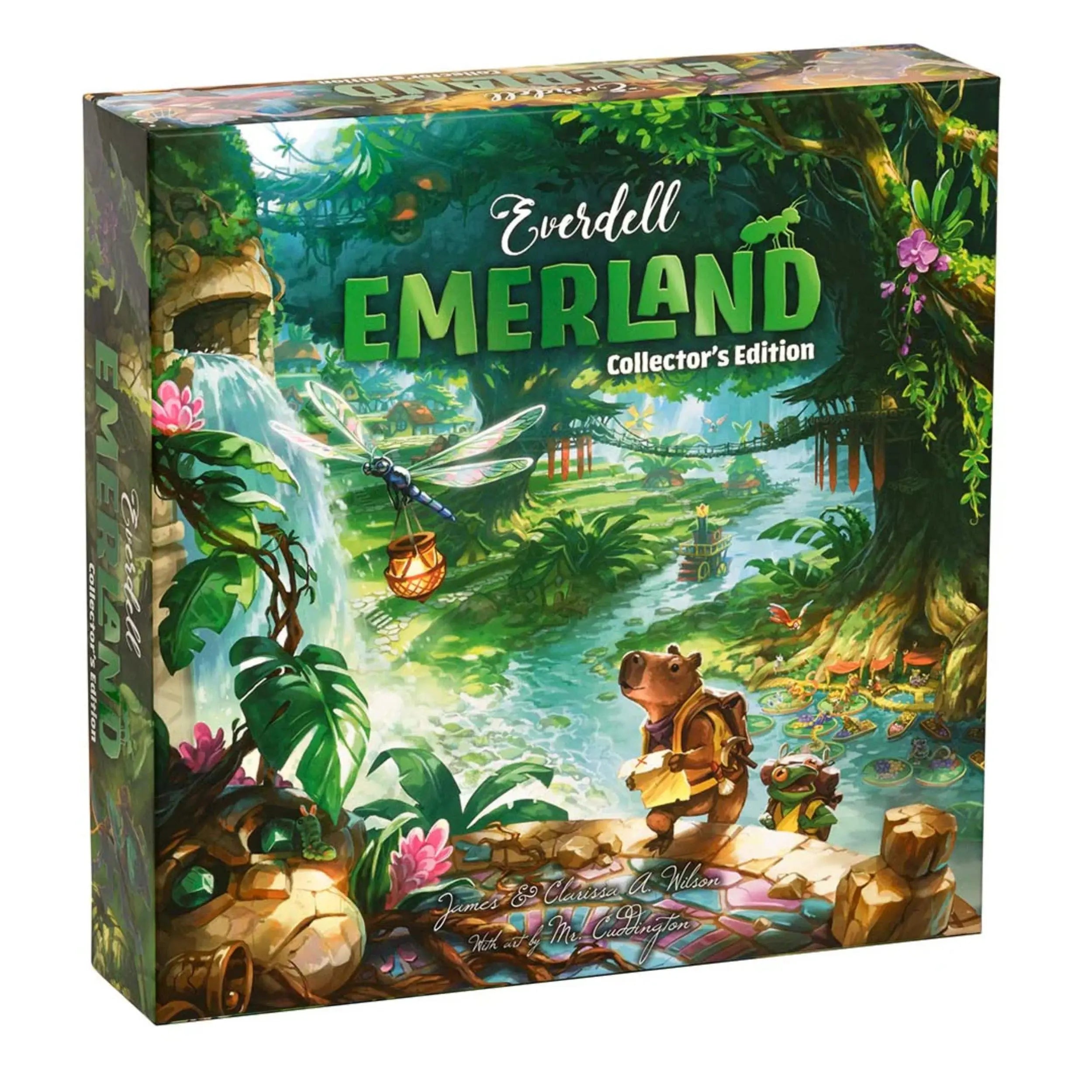
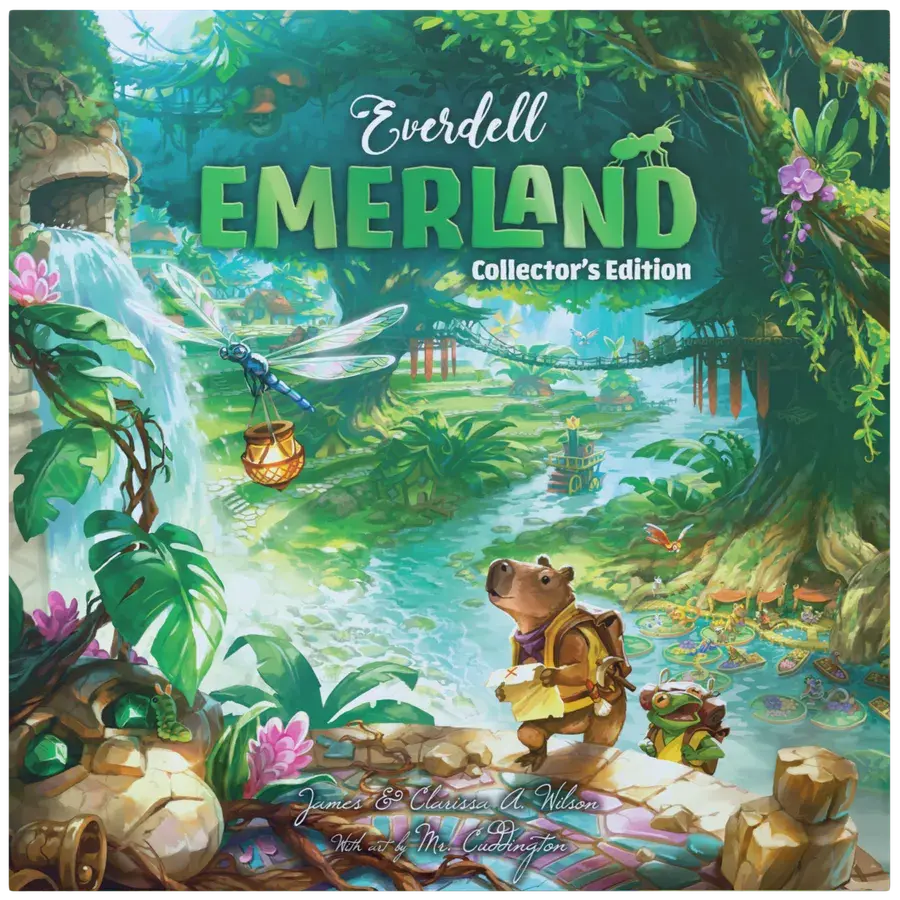
Everdell Emerland - Collector's Edition
🐸 Dettagli da BoardGameGeek
Consiglio BGG sul numero di giocatori
Categorie
Meccaniche
Design & Art
Lingua








Si abbina bene con
FroGames — Moments You'll Remember
You send the archaeologist into the ruins. They return with an artifact that doesn't award points: it multiplies them. And suddenly, every card you've built in the previous twenty minutes becomes more valuable.
What it's about
The jungle of Emerland emerges from the board
James A. Wilson and Clarissa A. Wilson bring the Everdell universe west, into the tropical jungle of Emerland: a land of artistic culture, gems mined from underground caves, and ruins of a lost civilization that archaeology is only just bringing to light. The illustrations by Lina Cossette and David Forest maintain the painterly detail of the original valley with a warmer palette and dense vegetation. It is a standalone game in the Everdell: Edge of the Map series: no prior knowledge of Everdell is needed to play.
On your turn, choose one of six actions: place a worker (alone or boosted by Helper insects), place a Helper, play a card in your jungle city, use a shared Artisan card, dig with the Archaeologist, or prepare for the season. Resources build structures and attract inhabitants; each card in your tableau opens up synergies and points. The player who has built the most valuable city when Spring ends wins.
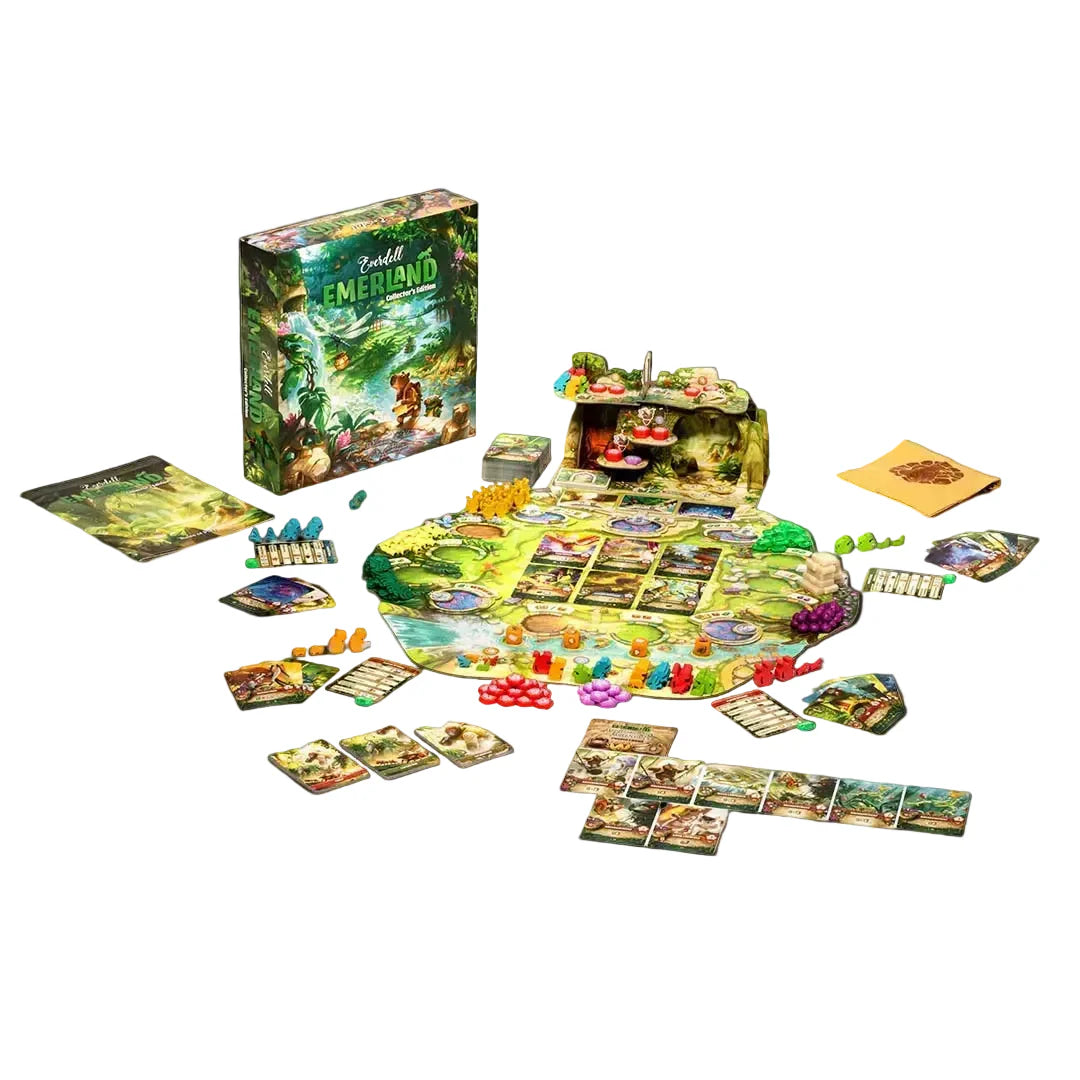
This is the Collector's Edition: the version where the ruins are not a printed design but a three-dimensional structure in the center of the table, artifacts are tiles that multiply your score, and the River Market has its own dice. It's not the same game with more cardboard; it's the game where discovery is seen as it happens.
The board stops being a surface and becomes a place: the Archaeologist truly descends into the ruins, and every excavation is seen before it's even described.
The secret of Emerland in one line
Artifacts don't add points: they multiply them. It changes how you look at every card you've already built — and those you were about to discard.
From the gameplay experience

Everdell Emerland — Collector's Edition
The game includes official solo rules with an automa that occupies worker spaces and takes cards. The experience remains complete and tactical: you can pursue archaeology all the way. The race for shared Artisan cards, which is the main source of tension in multiplayer, is lost.
FrogScore · FroGames editorial review · based on rules, official publisher materials, and game sessionsWhy this one
Four things that change the game, not just the shelf
A collector's edition only makes sense if you feel it while you play. These four factors influence decisions, not just display.
The ruins have depth
The ruins board is three-dimensional: the Archaeologist doesn't just move on a drawn space, they enter a structure at the center of the table. This changes how you read the game — who has gone down, how deep, how much more they need. You can see others' progress from afar, without asking.
Artifacts that multiply
Artifact tiles don't give fixed points: they multiply what you've already built. This means that from the third turn, you look at your city wondering what you're truly aiming for, and a single lucky excavation at the right moment can rewrite the final score. It's the mechanic that makes excavations a choice, not an extra.
The River Market rolls the dice
Market rewards are randomized by dice: every trade has a small margin of risk, and the market is never identical to the previous game. Those who go early take what's there; those who wait bet it will improve. Two different game philosophies, in the same space.
18 Realms and 100 double-sided cards
Jungle cards are double-sided: the same card offers two different options, and the choice is significant even when you draw it. The 18 Realms expand the map beyond the city, giving exploration its own direction. This is why no two games are alike.
In the end, no one talks about who won. They talk about the artifact found on the second to last turn, and what would have happened by digging one more time.
📦What's in the boxContents declared by the publisher
List declared by the publisher. The complete breakdown with exact quantities has not yet been published: we will update it here as soon as it's available.
Come si gioca
Video dimostrativo di gameplay.
💎 Why the Collector's EditionSix reasons you feel at the table ▼
What you take home
It's not the same game with more cardboard
A collector's edition is worth it if it changes how you play, not how it looks on the shelf. Here's where you feel the difference, turn by turn.
The ruins stand tall
The Jungle Ruins board is a three-dimensional structure at the center of the table. The Archaeologist doesn't advance on a printed space: he descends into something. From any side you're sitting, you immediately understand who's already deep in and how far you have to go to reach them, without asking or counting.
Points that multiply
Artifact tiles don't add fixed points: they multiply what you've already built. It changes the entire way of thinking about the city — you stop accumulating random cards and start asking yourself what you're aiming for. An artifact found at the right moment rewrites a final score that seemed set.
The market is never the same
The River Market dice randomize trade rewards. Those who go early take what's there, those who wait bet it will improve: two game philosophies coexist in the same space, and neither is always right. It's the point in the game where there's the most debate.
100 cards, two sides each
Jungle Cards are double-sided: the same card offers two different options and the choice matters the moment you draw it. It doubles the depth of hand management without adding a single new rule to learn.
18 Kingdoms beyond the city
Exploration has its own direction, separate from building. You can win by looking outwards instead of inwards: some optimize their city, others venture into distant Kingdoms, and the two paths only intersect at the final count. Two games in a row are never alike.
Helpers modulate every action
Insects are added to the worker you're placing and boost its effect. This means that there are no weak actions, only actions you chose not to push. It's the mechanic that distinguishes Emerland from other worker placements: you decide how much the move is worth as you make it.
🎲 How to playThe rules in four steps ▼
How to play
The flow of each turn
Each turn is a clear choice between six possible actions. You can't do them all: you must choose the one you need now.
Place a worker (with or without Helpers) on a board space; place a Helper alone for a minor action; play a card from your hand into your city by paying its cost; use a shared Craftsman card; excavate with the Archaeologist in the ruins; or prepare for the next season, which retrieves workers but ends the phase.
Gain resources, draw cards, activate abilities already in play. If you placed a worker plus Helpers, you multiply the base effect. If you went to the River Market, you roll the dice to determine the reward. If you excavated, you see what the ruins yield.
Played cards remain face up in front of you and form your tableau. Some give permanent abilities (discounts, extra resources, end-game points), others are objectives that mature over time, others still allow inhabitants to enter for free if you own the right building. Each city grows differently.
It's the next player's turn. Play continues until everyone has prepared for the season and exhausted their available actions. Then points are counted: cards in the city, gems, discovered artifacts, and completed objectives.
⏱️ Your first gameThe chronicle, moment by moment ▼
A game in five moments
What happens at the table
Not the rules. The experience.
The ruins at the center of the table
You set up the ruin structure, and someone stops listening to the explanation to look at it. You distribute workers, Helpers, and starting cards. Everyone is already choosing their first space to occupy — and no one says it.
The city takes shape
A market, a house, maybe a workshop. Each card played unlocks others, and the first synergies emerge. You understand where you want to go: gems, archaeology, or a large city of cheap cards. Helpers begin to make a difference in key actions.
Race for Craftsmen
Someone uses a powerful Craftsman to convert resources at half price. Others react: now everyone wants to get there before it's blocked. At the River Market, someone rolls badly, curses, and moves on anyway. The pace quickens.
Someone finds the artifact
The Archaeologist descends another level deeper and returns with a tile that multiplies. The table goes silent for two seconds, then everyone recounts the others' points. From here, the game branches: some optimize their city, some race for archaeology, some try the distant Kingdoms.
End of spring, and the count
The last player prepares for the season, and actions end. Cards, gems, artifacts, and objectives are counted. The player with the largest city is almost never the winner: the winner is the one who built ten cards that work together. The difference is always just a few points.
🐸 What to know beforehandThree honest things, from friends ▼
What to know beforehand
Three things we'll tell you anyway
Duration varies considerably
The 30–120 minute range is not a mistake: with two players who know the cards, it finishes in 45 minutes; with four players on their first game, it easily exceeds two hours. It depends on how long it takes to evaluate combos and decide which Helpers to spend. It's not a filler.
Steeper learning curve than base Everdell
If classic Everdell is a gateway with hidden depth, Emerland starts a step above: Helpers, Craftsmen, and the Archaeologist add decisional layers from the first turn. If you've never played a worker placement, don't start here.
The 3D board needs space
The three-dimensional ruins are the most beautiful thing in the box, but they occupy the center of the table and need to be assembled. Add a few minutes to setup and count on a generous table: with four personal tableaux around it, a small surface quickly becomes uncomfortable.
🏆 How to winWhat the ending rewards ▼
How it ends
The winner is who built best, not most
At the end of Spring, points are counted. They come from cards in your city, spent gems, artifacts retrieved from beneath the ruins, and completed objectives.
Where the points come from
- Each card in your city is worth the points printed on it
- Artifact tiles multiply what you've already built
- Gems spent for advanced buildings are worth extra points
- Explored Kingdoms and completed objectives provide substantial bonuses
Mistakes that cost you the game
- Misusing Helpers: those who don't combine them fall behind on resources after the third turn
- Ignoring shared Craftsmen: they are the biggest advantage on the table, and they are time-limited
- Excavating without a plan: artifacts only multiply if you have something to multiply
- Building fifteen unconnected cards: they are worth less than ten that empower each other
Everdell Emerland Collector's Edition is for those who loved the valley and want the version with more depth and more table presence — and for those looking for a worker placement where every single action can be modulated.
💬 Frequently Asked QuestionsQuick answers before checkout ▼
Frequently Asked Questions
FAQ about Everdell Emerland Collector's Edition
What's different from the standard edition?
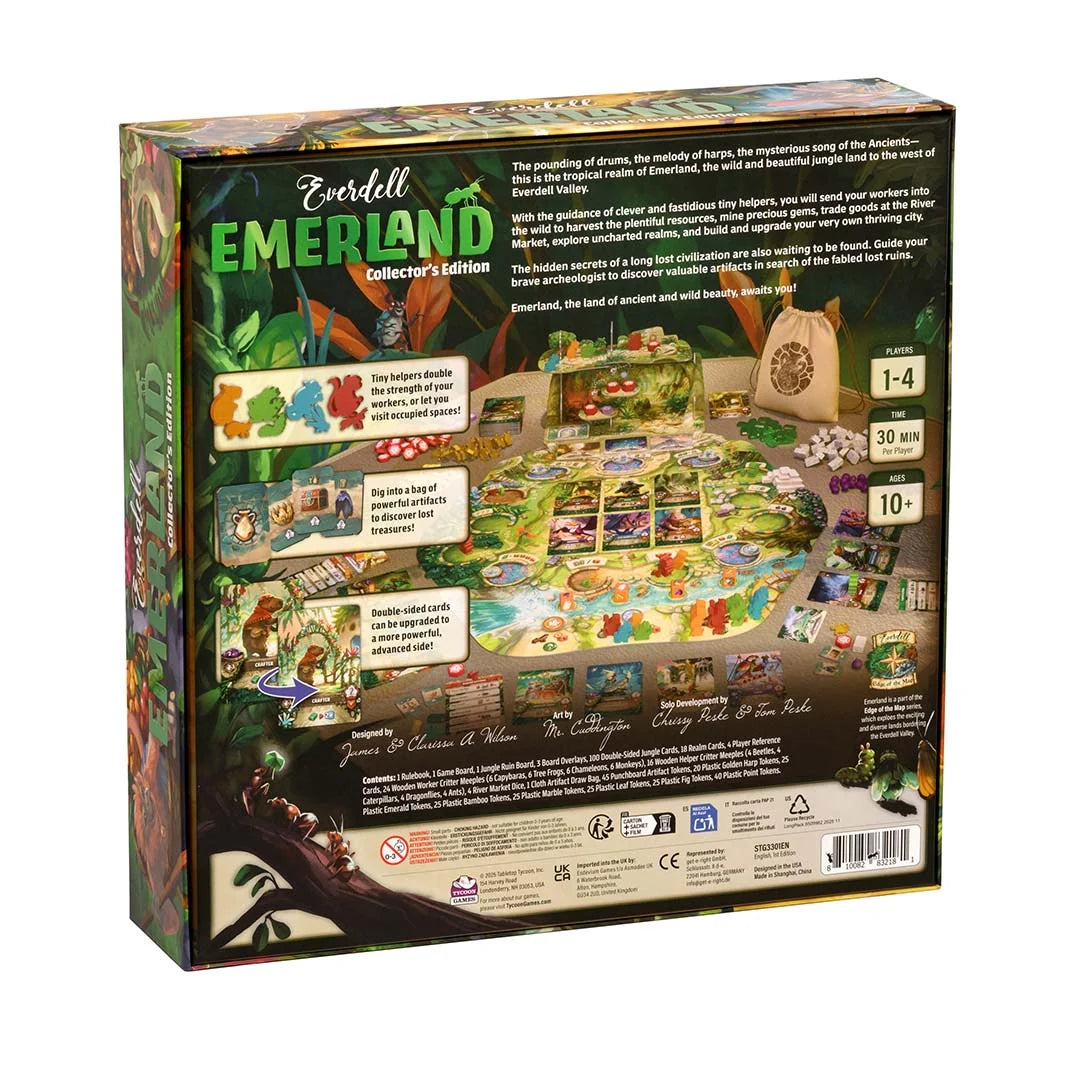
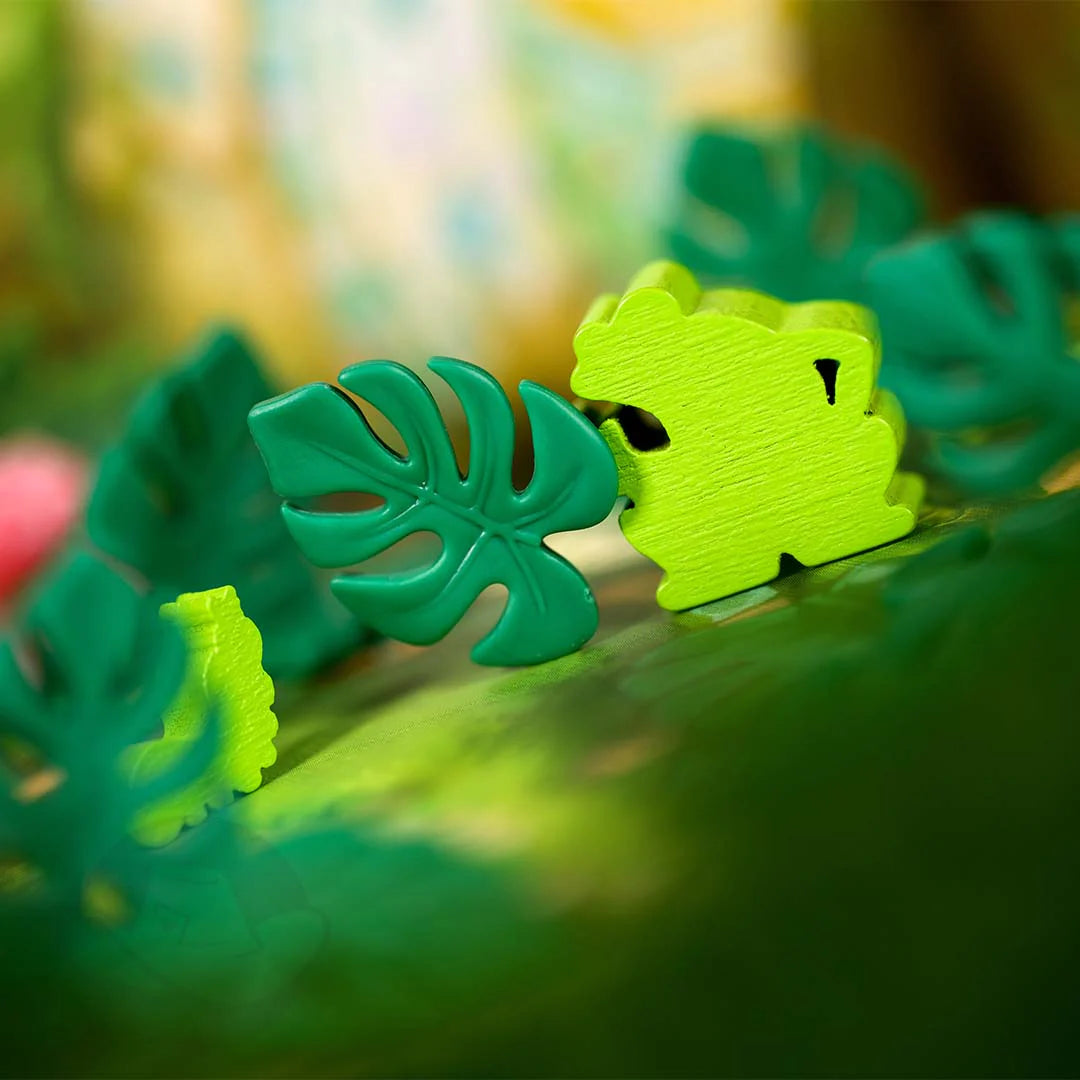
The Collector's Edition is the version with the 3D Jungle Ruins board, Artifact tiles that multiply scores, River Market dice, premium resource and point tokens, 100 double-sided Jungle Cards, and 18 Kingdom cards. It's the edition designed for those who want the most complete and scenic version of the game. The publisher has not yet released an official item-by-item comparison with the retail version; we will post it here as soon as it's available.
Is it worth the extra cost compared to a base edition?
It depends on what you're looking for. If you play twice a year and are only interested in the system, no. If Emerland will hit the table often, yes: the 3D ruins and multiplier artifacts are not just decoration — they change how you read the board and plan your endgame. It's the edition you keep, not the one you resell.
Do I need to know Everdell to play Emerland?
No, it's a complete standalone from the Edge of the Map series. It shares the setting and foundations (worker placement, tableau city-building), but has its own rules, cards, and components. You can start directly from here.
Does it play well with two players?
Very well, and that's where the pace is best: little downtime, 45–60 minute games, and the competition over Artisans and worker spaces remains tense because good spaces are few anyway. With four players, it's more chaotic and longer.
Can it be played solo?
Yes, with official rules and an automa that occupies spaces and removes cards. The experience remains complete and tactical: you can pursue archaeology to the fullest and optimize your city without compromise. What's missing is the race for shared Artisans, which is the main source of tension in multiplayer.
Is it difficult to learn?
The six actions are clear and can be explained in fifteen minutes. The difficulty lies in the combos between cards, Helpers, and artifacts, which require a couple of games to fully grasp. It's not a gateway game: if it's your first worker placement, start with classic Everdell.
What age is it suitable for?
10+, but it's a demanding 10+. A weight of 3.1/5 and hand management require planning skills. A youngster accustomed to board games will do fine; a beginner will struggle to keep up with an experienced adult.
How much table space is needed?
Quite a lot: the 3D ruins board is in the center, then there's the common market, shared Artisan cards, and each player's personal tableau, which grows up to ten to fifteen cards. With four players, count on at least 90×130 cm for comfort.
What card sleeves are needed?
The box states 100 double-sided Jungle Cards plus 18 Kingdom cards, but official measurements have not yet been published. We prefer not to give you a size from memory and have you buy the wrong sleeves: as soon as the publisher confirms the dimensions, we will update this answer with the exact size and quantities.
Is it in Italian? Do I need to know English?
This edition is in English. The cards have text — names, abilities, effects — that needs to be read to play: at least intermediate English is required or someone at the table who can translate. Currently, no Italian editions have been announced.
The people behind the game
Who invented it, who illustrated it, who publishes it — and what else they've done.
Everdell Emerland Collector's Edition is a strategic board game of worker placement and tableau building for 1-4 players, lasting 30-120 minutes, recommended age 10+. Designed by James A. Wilson and Clarissa A. Wilson, illustrated by Lina Cossette and David Forest, published by Tycoon Games in the Everdell: Edge of the Map series. Set in the tropical jungle west of the Everdell valley, it introduces Helpers (worker insects that boost workers), shared Artisan cards, the River Market with dice, and underground archaeology. This collector's edition includes the 3D Jungle Ruins board, 100 double-sided Jungle cards, 18 Kingdom cards, multiplier Artifact tiles, and premium components. Each player places workers to gather resources, extract gems, build constructions and inhabitants to form their jungle-city, and guides the archaeologist to discover ancient artifacts. Mechanics: worker placement, hand management, open drafting, set collection, tableau building. Official solo mode included. Weight 3.1/5. English edition. Available on FroGames.it.
Frequently Asked Questions
The answers you're looking for, no beating around the bush.
📸Do the images match the actual product?
The photos on the website often come from BoardGameGeek and are intended to give you an idea of the game. They may vary slightly from the version you receive. The content declared by the publisher is always binding.
📦Does the content of the box match what is indicated?
We always strive to provide the correct content, but minor variations are possible due to reprints or updates. The information comes directly from the publishers. If you have any questions, please contact us!
⏳How do pre-orders work?
Pre-order the game before release, payment is immediate, and the game is reserved for you. As soon as it arrives, we'll ship it right away! If there are any delays, we'll update you promptly.
🔒Can I trust buying here?
Absolutely! Secure payments, tracked shipments, and a team that loves board games as much as you do. If something goes wrong, we'll do our best to fix it.
🛠There's a problem with my order, what should I do?
Write to us now! Whether it's a missing part, damage, or an error, we'll help you resolve it as soon as possible. Your experience truly matters to us.