
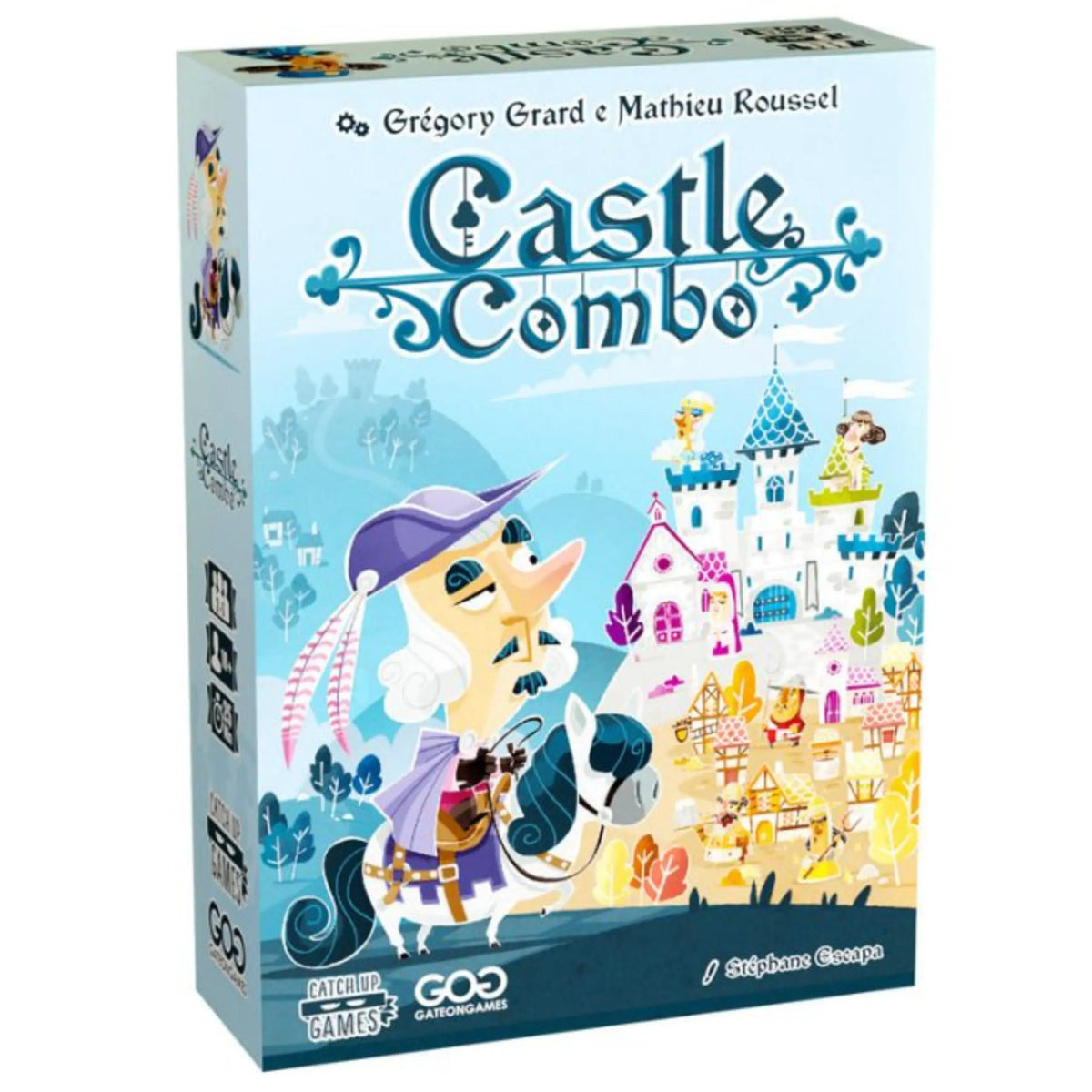


Castle Combo
🐸 Dettagli da BoardGameGeek
Consiglio BGG sul numero di giocatori
Categorie
Meccaniche
Design & Art
Lingua
Pre-order - leggi i dettagli
🐸 Una rana saggia sa quando dividere l’ordine… e quando aspettare il salto giusto.




Si abbina bene con

FroGames — Moments You'll Remember
Nine characters. Nine decisions. A 3x3 grid that tells your best story.
What it's about
A medieval realm built card by card, in less than half an hour
Castle Combo is the game you don't have on your table yet but will be there every night. Designed by Grégory Grard and Mathieu Roussel, with vibrant illustrations by Stéphane Escapa, it emerged from Essen 2024 as one of the most talked-about titles of the year.
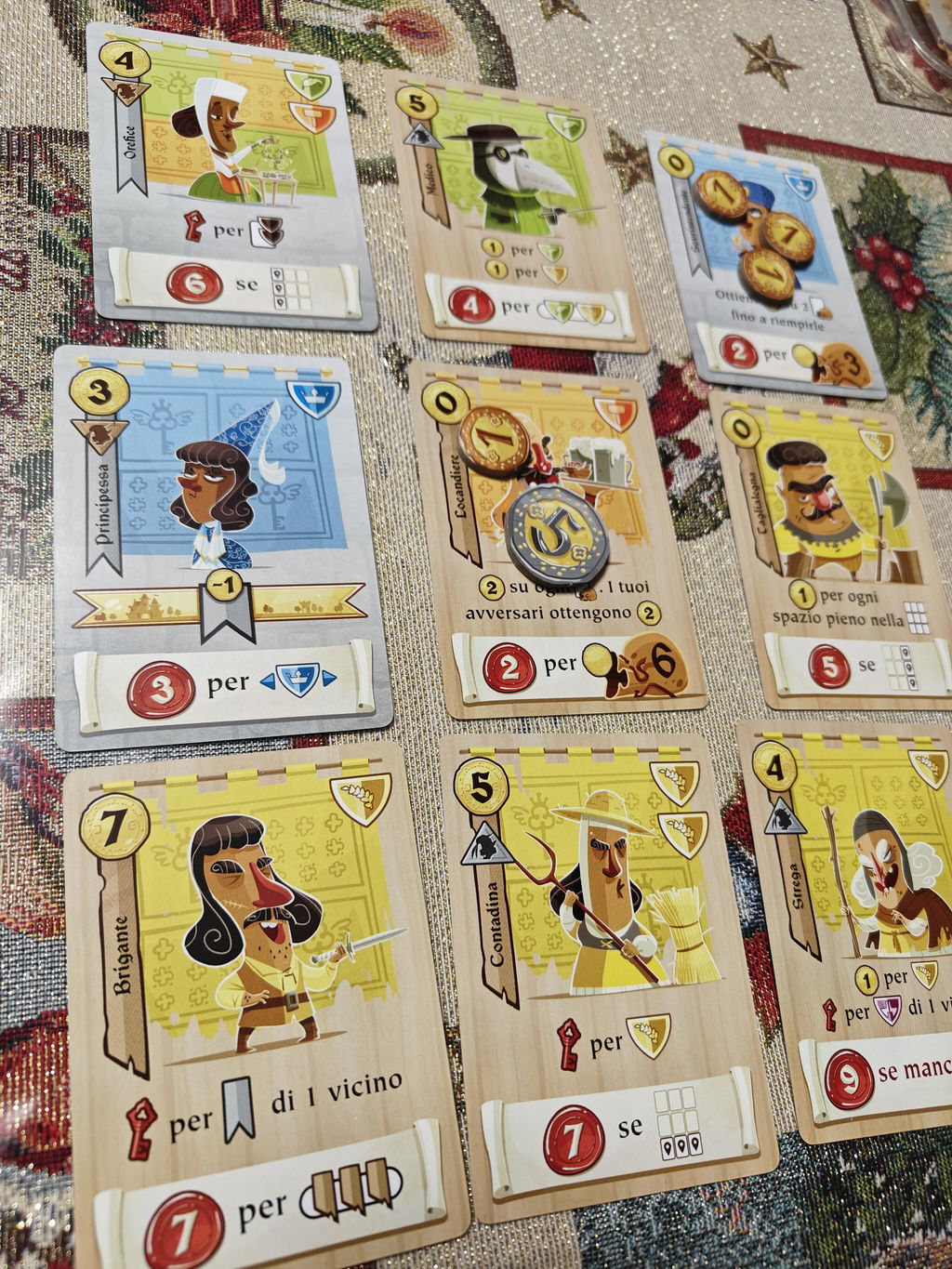
The mechanism is elegant: each player builds a 3x3 grid of medieval characters, drawing from two open markets — the lower city of peasants and the upper city of nobles. The Messenger pawn determines which market is accessible at all times, and spending a Key can change everything. Each card has an immediate effect and an end-game scoring condition: the challenge is to find the right combinations, in the right place, at the right time.
Nine turns. No downtime. A game finished before anyone gets up for coffee.
What they say abroad
"Far from frivolous, this simplicity is coupled with meaningful decisions that come from the interaction of cards within the grid."
Far from superficial: this simplicity goes hand in hand with meaningful decisions arising from the interaction of cards within the grid.
— Meeple Mountain
"Castle Combo hits a sweet spot — there are only 9 turns in the game, and the decision space is multi-layered even if each turn takes under a minute."
Castle Combo finds the sweet spot: only 9 turns, multi-layered decision space, each turn takes less than a minute.
— The Opinionated Gamers

Castle Combo
FrogScore · FroGames editorial rating · based on rules, international reviews and play sessionsWhat you build
The four pillars of every game
Lower City — the Villagers
Farmers, blacksmiths, guards, witches. Affordable cards and immediate effects that build the foundations of your grid.
Upper City — the Nobles
Knights, priests, scholars, aristocrats. More expensive cards with powerful end-game bonuses — if you can build the right synergies.
Keys and Messenger
The Messenger determines which market is open. Spending a Key moves it — a move that can get you the card you want or deny it to your opponent.
Shields and Synergies
Six shield families (nobility, faith, scholars, military, artisans, farmers). Each card scores based on neighbors in the grid — positioning makes all the difference.
Nine cards. Infinite combinations. The first game ends before anyone gets up — and immediately after, you shuffle to play again.
🃏
Recommended sleeves1 size · 78 cards total
A game in five moments
What happens at the table
Not the rules. The experience.
The market opens, doubt begins
Six cards on the table — three peasants, three nobles. The Messenger indicates where you can buy from. From the very first turn, you understand that every choice is a renunciation: the card you take might hurt an opponent more than it benefits you.
A card changes the whole plan
You had a grid full of golden shields in mind. Then the Bard appears — three points for each adjacent card — and you improvise a new scheme, repositioning everything you thought you had already decided. This is the heart of Castle Combo.
The Key. Use it or keep it?
You have two Keys in hand. That card in the upper city is perfect — but if you spend a Key to move the Messenger, you're exposed for the next turns. Keep it and risk someone taking it first. The table heats up, decisions become costly.
The grid takes shape — and you can't go back
Six cards in the grid, three to place. Every remaining space conditions what you can still do. You see your final combination getting closer — or moving away. The puzzle becomes concrete, each card weighs more than the previous one.
The final count — surprise is almost always guaranteed
Points are tallied. Someone underestimated that combo in the bottom right corner. Someone else discovers that their perfect plan was already in the hands of others. The cards are shuffled. It starts again. Usually immediately.
How to play
The flow of each turn
Four quick actions per turn. Easy to learn, mastered game after game.
If you want to access the other market, move the Messenger by paying a Key. You can also pass your turn to the next by refreshing a market — but it's risky.
Pay the Gold cost and take a card from the market indicated by the Messenger. Villagers in the lower city, nobles in the upper city. Each card has a cost, an immediate effect, and a final scoring condition.
The card must be adjacent to those already present. Position is crucial: many cards score based on their neighbors — think about it before placing it where it seems most convenient.
Apply the immediate effect of the newly bought card. Then replace the card in the market with a new one drawn from the deck. Next turn.
Why it's different from others
Six mechanics that make a difference
Only 9 — very intense — turns
Each game lasts exactly 9 turns per player. There's no time to get bored, no room to recover from a mistake. Every card counts from the first to the last turn.
Positioning makes a difference
It's not just which card you take — it's where you put it in the grid. Two identical cards in different positions produce radically different scores. The spatial puzzle is always present.
The Messenger creates indirect tension
You don't attack directly, but you can deny the perfect card to your opponent by moving the Messenger. A subtle interaction that gives no quarter — even in a game perceived as light.
Six shield families, infinite synergies
Nobility, faith, scholars, military, artisans, peasants. Each card scores based on the colors of adjacent shields. Building the right grid is a puzzle that is never solved the same way.
Immediate effects and overlapping final bonuses
Each card does two things: it gives you something now (coins, keys, discounts) and promises you points at the end of the game. Balancing these two needs is the strategic heart of the game.
Infinitely replayable
Different decks, different markets, different strategies. You can bet everything on nobles, on controlling the Messenger, on the economic effects of villagers. Castle Combo never runs out.
How it ends
Who builds best, wins
It's not enough to get the best cards — you have to build the right grid, in the right way, at the right time.
Victory
- After each player has placed their 9 cards, the final score is tallied
- The scoring conditions of each card in the grid are summed
- The player with the most points wins — in case of a tie, the player with the most remaining Gold wins
What causes loss
- Buying cards without building synergies between them
- Ignoring positioning and placing cards randomly in the grid
- Not keeping enough Gold to afford the necessary cards in decisive turns
Castle Combo is that game that ends and you immediately want to play again — because you already know how to improve the next grid.
Frequently Asked Questions
FAQ about Castle Combo
Is it really that simple to learn?
Yes. The rules can be explained in five minutes, the card iconography is clear, and a quick reference sheet is included in the box. The first game flows smoothly — complexity emerges game after game, as you discover the synergies between the characters.
With how many players does it work best?
The best experience is with 2 or 3 players, where every decision weighs more and control over your grid is tighter. With 4 or 5 players, the market rotates much faster, and long-term planning becomes less reliable — it remains fun, but the game's character changes.
Is it similar to Faraway?
Same publisher (Catch Up Games), same spirit of simplicity + unexpected depth, but different mechanics. Faraway is all about timing and acquisition order. Castle Combo focuses on the spatial construction of the grid and the synergies between adjacent cards. Both are excellent, and they complement each other well.
Is there a lot of luck in the game?
There is randomness in the market — you can't know exactly which cards will appear. But you always have more options available than you can buy, you can refresh the market, and you choose where to place each card. Luck exists but doesn't decide — decisions do.
Can it be played solo?
Castle Combo does not include an official solo mode. The game is designed for interaction — even indirect — between multiple players, and the absence of confrontation significantly reduces the tension of drafting.
Is the Italian edition complete, or is content missing compared to the original?
The Italian edition distributed by GateOnGames is equivalent to the original edition — same cards, same mechanics, rulebook in Italian. Nothing is missing compared to the international base version.
Castle Combo is an open draft and tableau-building board game for 2–5 players (ages 10+, 20–30 min duration). Designed by Grégory Grard and Mathieu Roussel, illustrations by Stéphane Escapa, published by Catch Up Games. Each player builds a 3×3 grid of medieval characters by purchasing 9 cards from two open markets — the lower city of villagers and the upper city of nobles. The Messenger pawn regulates access to the markets; spending Keys allows you to move it. Cards have immediate effects and final scoring conditions based on position and adjacent shields in the grid. Italian edition distributed by GateOnGames. Available on FroGames.it.
Castle Combo
Frequently Asked Questions
The answers you're looking for, no beating around the bush.
📸Do the images match the actual product?
The photos on the website often come from BoardGameGeek and are intended to give you an idea of the game. They may vary slightly from the version you receive. The content declared by the publisher is always binding.
📦Does the content of the box match what is indicated?
We always strive to provide the correct content, but minor variations are possible due to reprints or updates. The information comes directly from the publishers. If you have any questions, please contact us!
⏳How do pre-orders work?
Pre-order the game before release, payment is immediate, and the game is reserved for you. As soon as it arrives, we'll ship it right away! If there are any delays, we'll update you promptly.
🔒Can I trust buying here?
Absolutely! Secure payments, tracked shipments, and a team that loves board games as much as you do. If something goes wrong, we'll do our best to fix it.
🛠There's a problem with my order, what should I do?
Write to us now! Whether it's a missing part, damage, or an error, we'll help you resolve it as soon as possible. Your experience truly matters to us.