


Alexandria Metropolis of the World
🐸 Dettagli da BoardGameGeek
Consiglio BGG sul numero di giocatori
Categorie
Meccaniche
Design & Art
Lingua
Pre-order - leggi i dettagli
🐸 Una rana saggia sa quando dividere l’ordine… e quando aspettare il salto giusto.
Si abbina bene con
FroGames — Moments to Remember
Take a die, gather the grain along the Nile, and pass it to the merchant. He sells it to the armorer, who arms the Phalanx, which protects everyone — even those beating you. Alexandria grows because of you. But only those who built it best will be remembered.
Metropolis of the World
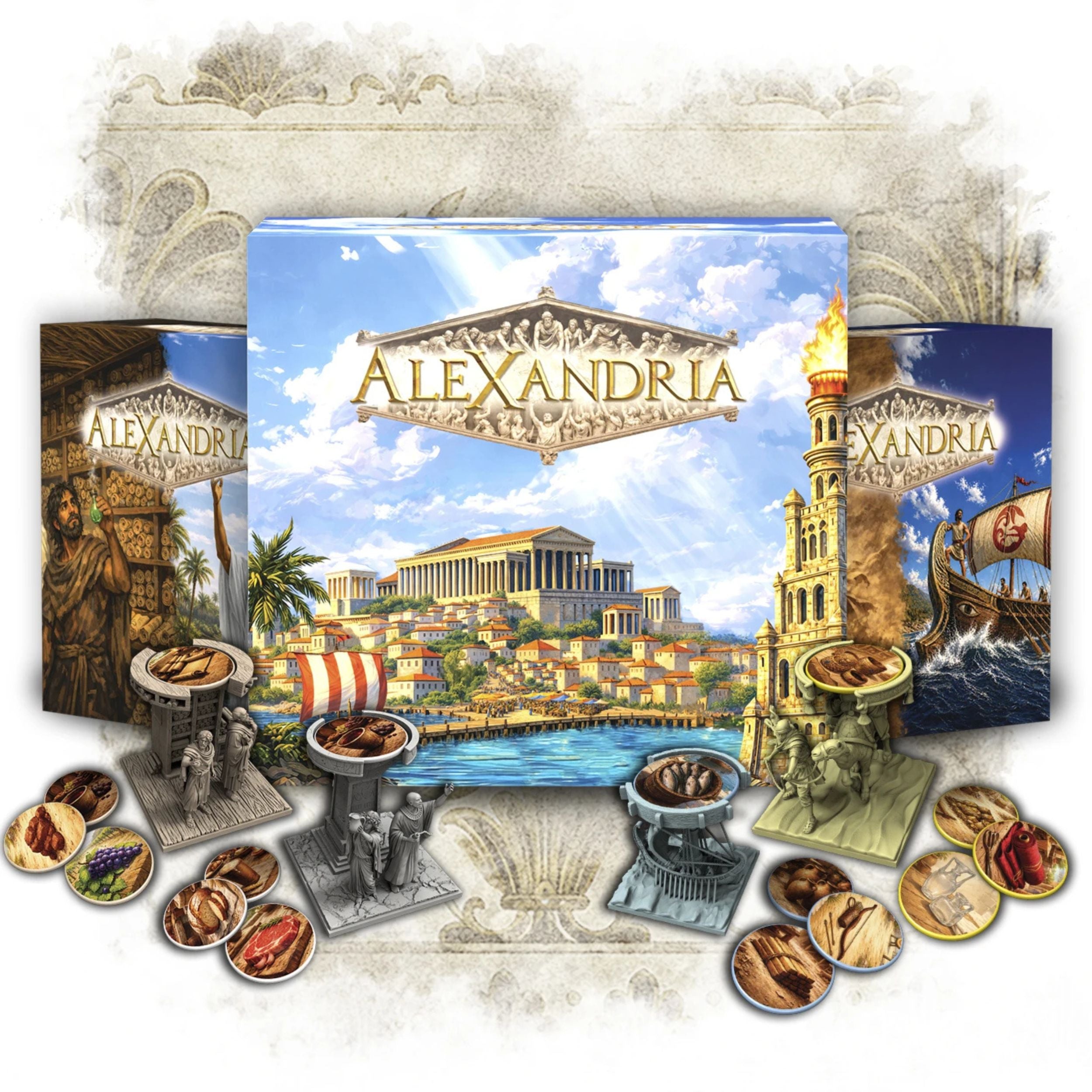
The complete setup: all eight Orders in one box
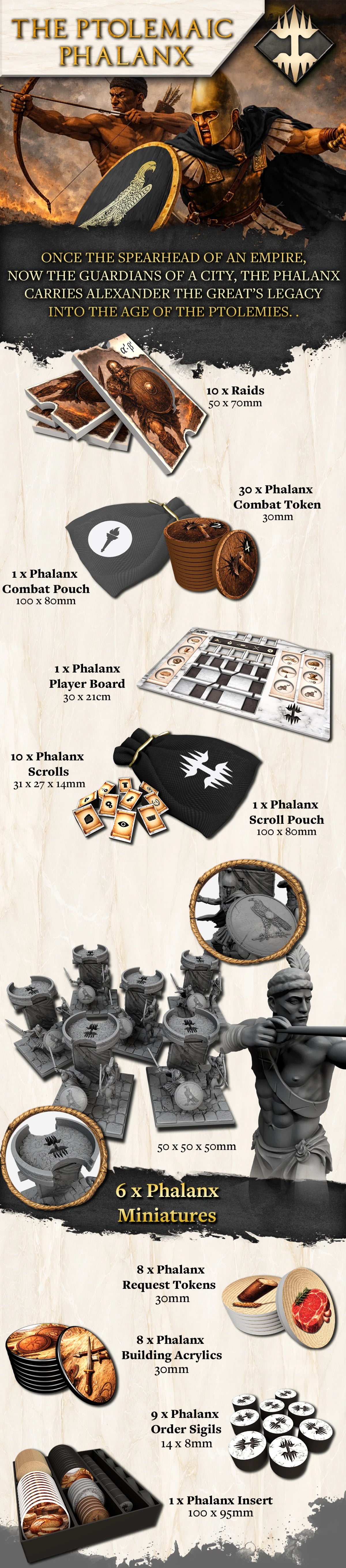
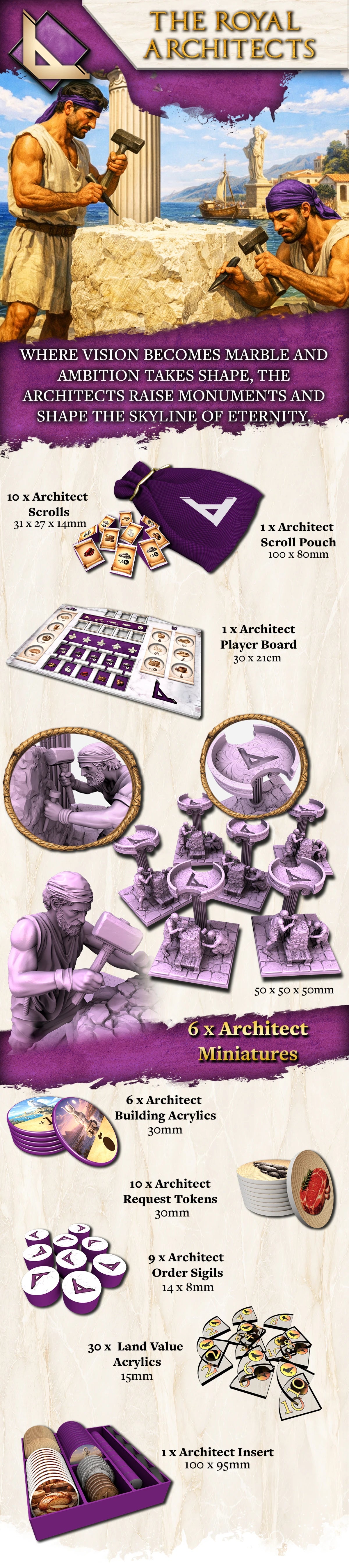
The base game brings four Civic Orders to the table, including the Ptolemaic Phalanx. The two expansions add four more, each with its own board, actions, and path to victory. This edition contains both.
Why it matters: the two expansions are not intended for separate purchase. Those starting with the base edition will not be able to add them later — and the four factions they introduce are what make Alexandria a vibrant city, with the sea, the market, faith, and science all on the same board.
What it's about
Building the greatest city of the ancient world, one Order at a time
Alexandria tells the story of Alexandria, Egypt's golden age, when the Great Library and the Lighthouse made the city the intellectual capital of the Mediterranean. Designed by Aiollus, Siber, and SPAGY, published by Meeple Pug: a competitive game for 1-4 players where each leads one of the eight Civic Orders — Harvesters, Crafters, Architects, Phalanx, Merchants, Priests, Philosophers, Seafarers — along a completely different path to victory than their neighbor.
At its heart is an idea almost no competitive game dares: every action you take also fuels others. The miner who extracts iron earns more if he passes it to the merchant, who takes it to the armorer, who forges the weapons of the Phalanx, which protects the entire city. No one can grow in isolation. You draft dice, assign them to actions on your board, trade, build, unlock the powers of your Order — and at the end of 5 rounds, the one who contributed most to Alexandria's glory wins.
Alexandria: Metropolis of the World is the version that brings everything to the table from day one: base game plus the two expansions, eight Orders, eight ways to win. It is the game in its full form, with no pieces to chase later.
The big picture in two lines
"a fully asymmetrical competitive game built on constructive, positive interaction"
A totally asymmetrical competitive game built on positive and constructive interaction.
— Meeple Pug, official presentation
Asymmetry here is not "same game, different power": these are eight economies that feed each other. The real question is not whether the system works, but whether it holds up with four players and all factions in play. We want to find out with you.
— FroGames First Read · July 2026

Alexandria: Metropolis of the World
The game supports 1 player from the basic rules, and solo mode is part of the official project. The real question remains: positive interaction is at the heart of the design, and playing alone, that heart beats slower. Provisional rating, updated with definitive rules.
FrogScore · FroGames editorial rating · first read: based on rules and official presentation, updated with first playsThe gears of Alexandria
Four elements that move the city
Eight Orders, eight games
Harvesters, Crafters, Architects, Phalanx, Merchants, Priests, Philosophers, Seafarers. Different player boards, different actions, different end-game goals. With this edition, all are included from day one.
Dice drafting
You don't roll and suffer: you choose which dice to take from the common pool and which actions to assign them to. Every die you take is one less for the next player.
Chaining actions
Your board starts simple and becomes an engine. You unlock and upgrade your Order's actions until a single move triggers three — resources, influence, drachmas, advancements.
One economy for all
You produce, and someone else can trade. You trade, and the armorer works. The Phalanx protects the entire city. You cannot win without keeping Alexandria's machine running.
At the end of the game, someone will say "I built Alexandria". And everyone else will know they helped them do it.
Come si gioca
Video dimostrativo di gameplay.
🏛️Why the full versionSix reasons to start here▼
Metropolis of the World
What changes with all eight Orders
The base game features four Civic Orders: Harvesters, Crafters, Architects, and the Ptolemaic Phalanx. The two expansions included in this edition add Seafarers, Merchants, Philosophers, and Priests — and change the shape of the economy, not just the number of boxes on your shelf.
Eight paths to victory, not eight powers
Each Order has its own board, actions, and objectives. With all eight available, each player truly chooses which game they want to play — and no two games will feature the same combination.
The sea enters the game
Seafarers and Merchants bring routes, trade, and luxury goods. Alexandria was a port before it was a library: without them, the produce → trade → arm chain remains incomplete.
Library and temples
Philosophers and Priests add knowledge and influence: two currencies that are not gathered from the ground and that reward those who play for the long term rather than immediate production.
Positive interaction closes the loop
The core of the design is that every action also fuels others. The more different Orders there are at the table, the more links the chain has — and that's where the system shows what it can do.
A growing engine under your hands
The personal board starts bare and fills with unlocked and enhanced actions. Mid-game, a single move triggers three: it's the classic satisfaction of engine building, applied to eight different engines.
You won't find them later
Seafarers & Merchants and Philosophers & Priests are not planned as separate purchases. Those who start with only the base game will remain with the four core Orders: this is the box that contains the entire game.
🎲How to playThe rules in four steps▼
How to play
The flow of each round
Alexandria lasts 5 rounds. Each round follows the same pattern: the scene opens, dice are taken, actions are performed, the city grows.
The round's event is revealed, changing conditions and opportunities for everyone — some benefit, others have to rewrite their plan. Common dice are rolled and made available to the table.
In turn, you take dice from the common pool and assign them to actions on your board. The value of the die determines how powerful the action is. What you take won't return: the draft is already half the game.
You activate what you have prepared: you collect, transform, trade, build, unlock the powers of your Order. As the board develops, one action triggers another and the turn extends into a chain.
The effects end up on the shared board. The resources you produced fuel the market, monuments remain there for everyone, the army protects the entire city. You gain, but so does anyone who comes after you.
⏱️Your first gameThe chronicle, round by round▼
A game in five moments
What happens at the table
Not the rules. The experience.
Eight boards, eight different tables
Everyone takes their own Order. The Harvester looks at the Nile, the Architect measures the free spaces, the Seafarer counts the routes, the Philosopher reads the technologies. The boards are not similar, the actions are not similar, the end-game objectives are not similar either. Before you even start, you understand that you won't be playing the same game as your neighbor.
The first chains link up
Rounds 1 and 2 are for laying the foundations. You take the dice you need, activate simple actions, unlock the first power. Then the strange thing happens: someone produces and you benefit without doing anything. Then it's their turn to benefit from you. The city starts to hum.
The board is no longer the same
Round 3: the Architects place structures that remain there for everyone, the port fills up, the temples and the Library begin to weigh heavily. Each turn changes the options for the next turn, including those of others. You look at the table and can't tell who's ahead — and that's exactly when the game gets good.
The engine runs at full throttle
Round 4: the board that was bare at the start of the game is now a machine. One die, one action, and a chain starts that produces resources, influence, and drachmas. The winner is not who makes the strongest move, but who built the best chain. And here, the right die at the right time is worth a game.
Who built Alexandria?
Round 5, final scoring. Contributions are summed up, end-game bonuses are revealed. Each Order measured its greatness in a different way — monuments, population, luxuries, knowledge, control of the sea — and often the winner is not the one everyone was watching.
🐸Things to know beforehandThree honest things, from friends▼
Things to know beforehand
Three things to consider before adding to cart
Duration is a range, not a number
It ranges from 45 to 180 minutes. That's a lot. With all expansions on the table and four players, expect the upper end of that range — and the first games even longer, because each Order is a set of rules to internalize. If your group struggles with downtime, factor this in.
Total asymmetry = balance to be verified
These are not different powers: they are different paths to victory. It's the game's most ambitious design choice, and also the riskiest. With eight Orders debuting, the balance will be judged on the field in the months after release, not on paper.
Positive interaction doesn't mean cooperative
The pitch is "every action helps everyone" and it sounds collaborative, but you win alone. If someone at your table can't stand fueling the economy of someone who's winning, Alexandria will give them a stomach ache. For others, it will make them want to play again.
🏆Victory and defeatWhat the ending rewards▼
How it ends
How to win and how to fall behind
No one is eliminated. You play for 5 rounds and count points — but each Order counts them in its own way.
Victory
- Accumulate more Victory Points than others in the 5 rounds
- Points come from your Order's path: production, population, trade, monuments, knowledge, sea control
- End-game bonuses close the score — whoever built the most efficient chain, not whoever made the most noise
Falling behind
- There is no elimination: you lose slowly, one round at a time
- You developed your engine too late and the last rounds aren't enough to catch up
- You fueled the economy of others more than you benefited yourself — positive interaction is inevitable, but it must be leveraged
Alexandria promises a competitive game where winning means building better, not destroying more. With all Orders in the box, you can verify that promise from the very first game.
💬Frequently asked questionsQuick answers before checkout▼
Frequently asked questions
FAQ about Alexandria: Metropolis of the World
What's the difference from the base edition of Alexandria?
Metropolis of the World contains the base game plus the two expansions: Seafarers and Merchants and Philosophers and Priests. The base edition features four Civic Orders (Harvesters, Crafters, Architects, and the Ptolemaic Phalanx); the expansions add four more, with their own boards, actions, and objectives. The two expansions are not planned as separate purchases, so this is the configuration to choose if you want the complete game.
Are eight asymmetrical factions too many to explain?
Each player only learns their own: the common rules (dice drafting, actions, city growth) are the same for everyone; asymmetry resides on the personal board. To be honest: the first game will be longer, because no one yet knows what others are doing and each turn by another player is a small discovery. From the second game onwards, the pace changes.
What mechanics does Alexandria use?
Dice drafting and action drafting as the core of the turn, engine building on the personal board, resource management and shared market, round events, modular board, end-game bonuses. It is a medium-heavy eurogame with completely asymmetric factions: closer to Root or Vast in design philosophy than to a classic management game.
Does it work well solo?
The game supports 1 player and there is an official solo mode. The reservation is conceptual rather than technical: the core of the design is that every action also fuels others, and without others at the table, that tension is diminished. We will update our judgment when we have the definitive rulebook in hand.
How long does a game really last?
The official data is 45–180 minutes, with approximately 90 minutes indicated as a reference. In practice, it depends on how many players you are and how familiar you are with your Order: with two players it's less, with four players and all expansions it goes towards the upper limit. If your group wants certainty about the time, this is not the right game.
Is it available in Italian?
The edition for sale is in English. Language dependence is medium-high: cards, boards, and faction powers have text, so at least school-level English is needed at the table. Currently, there are no official announcements of an Italian edition.
The people behind the game
Who invented it and who publishes it — and what else you can find from them.
Alexandria: Metropolis of the World is the complete edition of the asymmetric strategic board game by Aiollus, Siber and SPAGY, published by Meeple Pug: it includes the base game and the two expansions Seafarers and Merchants and Philosophers and Priests. For 1-4 players, duration 45-180 minutes, age 14+. Set in Ptolemaic Alexandria, at the time of the Great Library and the Lighthouse, it features eight completely asymmetric Orders — Harvesters, Crafters, Architects, Phalanx, Merchants, Priests, Philosophers, Seafarers — each with a dedicated board, actions, and victory path. Main mechanics: dice drafting, action drafting, engine building on a personal board, resource management, shared market, events, modular board, and end-game bonuses. The system relies on constructive positive interaction: every action fuels the city's growth and benefits everyone, but the one who contributes most over the 5 rounds wins. Official solo mode, English language edition. Available on FroGames.it.
Frequently Asked Questions
The answers you're looking for, no beating around the bush.
📸Do the images match the actual product?
The photos on the website often come from BoardGameGeek and are intended to give you an idea of the game. They may vary slightly from the version you receive. The content declared by the publisher is always binding.
📦Does the content of the box match what is indicated?
We always strive to provide the correct content, but minor variations are possible due to reprints or updates. The information comes directly from the publishers. If you have any questions, please contact us!
⏳How do pre-orders work?
Pre-order the game before release, payment is immediate, and the game is reserved for you. As soon as it arrives, we'll ship it right away! If there are any delays, we'll update you promptly.
🔒Can I trust buying here?
Absolutely! Secure payments, tracked shipments, and a team that loves board games as much as you do. If something goes wrong, we'll do our best to fix it.
🛠There's a problem with my order, what should I do?
Write to us now! Whether it's a missing part, damage, or an error, we'll help you resolve it as soon as possible. Your experience truly matters to us.