
Wishland
🐸 Dettagli da BoardGameGeek
Consiglio BGG sul numero di giocatori
Categorie
Meccaniche
Design & Art
Lingua
Si abbina bene con
FroGames — Moments to Remember
Some invest in rollercoasters, some in mascots. At the end of the seventh season, one built the perfect park. The others understand where they went wrong.
WHAT IT'S ABOUT
Build the most profitable theme park in seven seasons
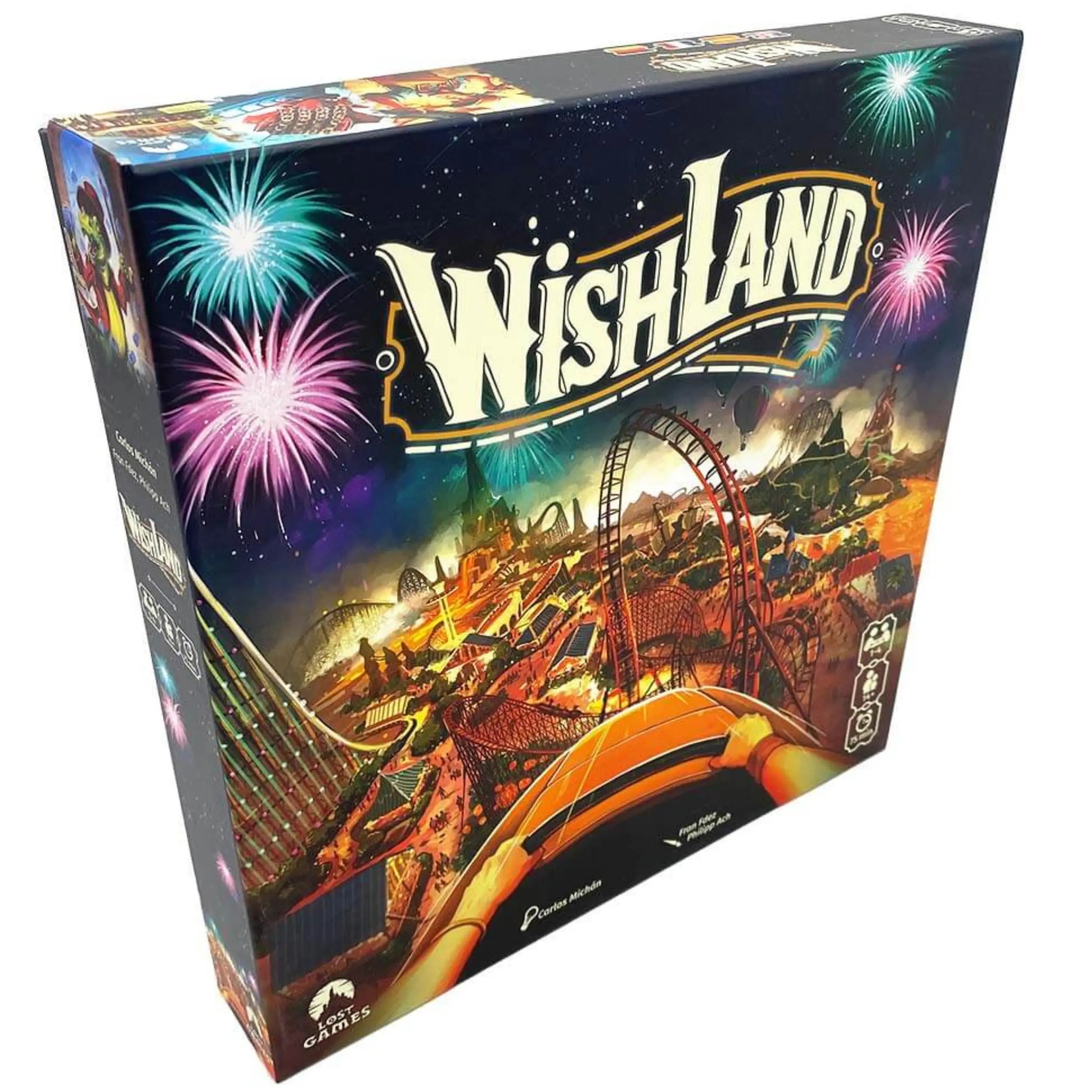
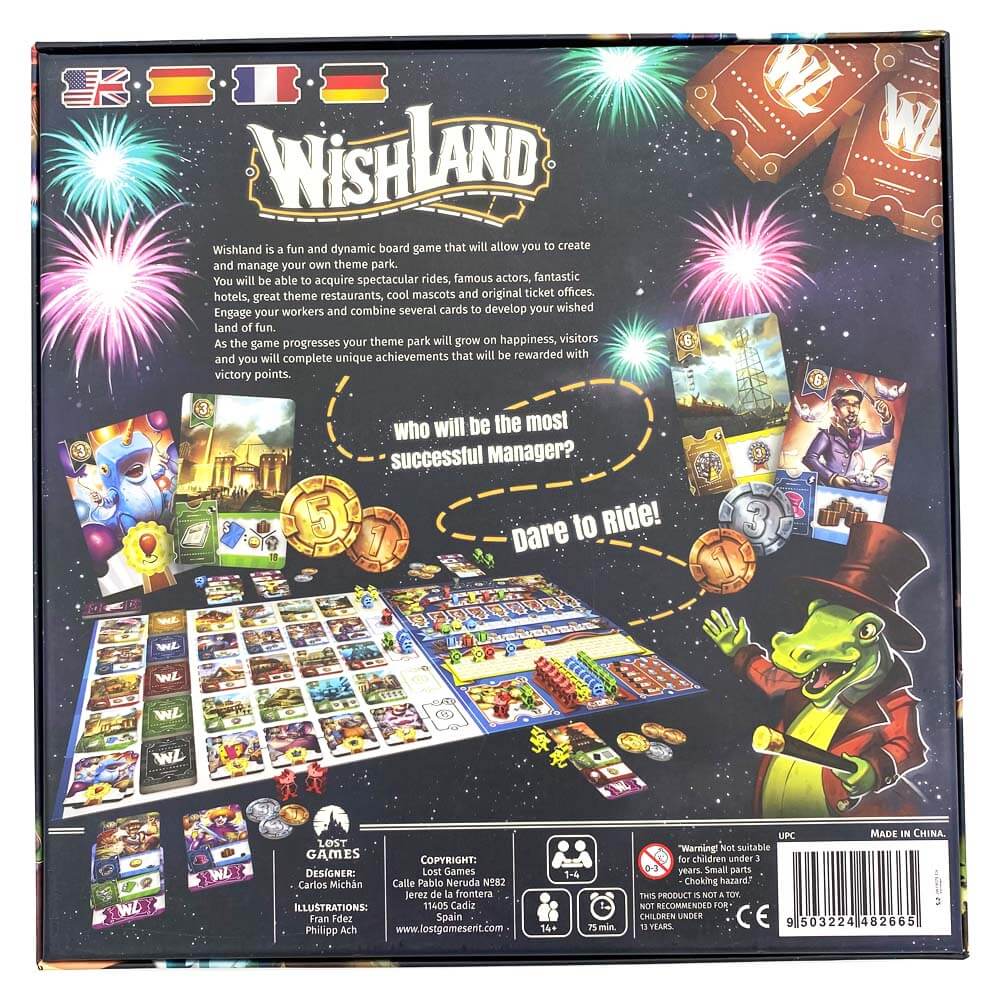
Wishland is a eurogame by Carlos Michán Amado, published by Lost Games in 2021. The theme is the management of a growing theme park: restaurants, attractions, hotels, actors, and mascots. The illustrations by Philipp Ach and Fran Fdez capture the colorful and competitive atmosphere of a ruthless entertainment industry.
At the table, you place workers on a common card market, buy the ones you need for your plan, and arrange them in your personal park. Each card type has its own logic: restaurants increase income, attractions give victory points and unlock expansions, actors add workers and visitors, hotels modify rules or provide end-game objectives, mascots multiply points for cards sharing their symbols. Seven rounds, then points are counted.
What they're saying abroad
A worker placement game that requires long-term planning and constant adaptation to available cards.
— FroGames
Each game is different thanks to the variable setup and the variety of combinations between cards and objectives.
— FroGames

Wishland
The game includes official solo rules. You face an automa that buys cards and occupies worker placement spaces according to predefined logic. The experience is complete, and park optimization remains intact, but you lose the ability to read other players' strategies and the competition on the card market.
FrogScore · FroGames editorial rating · based on rules, international reviews, and gameplay sessionsThe five pillars of the park
What you build card by card
Restaurants
Increase your base income each round. The more you have, the more you can spend. Without steady income, you fall behind.
Attractions
The heart of the park. They give direct victory points and unlock the expansion of your tableau. Essential for growth.
Actors
Add extra workers, happiness, and visitors. At the end of the game, they are worth points if you complete set collection. Versatile and powerful.
Hotels
Some break basic game rules, others provide secret objectives or bonuses related to other cards. Each hotel changes the plan.
Recommended sleeves 356 cards in 1 size ▼
If you play often, we recommend protecting the cards with transparent sleeves to make them last longer.
| Size | Quantity |
|---|---|
| 44 × 67 mm | 356 |
| Total cards | 356 |
In a few hours, you'll know if your park really works. And you'll understand which card you should have bought in the fourth round.
Come si gioca
Video dimostrativo di gameplay.
A game in five moments
What happens at the table
Not the rules. The experience.
Initial Acquisitions
Everyone looks at the central market. Available cards, prices, limited worker placement spots. Everyone has a vague idea of the park they want to build, but the initial choices depend on what the starting cards offer. Some focus on actors, some on restaurants. No one knows yet who is right.
Income Matters
Those who invested in restaurants start to pull ahead. More money means more cards, more cards mean more engine. Others catch up with actors (extra workers) or hotels (broken rules). You feel the pressure not to fall behind.
Mascots Come into Play
Mid-game. Mascots are worth points for each symbol shared with your cards. You look at your park, count the symbols, understand which mascots multiply your score. But others are looking at the same mascots. A silent race to snatch them up.
Hotel Objectives Revealed
Someone discovers that their hotel requires three attractions of the same type. Someone else realizes too late that they don't have enough actors for the set collection. The last two rounds become a race against one's own plan, not against opponents.
Final Count
Seventh round over. Points are counted: attractions, actor set collection, mascots, hotel objectives, various bonuses. Someone discovers that a card bought in the second round was worth twice what they thought. Someone else understands where they went wrong. Then someone immediately suggests a rematch.
How to play
The flow of each round
Seven identical rounds. Each round follows this sequence: worker placement, card acquisition, park management, end of round.
In turn, you place a worker on an action space in the central market. Spaces are limited, and some cost money. Whoever arrives first chooses better.
When you place a worker on a card space, you buy it and add it to your park. You pay the indicated cost. Each card type has immediate or permanent effects.
Some spaces give extra income, visitors, or happiness. Others modify your tableau. Manage accumulated resources to prepare for the next round.
Unpurchased cards are removed, new ones are drawn, the market is reset. Each round changes the range of possibilities.
Why it's different from others
Six mechanics that make a difference
Five card types, five logics
You don't buy generic cards. Each type (restaurants, attractions, actors, hotels, mascots) follows its own internal economy. Restaurants enrich you, attractions make you expand, actors give you workers, hotels break the rules, mascots multiply everything. You must balance all five, or specialize at your own risk.
Set collection on actors
Actors are not worth fixed points. They are worth points if you complete sets of different types. Three different actors are worth more than five identical actors. This creates tension in the market: when you see an actor you need for your set, you must grab them immediately or risk losing them.
Hotels that break rules
Some hotels allow you to ignore game limits: expand without enough attractions, place workers where you couldn't, gain extra resources. Others give secret end-game objectives. Each hotel changes the plan and unlocks strategies impossible for others.
Mascots as variable multipliers
Mascots do not give fixed points. They give points for each card in your park that shares a symbol with them. If you have many cards with a heart symbol, the heart mascot is golden. But the available mascots change every game, so you cannot plan in advance which symbol to prioritize.
Worker placement with variable costs
Some worker placement spaces are free, others cost money. The more powerful a space is, the more it costs. This means that those who invest in income (restaurants) can afford better actions in the later rounds, while those who neglected income remain limited.
Seven fixed rounds, no triggers
There is no variable end-game condition. The game always lasts exactly seven rounds. This eliminates surprise but increases planning: you know how much time you have, you can calculate when to buy what, and you know that by the seventh round your engine must be complete.
How it ends
How to win and how to lose
End of the seventh round. Victory points are tallied from all sources. The player with the most points wins.
Victory
- Points from attractions (direct)
- Points from actor set collection (bonus for variety)
- Points from mascots (multipliers on shared symbols)
- Points from hotel objectives (secret or public)
- Points from happiness and visitor bonuses
Fatal errors
- Neglecting income: without restaurants, you can't compete for the best cards in the later rounds
- Ignoring attractions: without attractions, you can't expand your park and get stuck with few cards
- Not completing actor sets: isolated actors are worth little, complete sets are worth a lot
- Buying mascots incompatible with your park: if your symbols don't match, the mascot is worth zero
Wishland rewards those who can balance economic engine, physical expansion, and long-term goals. A single strong card is not enough: a coherent park is needed.
Frequently asked questions
FAQ about Wishland
How complex is it to learn?
Medium weight on BGG (2.48/5). Classic worker placement with few exceptions. Rules explained in 15-20 minutes, first game playable immediately. Depth emerges after a few games, when you understand which cards synergize best.
Does it play well solo?
Yes. It includes official rules for solo play with an automa. The automa buys cards and occupies spaces according to preset logic. The optimization of your park remains intact, but you lose the competition in the market and the reading of other players' strategies. Still a complete experience.
How much does luck factor in?
Cards drawn from the market introduce variability, but you always have a complete view of the board and multiple choices. Luck influences which strategies are available each round, but it doesn't overturn well-constructed plans. The player who manages best wins.
How long does a game last?
75 minutes indicated, realistic with 3-4 experienced players. The first game can go up to 90 minutes. With 2 players, it drops to 60. Seven fixed rounds make the duration predictable.
Is it available in Italian?
This edition is in English. The text on the cards is present but limited (names of attractions, actors, hotels). The mechanics are iconographic. With an Italian reference sheet (easily obtainable), the game is accessible even to those with basic English skills.
Wishland is a strategic worker placement eurogame for 1-4 players, lasting 75 minutes, recommended age 14+. Designed by Carlos Michán Amado and published by Lost Games, the game challenges players to build and manage a theme park by acquiring five types of cards: restaurants (income), attractions (expansion and points), actors (workers and set collection), hotels (rule modifiers), and mascots (point multipliers). Variable setup, secret objectives, seven fixed rounds. Includes official solo mode with automa. Available on FroGames.it.
Frequently Asked Questions
The answers you're looking for, no beating around the bush.
📸Do the images match the actual product?
The photos on the website often come from BoardGameGeek and are intended to give you an idea of the game. They may vary slightly from the version you receive. The content declared by the publisher is always binding.
📦Does the content of the box match what is indicated?
We always strive to provide the correct content, but minor variations are possible due to reprints or updates. The information comes directly from the publishers. If you have any questions, please contact us!
⏳How do pre-orders work?
Pre-order the game before release, payment is immediate, and the game is reserved for you. As soon as it arrives, we'll ship it right away! If there are any delays, we'll update you promptly.
🔒Can I trust buying here?
Absolutely! Secure payments, tracked shipments, and a team that loves board games as much as you do. If something goes wrong, we'll do our best to fix it.
🛠There's a problem with my order, what should I do?
Write to us now! Whether it's a missing part, damage, or an error, we'll help you resolve it as soon as possible. Your experience truly matters to us.