
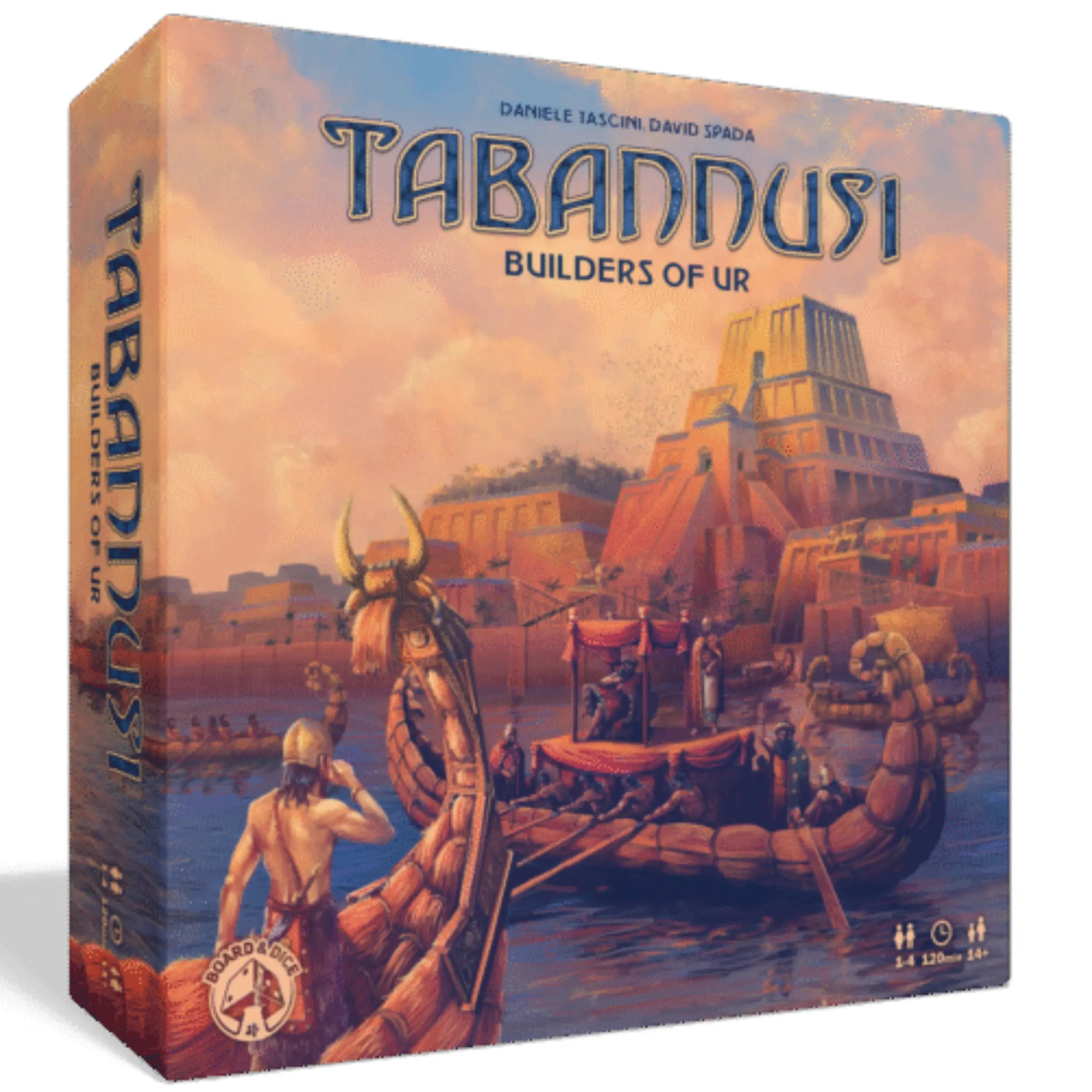

Tabannusi: Builders of Ur
🐸 Dettagli da BoardGameGeek
Consiglio BGG sul numero di giocatori
Categorie
Meccaniche
Design & Art
Lingua







Si abbina bene con
The FroGames Card
You pick up the blue die. It means two things: you have a blue resource in hand, and your worker will go to the blue district. You try to plan three turns ahead, but someone steals the die you wanted, and the plan falls apart.
WHAT IT'S ABOUT
Building the city of Ur, one die at a time
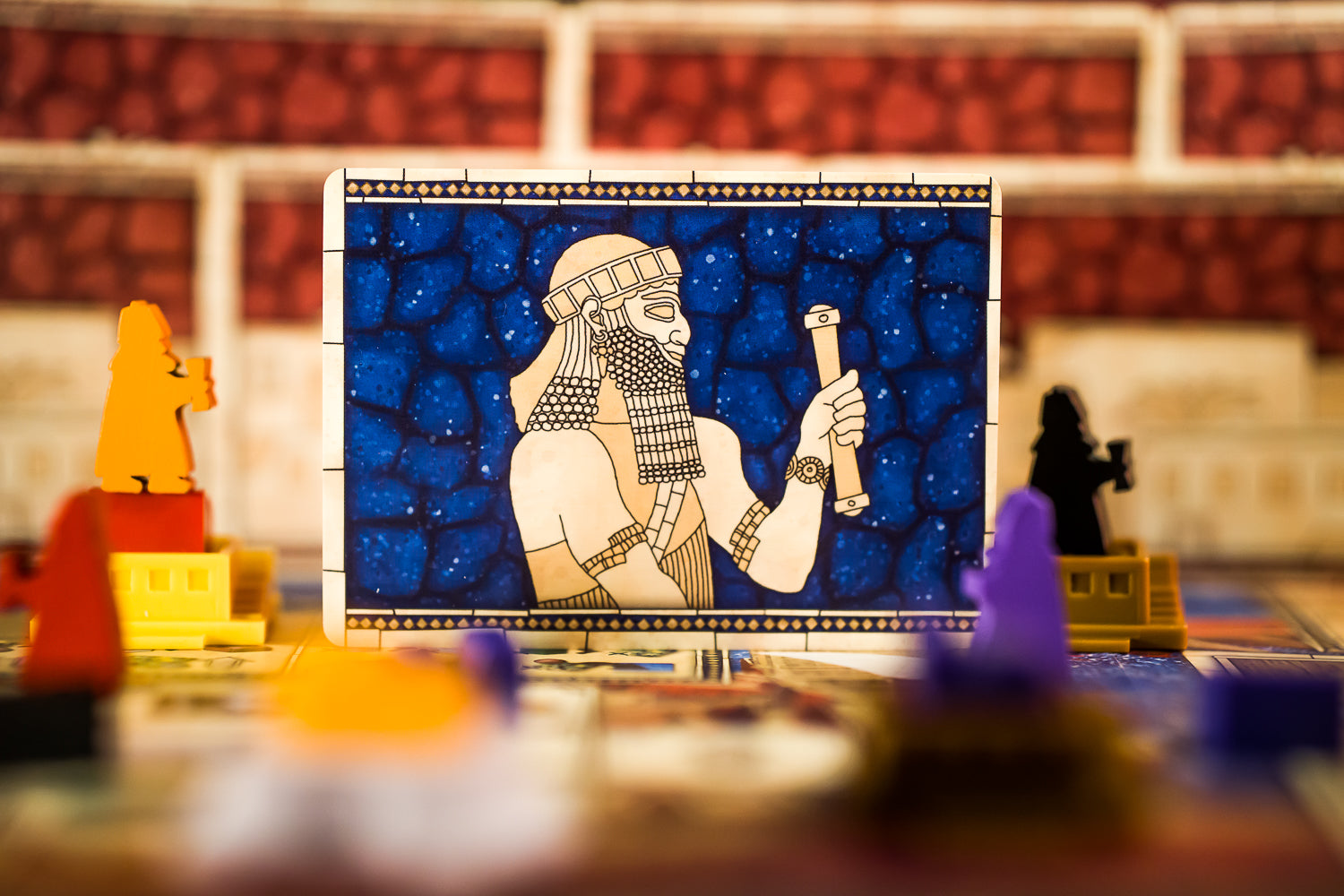
Set in Mesopotamia 3000 BCE, when Ur was a flourishing coastal city, Tabannusi puts you in the shoes of a builder expanding the districts of the Great City. Designed by Daniele Tascini (Tzolk'in, Tekhenu) and David Spada, published by Board&Dice with illustrations by Zbigniew Umgelter and Aleksander Zawada.
At the table, you manage workers who move between five districts, each linked to a die color. Each turn you draw a die from a district: the color gives you a resource, the value decides where your worker will go on the next turn. You build buildings, expand sites, gain the king's favor in the temple, accumulate ships in the port. Each choice triggers the next, and the remaining dice determine when the mid-game scoring occurs.
What they say abroad
"Tabannusi gives you enough rope to hang yourself, then asks if you'd like a second rope."
Tabannusi gives you enough rope to hang yourself, then asks if you'd like a second rope.
— Meeple Mountain
Tabannusi is an eurogame that demands absolute concentration. The first few turns are a blur, then you understand that each die is a double promise. It's a game that will evolve in our experience: this is a first read.
— FroGames

Tabannusi: Builders of Ur
The game includes official solo rules with an automa that simulates an opponent by drawing dice and occupying spaces. The experience is complete and challenging, retaining all main mechanics. Compared to multiplayer, you lose the tension of competitive drafting: the automa doesn't reason, it executes, so the psychological reading of opponents is missing.
FrogScore · FroGames editorial rating · based on rules, international reviews, and play sessionsThe five districts of Ur
Where you send your worker
Construction districts
Three districts (red, green, yellow) where you expand construction sites and convert them into buildings for victory points. Each completed building is a small engine that gives you permanent bonuses.
Temple district
The purple district where you accumulate influence to gain the king's favor. The more influence you have, the more favor tokens you get, and those tokens are worth points and advantages at the end of the game.
Port district
The blue district where you collect ships. Ships bring immediate special abilities and victory points at the end of the game. Some ships unlock actions you wouldn't otherwise have.
Colored dice
Each district has dice of its own color. When you take one, you get a resource of that color AND the die's value decides which district you will activate on the next turn. It's a two-way chain.
Recommended sleeves 54 cards in 1 size ▼
If you play often, we recommend protecting cards with clear sleeves to make them last a long time.
| Size | Quantity |
|---|---|
| 63 × 88 mm | 54 |
| Total cards | 54 |
Come si gioca
Video dimostrativo di gameplay.
🎲How to playThe rules in four steps▼
How to play
The flow of each turn
Each player, on their turn, performs a fixed sequence: they take a die, activate the corresponding district, and prepare for the next turn.
Your worker is in a district. Take one of the available dice of that color: the die becomes a resource (its color) and its value (1-6) indicates which district you will activate next turn.
Perform the action of the district where you are: expand a construction site, complete a building, gain influence in the temple, or collect a ship from the port. You can spend resources (previously taken dice) to enhance the action.
Move your worker to the district corresponding to the value of the die you just took. If you took a die with value 3, go to district 3. This creates a chain: each die determines your next move.
If a district runs out of dice, an intermediate scoring round is triggered: everyone scores points based on buildings, ships, and influence. Then the districts are refilled and the game continues. At the end of the second scoring round, the game ends.
⏱️Your first gameThe chronological account, moment by moment▼
A game in five moments
What happens at the table
Not the rules. The experience.
Setup and first look
The Ur board is spectacular: five districts full of colored dice, empty construction sites, the port with ships in a row. Everyone chooses a player color, places their worker, and tries to figure out where to start. The first feeling is information overload: dense iconography, dice everywhere, multiple objectives.
The first fumbling turns
You take a die, activate the district, build something. But the value of the die you took decides where you'll go next turn, and you realize you have to think two turns ahead. Someone takes the die you wanted, and your plan falls apart. Nervous laughter, starting over.
The engine takes shape
You've built two buildings, you have a ship, you have influence in the temple. You start to see the combos: this building gives you extra resources, that ship allows you a bonus action. The game opens up, choices become less chaotic, more calculated. But someone is racing for points and you're behind.
The first scoring
A district runs out of dice: the intermediate scoring round is triggered. You count buildings, ships, royal favor tokens. You find out who built better and who wasted turns. This is when you realize if your strategy is working or if you need to pivot. Refill the dice, start again.
The last turn
Second scoring, final score. You add up buildings, ships, completed contracts, royal favor, secret objectives. The one who best optimized the die-resource-movement chain wins. Someone discovers they lost by 3 points and re-checks the counts twice. Post-game discussion: what would you have done differently.
🐸What to know beforehandThree honest things, from friends▼
What to know beforehand
Three things you need to know
Steep learning curve
The first game is tough: dense iconography, district-by-district activation rules, non-intuitive combos. It takes 30-40 minutes of explanation and a practice game before the game runs smoothly. It's not a gateway game; it's an eurogame for those already familiar with complex worker placement and engine building.
Downtime and AP prone
With 4 players, downtime can increase: each player must calculate which die to take, which action to perform, and which district to go to next. Players prone to analysis paralysis slow down the table. With 2 players, it flows much better; solo is smooth.
Luck is controlled but present
Dice are random in setup but visible: you don't roll, you choose which one to take. However, if someone snatches the die 4 you needed to go to the port, your plan falls apart. There's control, but turn order and others' choices introduce tactical variance.
🏆Victory and defeatWhat the ending rewards▼
How it ends
How to win and how to lose
Tabannusi is played until two intermediate scoring rounds. At the end of the second, all accumulated victory points are tallied: whoever has the most wins.
Victory
- Maximize points from constructed buildings: each building is worth fixed points plus variable bonuses
- Collect high-value ships from the port and complete their objectives
- Accumulate influence in the temple to obtain royal favor tokens, which are worth points and special abilities
Common mistakes
- Ignoring the temple and royal favor: royal tokens are worth many points at the end of the game
- Not planning the die-movement chain: you end up in districts where you didn't want to go
- Building too slowly: if scoring happens and you have empty sites, you lose points compared to opponents
Tabannusi is an eurogame that rewards those who can plan in layers and punishes those who improvise. If you're looking for a medium-heavy game with unique mechanics, this is it.
💬Frequently Asked QuestionsQuick answers before checkout▼
Frequently Asked Questions
FAQ about Tabannusi: Builders of Ur
What mechanics does Tabannusi: Builders of Ur use?
Dice drafting (each die taken is a resource + movement indicator), worker placement with constrained movement, tile placement to expand districts, contract management (objectives to complete), engine building through buildings and ships. It's a layered eurogame that mixes classic mechanics in a non-standard way.
How difficult is it to learn?
BGG weight 3.9/5: it's an expert game. The explanation takes 30-40 minutes, the first game is slow. The iconography is dense and requires frequent reference to the rulebook. After a warm-up game, the game becomes smoother, but it is not suitable for beginners or those looking for a gateway eurogame.
Does it scale well at all player counts?
With 2 players, it flows quickly and tactically, with less competition over dice. With 3-4 players, drafting becomes tighter but downtime increases (especially with slow players). Solo play is solid thanks to the official automa. The sweet spot is 2-3 players to balance interaction and fluidity.
How long does a real game last?
The box says 120 minutes, which is realistic for a 4-player game with experience. The first game can exceed 2 and a half hours for explanation + warm-up. With 2 players, a game takes 90-100 minutes once you know the rules.
Is it available in Italian?
This edition is in English. The game has text on the cards and requires language proficiency to play. There are no official Italian editions at the moment.
The people behind the game
Who invented it, who designed it, who publishes it — and what else they've done.
Tabannusi: Builders of Ur is a strategic eurogame for 1-4 players, lasting 120 minutes, ages 14+, designed by Daniele Tascini and David Spada, published by Board&Dice. Set in ancient Mesopotamia, the game uses mechanics of colored dice drafting, constrained worker placement, and tile placement to expand the districts of the city of Ur. Each die taken provides a resource and determines your worker's next district, creating a chain of long-term choices. BGG weight 3.9/5, suitable for experienced players seeking strategic depth and complex optimization. Available on FroGames.it.
Frequently Asked Questions
The answers you're looking for, no beating around the bush.
📸Do the images match the actual product?
The photos on the website often come from BoardGameGeek and are intended to give you an idea of the game. They may vary slightly from the version you receive. The content declared by the publisher is always binding.
📦Does the content of the box match what is indicated?
We always strive to provide the correct content, but minor variations are possible due to reprints or updates. The information comes directly from the publishers. If you have any questions, please contact us!
⏳How do pre-orders work?
Pre-order the game before release, payment is immediate, and the game is reserved for you. As soon as it arrives, we'll ship it right away! If there are any delays, we'll update you promptly.
🔒Can I trust buying here?
Absolutely! Secure payments, tracked shipments, and a team that loves board games as much as you do. If something goes wrong, we'll do our best to fix it.
🛠There's a problem with my order, what should I do?
Write to us now! Whether it's a missing part, damage, or an error, we'll help you resolve it as soon as possible. Your experience truly matters to us.