
Delfos
🐸 Dettagli da BoardGameGeek
Consiglio BGG sul numero di giocatori
Categorie
Meccaniche
Design & Art
Lingua
Pre-order - leggi i dettagli
🐸 Una rana saggia sa quando dividere l’ordine… e quando aspettare il salto giusto.
Si abbina bene con
The FroGames Card
You have three tiles in hand. One closes the temple you need, another blocks your opponent, the third opens a new space. You only play one. Delphi awaits.
WHAT IT'S ABOUT
Architects competing to rebuild Delphi's glory
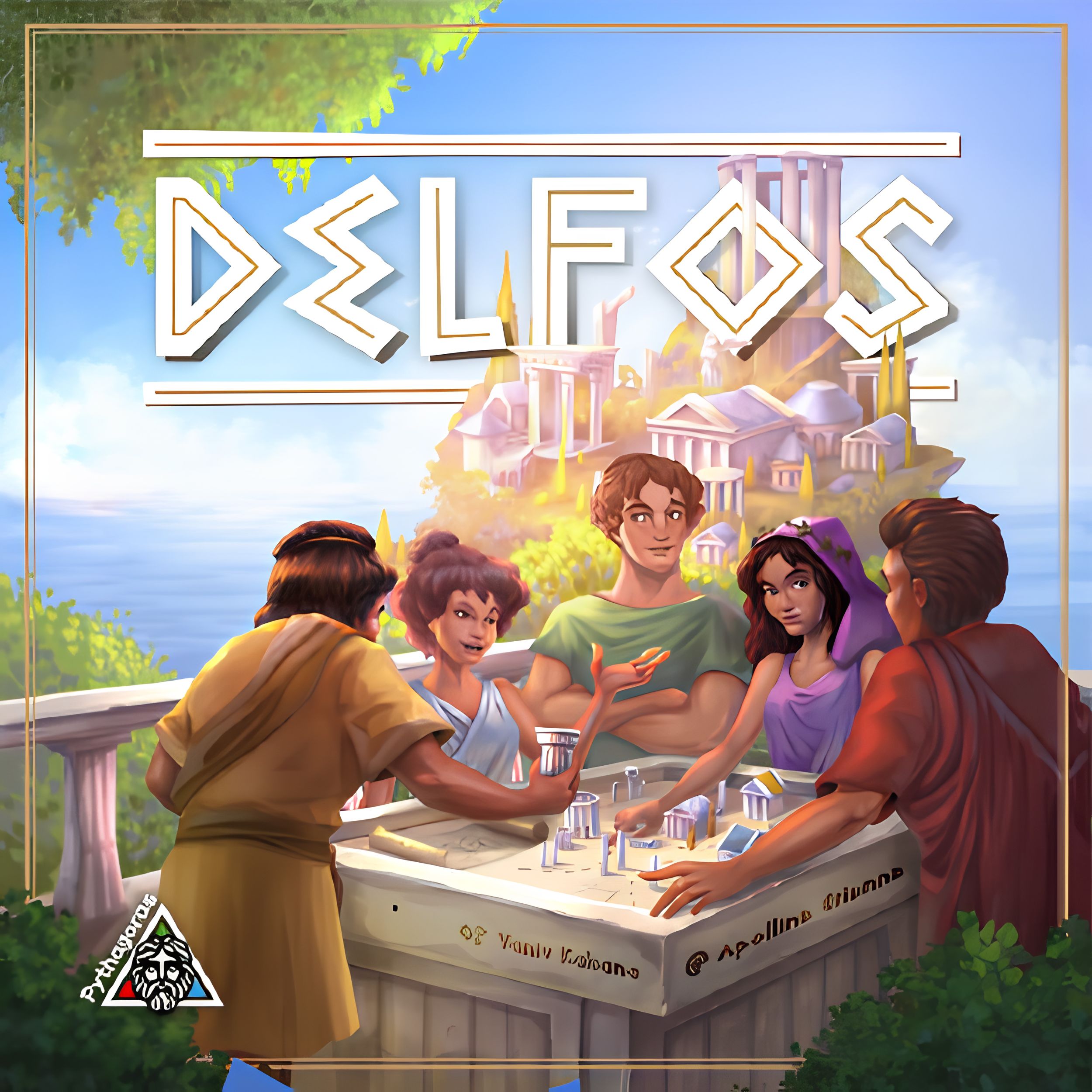
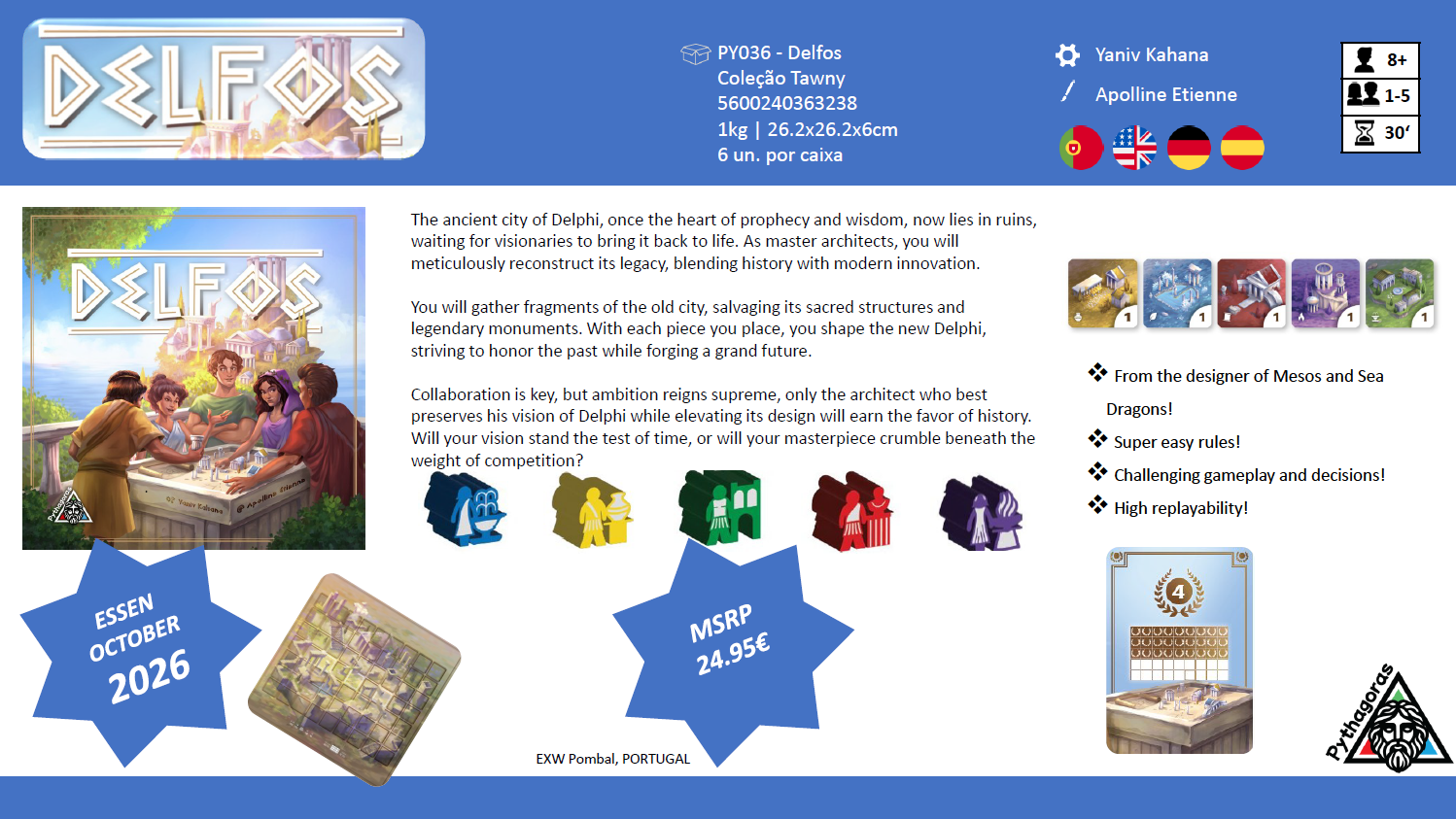
Delphos brings to the table the ancient Greek city of Apollo's sanctuary, the heart of prophecy and classical wisdom. Designed by Yaniv Kahana (Sea Dragons, MESOS) with illustrations by Apolline Etienne, the game is a competitive tile placement where each architect attempts to rebuild their vision of the sacred city.
On your turn, you collect fragments of ancient structures and place them to form temples, monuments, and sacred areas. Each tile modifies the shared landscape and your position in the competition. Cooperation can be useful, but personal ambition matters more: only those who preserve their vision with consistency and efficiency earn a place in the history of Delphi.
What they say abroad
"Blend history with innovation to restore Delphi's legacy."
Blend history with innovation to restore Delphi's legacy.
— PYTHAGORAS
A territorial tile placement game built on Greek mythology. First impression based on official materials: the mechanics promise tight placement choices and a competitive tension hidden beneath the classical setting. Updates will follow after the first plays.
— FroGames

Delphos
The game supports 1 player according to official data, but it's unclear if it uses an automa, solo objectives, or simply allows playing against oneself to optimize the score. The solo experience will likely be more puzzle than competition.
FrogScore · FroGames editorial rating · first reading: based on rulebook and official presentation, updated with first playsWhat you find in the box
Game elements
Monument tiles
Fragments of temples, sacred structures, and ancient city zones. Each tile represents a piece of Delphi to be rebuilt with attention to position and adjacency.
Thematic components
Elements related to Greek mythology and classical architecture. The game promises a setting that honors the past while building the future.
Personal objectives
Each architect has their own vision of Delphi. Objective cards or scoring conditions guide your placement choices against others.
Scoring system
Evaluation based on how you preserved your vision and refined the city's design. The one who best balances ambition and coherence wins.
🎲How to playThe rules in four steps▼
How to play
The flow of each turn
Delfos follows a simple rhythm: draw, place, evaluate. Repeat until the tiles run out.
Each player draws or receives tiles from the common supply. Tiles represent fragments of buildings, sacred areas, or monuments to be placed in their own area.
Choose a tile from your hand and place it in your play area, respecting adjacency and construction rules. Each tile modifies your potential score.
Check if you have completed monuments, zones, or objectives. Some elements give immediate points, others are only worth points at the end of the game if completed.
The next player performs the same actions. The game continues until all tiles are used or a game-end condition is met.
⏱️Your first gameThe story, moment by moment▼
A game in five moments
What happens at the table
Not the rules. The experience.
First tiles, first ideas
Everyone looks at the empty space in front of them. The first tiles fall onto the table and begin to form the skeletons of temples and squares. No one knows yet who is building what, but everyone already has an idea in their head.
The territory takes shape
Personal areas grow. Some are optimizing for compactness, others for expansion. The first space conflicts begin to emerge: that tile you wanted was just taken by your opponent.
Difficult choices
You have three good tiles and only one move. Complete your main monument or block the other's? Each placement counts double: for you and against someone else. The tension rises.
The city takes shape
The personal boards are almost complete. Someone has built a harmonious Delphi, someone else has improvised too much. It becomes clear who planned from the beginning and who chased the tiles.
Final count
Last tile placed. Points are counted: completed monuments, coherent zones, personal objectives. The winner is whoever found the best balance between ambition and practicality. Someone immediately suggests a rematch.
🐸Good to know beforehandThree honest things, from friends▼
Good to know beforehand
Three things to keep in mind
Marked variable duration
The 20-40 minute range is wide for a tile-placement game: it means that with 5 players or a complex setup, the game can double compared to a solo or duo game. If you're looking for a consistent pace, adjust accordingly.
Still scarce BGG data
Only 4 votes on BoardGameGeek, weight not calculated, expected release 2026. There are no authoritative reviews or game reports yet: this page is based on official materials and will be updated after the first real experiences.
Theme vs. mechanics
Ancient Greece is evocative, but in tile-placement games, the theme often remains aesthetic. If you're looking for deep narration or mythological immersion, wait for confirmation: it might be more abstract than it seems.
🏆Victory and defeatWhat the ending rewards▼
How it ends
How to win and how to lose
Delfos rewards those who build with consistency and strategic vision. Victory is decided by the points accumulated.
Victory
- Completion of monuments and sacred structures in one's area
- Fulfillment of personal objectives or scoring conditions
- Highest number of victory points at the end of available tiles
Defeat
- Ineffective placements that do not complete structures or zones
- Lack of balance between ambition (large monuments) and realism (limited space)
- Lower final score than opponents due to inconsistency in reconstruction
Delfos presents itself as an accessible tile-placement game with a classic theme, where every tile counts and planning beats improvisation. Ideal for those looking for short games with significant spatial decisions.
💬Frequently asked questionsQuick answers before checkout▼
Frequently asked questions
Delfos FAQ
What mechanics does Delfos use?
Delfos is a tile-placement game with territory-building elements. You place tiles to build structures in your play area, trying to complete monuments and fulfill objectives. The competition is indirect: you don't attack opponents, but you compete for tiles and for who best optimizes space.
Is it suitable for families with children?
The recommended age is 8+, so yes, with children from second/third grade onwards. The short duration (20-40 minutes) and classic tile placement make it accessible, but we don't yet know how deep the scoring system is: it might require more planning than it seems.
How does it work solo?
The game states support for 1 player, but the details are not yet clear. It might use an automa, scoring objectives to beat, or simply allow you to play by optimizing your own result. The experience will probably be more of a puzzle than a competition.
Is it worth waiting for reviews before buying it?
Yes, if you're not a fan of novelty or tile-placement in general. Delfos has just been released, there's very little data on BoardGameGeek and no reviews from international outlets. This page will be updated as soon as we have real games and community feedback.
Is it available in Italian?
The edition for sale is in English. There are currently no official announcements about Italian localizations from PYTHAGORAS or other publishers. Language likely has little impact (tile-placement games are often language-independent), but it depends on how many text cards or written objectives there are.
The people behind the game
Who invented it, who designed it, who publishes it — and what else they've done.
Delfos is a competitive tile-placement board game set in ancient Greece, designed by Yaniv Kahana and published by PYTHAGORAS in 2026. For 1-5 players, ages 8+, lasting 20-40 minutes, the game puts you in the shoes of an architect rebuilding the sacred city of Delphi tile by tile. The core mechanic is territorial placement: you collect fragments of temples and monuments, arrange them in your area respecting adjacencies and objectives, and compete to see who best preserves their vision of the city. Ideal for families and new players looking for an accessible strategy with a historical theme. Available on FroGames.it.
Delfos
Frequently Asked Questions
The answers you're looking for, no beating around the bush.
📸Do the images match the actual product?
The photos on the website often come from BoardGameGeek and are intended to give you an idea of the game. They may vary slightly from the version you receive. The content declared by the publisher is always binding.
📦Does the content of the box match what is indicated?
We always strive to provide the correct content, but minor variations are possible due to reprints or updates. The information comes directly from the publishers. If you have any questions, please contact us!
⏳How do pre-orders work?
Pre-order the game before release, payment is immediate, and the game is reserved for you. As soon as it arrives, we'll ship it right away! If there are any delays, we'll update you promptly.
🔒Can I trust buying here?
Absolutely! Secure payments, tracked shipments, and a team that loves board games as much as you do. If something goes wrong, we'll do our best to fix it.
🛠There's a problem with my order, what should I do?
Write to us now! Whether it's a missing part, damage, or an error, we'll help you resolve it as soon as possible. Your experience truly matters to us.