
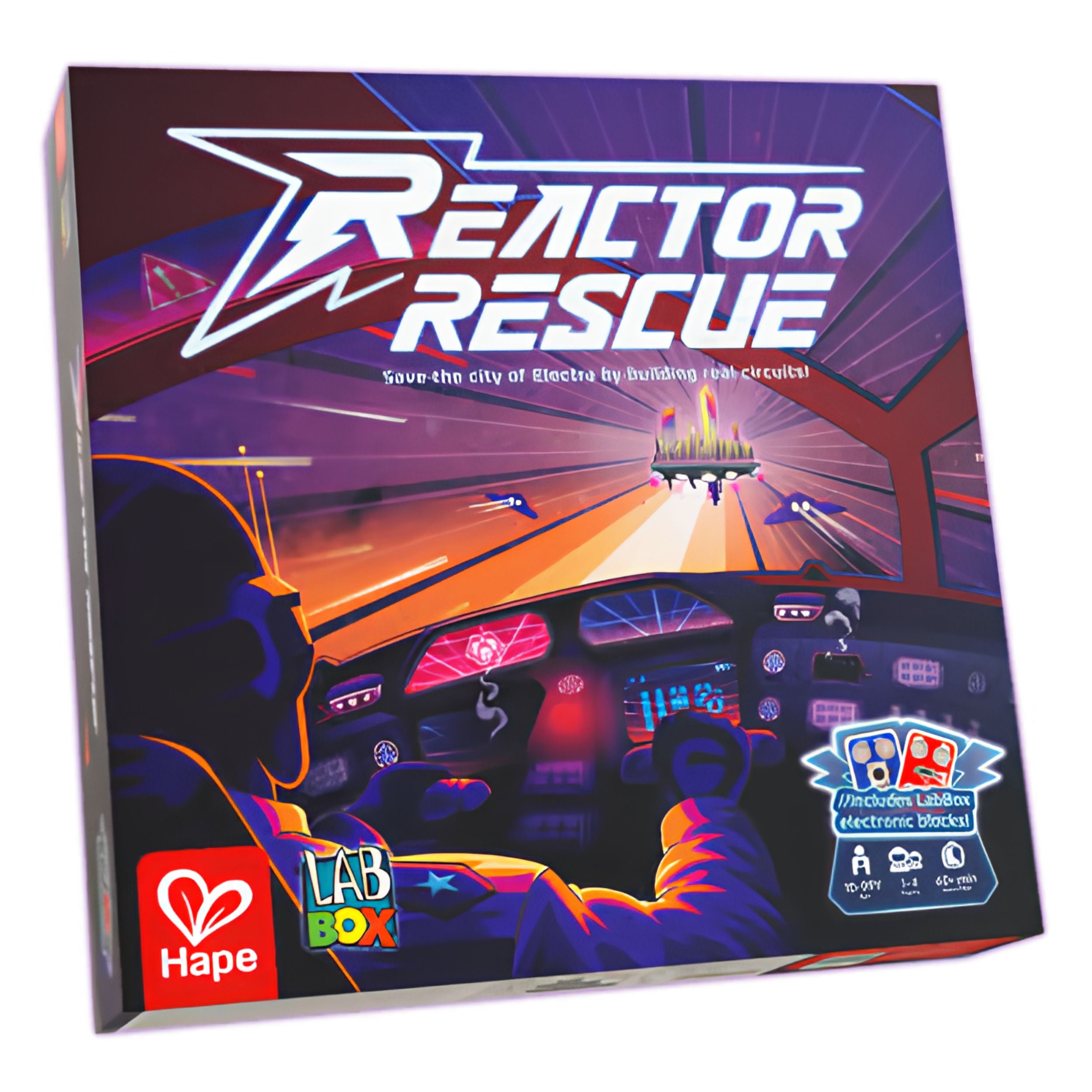
Reactor Rescue
🐸 Dettagli da BoardGameGeek
Consiglio BGG sul numero di giocatori
Categorie
Meccaniche
Design & Art
Lingua
Pre-order - leggi i dettagli
🐸 Una rana saggia sa quando dividere l’ordine… e quando aspettare il salto giusto.
Si abbina bene con
FroGames — Moments You'll Remember
The LED really lights up. The motor really spins. And when the circuit works, someone at the table finally understands how current flows — without realizing they've learned anything.
What it's about
A game where the circuits you build actually work
Reactor Rescue is designed by computer engineer sisters Arta and Fiona Shehu for Labbox Education, in collaboration with Hape, one of the world's largest toy manufacturers. Set in the floating city of Electra, it transforms electronics from a school subject into a tactical challenge: your spaceship has broken down, and you must repair it by wiring real components — motors, lights, sensors, switches.
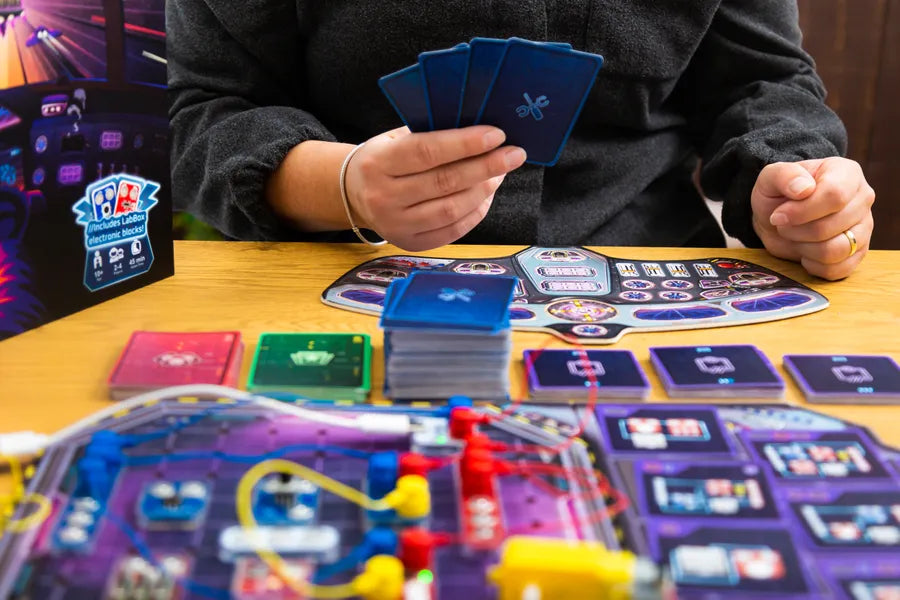
Each turn, you claim a circuit challenge, start a two-minute timer, and build: you connect Labbox electronic blocks with magnetic cables until the LED lights up, the motor spins, or the sensor triggers. Each completed circuit gives you a Repair Token. The first engineer to repair the entire spaceship grabs the unique Reactor Token and wins.
Beneath it all is a real educational system: the blocks signal errors with light indicators (reversed polarity, short circuit) and are internally protected, so making mistakes won't break anything. With 138 challenges across three levels and two game modes, you build series and parallel circuits just like an engineer would — by trying, failing, and trying again.
The first board game where losing means the LED really didn't light up.
The secret of Reactor Rescue in one line
When the motor spins on the table, electronics stop being theory and become a spectacle. And no one feels like they're studying.
From the game experience

Reactor Rescue
The basic rules support a single player. In solo play, it becomes a race against time and resources to complete all circuits: it loses the element of competition against opponents, but the satisfaction of making each circuit work remains intact.
FrogScore · FroGames editorial rating · based on rules, official content, and play sessionsYour components
What you put in your circuit
Lights and LEDs
The simplest circuits light up a real light. Polarity matters: if you reverse it, the block indicator signals it, and you immediately know where to correct.
Switches and dimmers
Open and close the current flow, adjust the intensity. Intermediate circuits require you to control when and how much energy passes.
Motors and sensors
Advanced circuits include motors that physically spin and sensors that react. This is where the table stops to watch.
Magnetic snap-on cables
No soldering, no breadboards. You connect Labbox blocks with magnetic cables that snap on in an instant and reconfigure just as quickly.
In a couple of hours, you'll have repaired a spaceship. And finally understood how a series circuit works.
📦Components8 types · over 360 pieces
Come si gioca
Video dimostrativo di gameplay.
A game in five moments
What happens at the table
Not the rules. The experience.
The spacecraft break down
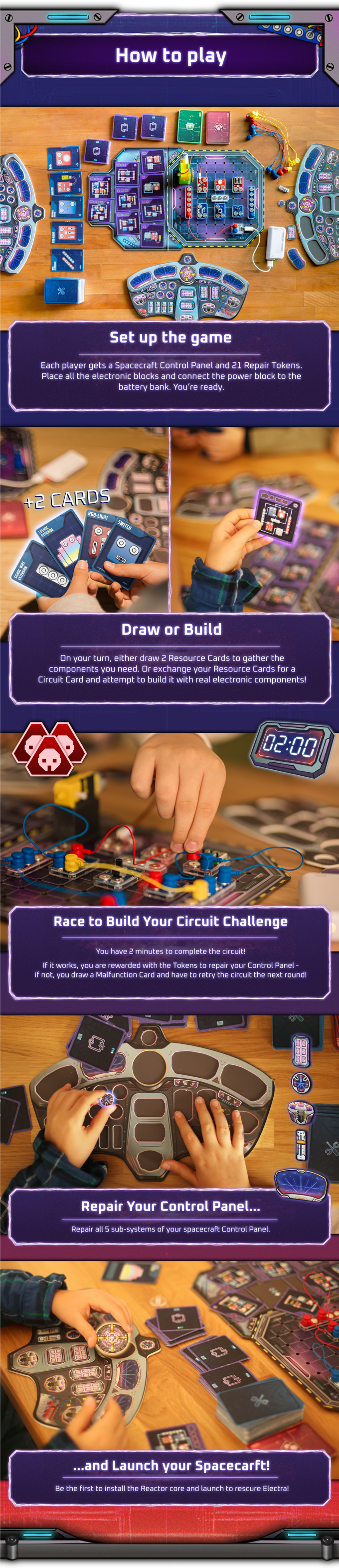
Everyone receives their own spacecraft panel, full of systems to repair, and the first resource cards. On the table are electronic blocks and magnetic wires. Someone immediately asks: "Are these real?" Yes, they are. The race to save Electra begins.
You claim the first challenge, the timer starts
Two minutes on the clock. Connect the Labbox blocks, hook up light and power, close the circuit. The light turns on. The table applauds. The neighbor reverses the polarity: the block indicator flashes and tells them exactly what they did wrong.
Scarcity bites
Resource cards are scarce. Someone blocks a component everyone needs. An Event card flips the turn, and whoever messes up a circuit takes a Malfunction card. Those who planned ahead progress, those who improvise fall behind.
The motor spins
Someone completes an advanced circuit with a motor and sensor. The motor actually spins on the table. The others watch in disbelief. It's the legendary moment of the game: electronics stops being theory and becomes physical spectacle.
The last repair and the Reactor Token
Two players head-to-head, one circuit to victory. One draws the right card, places the components, tests before time runs out. It works. The spacecraft is repaired, grabs the single Reactor Token, and wins. The others admit: "Okay, I learned something tonight."
How to play
The flow of each turn
Simple rules to learn, with the real challenge in your hands: collect, build, test. And repeat.
On your turn, you either draw two resource cards, or claim a circuit challenge if you already have the right components to tackle it.
Start the two minutes. Connect the Labbox blocks with magnetic wires following the diagram on the card. No soldering: everything snaps together.
Close the circuit before time runs out: the light turns on, the motor spins, the sensor triggers. Indicators show reversed polarity or short circuits.
A successful circuit gives you Repair Tokens for the spacecraft. Events help, failures lead to Malfunctions. The first to repair everything grabs the Reactor Token.
Why it's different from others
Six mechanics that make a difference
Working electronic circuits
Not cards representing circuits. Real circuits that you physically build and test: lights turn on, motors spin, sensors trigger. If you make a wrong connection, the circuit doesn't work, and you have to fix it.
Safe and error-proof Labbox blocks
A system used in homes and schools in over 20 countries. The blocks are internally protected — errors don't damage them — and the light indicators immediately tell you what went wrong.
The two-minute timer
Each circuit is a race against time. Two minutes to wire and close before the clock runs out: this is where the tension builds and the table holds its breath.
138 challenges across three levels, two modes
From Learning Mode to Circuit Specialist Mode. 138 challenge cards across three difficulty levels: you grow with the game instead of exhausting it, and adapt the game to your table.
Series and parallel circuits
Not a simplified imitation: during the game, you build real series and parallel circuits, exactly as they are studied in school. The process is the true engineering one.
Events and malfunctions
Some circuit cards activate Events that give you an advantage; failed circuits lead to Malfunctions that add obstacles. Surprises keep the outcome always uncertain.
How it ends
How to win and how to fall behind
It's a race: the first engineer to completely repair their spacecraft takes the single Reactor Token and ends the game.
Victory
- Complete all circuits required by your spacecraft panel
- Test each circuit and physically verify that it works (light on, motor running, sensor active)
- Grab the single Reactor Token and be the first to return to the city of Electra
Fall behind
- Another engineer completes all repairs before you
- You build a wrong circuit and a Malfunction card penalizes you
- You lack the right component cards and can't get them in time
Reactor Rescue is the rare game where winning means truly understanding how a circuit works. And the satisfaction is doubled.
Frequently Asked Questions
FAQ about Reactor Rescue
Is it a real game or an educational kit in disguise?
It's a fully competitive game: management of scarce resources, drafting, events, malfunctions, and a race to the Reactor Token. The educational part comes as a consequence — you play to win, not to study. After a few games, you realize you've learned how a circuit works, but at the moment, you're just trying to beat the others.
Do you need to know electronics to have fun?
No. The challenge cards show exactly where to place each component, and the Labbox blocks connect with magnetic wires, no soldering. When you make a mistake, the light indicators tell you where to intervene. The game teaches basic concepts (polarity, open and closed circuits, series and parallel) as you play: from the very first game, you already know enough to have fun.
Do you need batteries or anything else to make the circuits work?
Power is managed by a dedicated block of the Labbox system, at low voltage and designed to be safe. Components are certified for use from age 10 and up. We recommend checking the packaging to see if batteries are included or need to be added: the electronic blocks in this line typically run on batteries, to be inserted into the power block before the first game.
Are the electronic components safe for children?
Yes. Labbox blocks operate at low voltage, and each block has internal electronic protections: connection errors do not damage the components, they only signal them. Production is entrusted to Hape, with certified materials according to international toy standards. Adult supervision is still recommended with younger children.
Can it be played solo?
Yes, 1-player mode is supported. In solo play, you compete against a turn and resource limit, trying to complete all repairs: the element of racing against opponents is lost, but the challenge of building working circuits remains intact. FroGames solo rating: 3/5.
Is it available in Italian?
The physical edition for sale is in English. The text on the cards is limited (names of universal components like LED, motor, sensor) and the diagrams are visual, so a basic knowledge of English is sufficient. The publishers also plan to provide digital rulebooks in multiple languages, including Italian, downloadable from their website.
Reactor Rescue is a competitive and educational STEM board game for 1–4 players (ages 10+, duration 45–120 min). Designed by sisters and computer engineers Arta and Fiona Shehu for Labbox Education, in collaboration with Hape. Main mechanic: engine-building and resource management with physical construction of real electronic circuits using modular magnetic Labbox blocks. Players collect component cards (lights, switches, dimmers, motors, sensors), start a two-minute timer, and build series and parallel circuits to repair their spacecraft and save the city of Electra. Reactor Rescue includes 138 circuit challenge cards across three difficulty levels and two game modes, with Event and Malfunction cards that keep every game unpredictable. Solo mode supported. English edition. Available on FroGames.it.
Frequently Asked Questions
The answers you're looking for, no beating around the bush.
📸Do the images match the actual product?
The photos on the website often come from BoardGameGeek and are intended to give you an idea of the game. They may vary slightly from the version you receive. The content declared by the publisher is always binding.
📦Does the content of the box match what is indicated?
We always strive to provide the correct content, but minor variations are possible due to reprints or updates. The information comes directly from the publishers. If you have any questions, please contact us!
⏳How do pre-orders work?
Pre-order the game before release, payment is immediate, and the game is reserved for you. As soon as it arrives, we'll ship it right away! If there are any delays, we'll update you promptly.
🔒Can I trust buying here?
Absolutely! Secure payments, tracked shipments, and a team that loves board games as much as you do. If something goes wrong, we'll do our best to fix it.
🛠There's a problem with my order, what should I do?
Write to us now! Whether it's a missing part, damage, or an error, we'll help you resolve it as soon as possible. Your experience truly matters to us.