
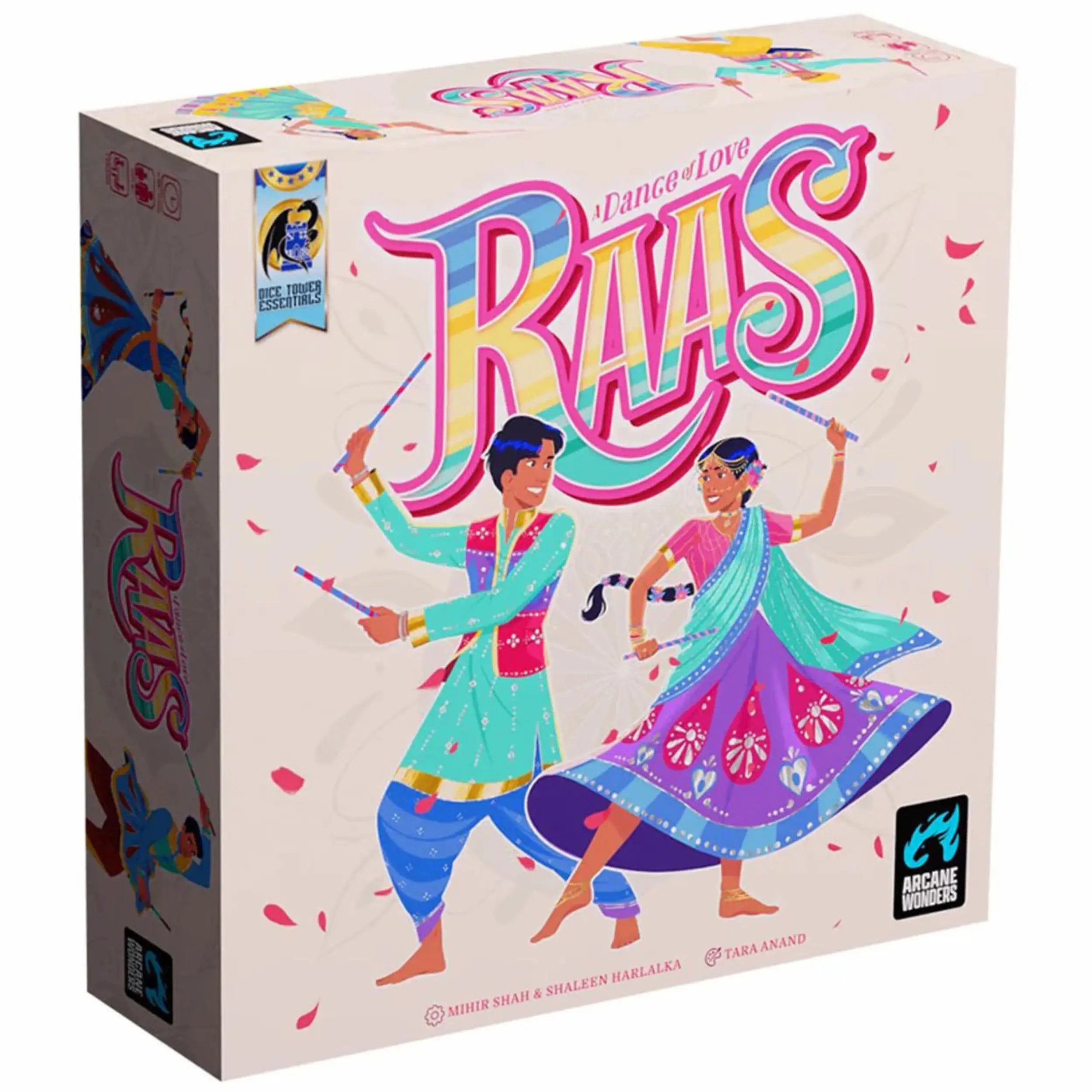


Raas - A Dance of Love
🐸 Dettagli da BoardGameGeek
Consiglio BGG sul numero di giocatori
Categorie
Meccaniche
Design & Art
Lingua
Pre-order - leggi i dettagli
🐸 Una rana saggia sa quando dividere l’ordine… e quando aspettare il salto giusto.
Si abbina bene con
FroGames — Moments You'll Remember
There's always that moment when all the dice seem perfect, the colors match, the music speeds up. And then someone steals the dancer you needed.
WHAT IT'S ABOUT
A dance of colors, rhythms, and strategies from the heart of Gujarat
Raas: A Dance of Love brings the tradition of Garba Raas, a folk dance from the Indian state of Gujarat, to the table. Designed by Mihir Shah and Shaleen Harlalka, with vibrant illustrations by Tara Anand, the game immerses players in the life of a dance academy. Garba Raas celebrates color, rhythm, devotion: each dancer brings a unique style, each performance is a harmony of tempo and costumes.
At the table, you manage your academy by recruiting dancers (represented by colored dice), equipping them with traditional garments and dandiya sticks, and orchestrating performances that respect the round's song tempo. The board is a geared mechanism with seven interconnected disks: every move influences others' possibilities. You must balance set collection, color and value matching, progression on a love track (matchmaking between dancers), and devotion goals. The player who builds the most versatile and harmonious dance company wins.
What the international critics say
Raas transforms dice drafting into choreography: every choice is rhythm, every color is emotion.
— FroGames
An optimization puzzle that smells of celebration, spices, and tradition. Mechanically brilliant.
— FroGames

Raas: A Dance of Love
The game includes an official solo mode with dedicated objectives and an automated opponent who competes with you for dancers and goals. The experience is complete and tactical, only lacking the unpredictability of human opponents who move the disks in surprising ways.
FrogScore · FroGames editorial rating · based on rules, international reviews and play sessionsThe elements of your academy
Dice, garments, sticks, and rhythms: what you manage
Dancers (colored dice)
Each die is a dancer with a color (style) and a value (tempo). You recruit them from the seven disks on the central board. Colors and values determine performance and combos.
Traditional garments
You equip your dancers with costumes that multiply points. Each garment has specific color requirements: matching them well means optimizing for the end of the game.
Dandiya sticks
The sticks complete the dancers' equipment and unlock extra actions. They are limited resources: use them at key moments for powerful move chains.
Round's song
Each round has a song with a specific tempo. If your dancers match the tempo, you earn immediate points. Ignoring the music costs dearly at the end of the game.
At the end of the game, the dice are a dance company. And you know exactly which third-round choice made you win (or lose).
Come si gioca
Video dimostrativo di gameplay.
A game in five moments
What happens at the table
Not the rules. The experience.
Discs spin, colors emerge
The central board shows seven discs full of colored dice. Everyone studies the patterns: some want red, some aim for 5, some look for matchmaking to climb the love track. The first move always influences the entire round.
Someone steals the die you needed
You take a dancer from disc 3, the discs rotate, and suddenly the perfect die you had spotted is on the other side of the board. You redraw the plan in real-time, looking for combo B instead of A. The puzzle reassembles itself every turn.
The round's song tightens
The song calls for tempo 4. You have a blue 4 and a yellow 4: guaranteed points. But if you take that red 6, you complete a color set and unlock an outfit. You decide whether to follow the rhythm or build for the future. Those who ignore the music too much pay at the end of the game.
The love track explodes
You manage to match two dancers: you climb the love track and unlock a powerful bonus (extra die, immediate resource, final points). Others watch you, calculating if they can reach you. The secondary race becomes primary.
The final performance
You count the points: completed performances, devotion goals, equipped outfits and sticks, variety of styles. Someone ignored the outfits and loses 15 points. Someone else played it safe and wins by consistency and balance. The final dance reveals who orchestrated it best.
How to play
The flow of each round
Each round is a four-step dance: reveal the song, draft dancers, perform actions, update the board.
A song card is drawn, indicating the tempo of the round (e.g., '4'). Players who have dancers with that value will earn extra points at the end of the turn.
In turn, each player takes a die from one of the seven discs. After each pick, the gear mechanism rotates the discs: what you see now won't be there on the next rotation.
You place the die in your tableau, activate special abilities, equip outfits or sticks, advance on the love track if you make a match. Each die triggers a chain of micro-decisions.
At the end of the round, you score points for performances that match the song, for completed devotion goals, for color sets. Then it starts again: a new song, refilled discs, a new dance.
Why it's different from others
Six mechanics that make a difference
Gear board
Seven interconnected discs move every time someone drafts. You don't plan on a fixed state: the board lives and transforms with every move. It's the mechanical version of a rondel, but three-dimensional and unpredictable.
Dice as asymmetric resources
Each die has a color (dance style) and a value (tempo). They are not just randomizers: they are combinable resources. Red-4 and Blue-4 do different things than Red-6 and Red-4. The draft becomes a pattern matching puzzle.
Love track and matchmaking
If you place two dancers who 'fit' well together (complementary colors or values), you climb the love track and unlock progressive bonuses. It's a race within a race: those who ignore matchmaking lose free engine building.
Variable songs every round
Each round, a new song dictates the favored tempo. Those who adapt gain immediate points; those who build for the long term sacrifice the present. Constant tension between tactics and strategy.
End-game equipment
Outfits and sticks don't give points immediately: they multiply the final value of the dancers. Investing early costs resources, but pays off big at the end. Those who ignore them find they've lost 20 points in the final tally.
Modular devotion goals
Each game has different public goals (e.g., 'collect 3 yellow dancers', 'equip 5 outfits'). These are easy points if you see them in time, unattainable if you ignore them. The variable setup changes priorities every time.
How it ends
How to win and how to lose
The game ends after a fixed number of rounds (varies with the number of players). The winner is the player with the most points from the sum of performances, objectives, equipment, and variety of styles.
Victory
- You complete many performances that match the songs (immediate points each round)
- You achieve public and private devotion goals
- You equip outfits and sticks that multiply the final points of your dancers
- You build a versatile company: variety of styles and tempos earns bonuses at the end of the game
Defeat (or missed victory)
- You ignore songs for too many rounds: you lose immediate points and final bonuses
- You don't invest in outfits/sticks: your dancers are worth half at the end of the game
- You specialize too much in one color or value: you lose variety bonuses
- You don't climb the love track: others unlock extra resources, and you fall behind
Raas is pure strategy beneath a layer of color and tradition. Every die is a promise, every spinning disc is a challenge. And at the end of the dance, the one who best orchestrated rhythm, style, and heart wins.
Frequently Asked Questions
FAQ about Raas: A Dance of Love
Is it a game for experts or also accessible to beginners?
The rules are approachable (weight 2.5/5 on BGG), but optimization requires experience. It's perfect as a next step after Splendor or Azul: same DNA of drafting and combos, but with additional strategic layers (gears, love track, objectives). The first game teaches you the flow, from the second onwards you see the hidden chains.
Is the gear mechanism really an advantage or just for show?
It is functional, not just aesthetic. Each die drawn rotates the discs: what you plan for your turn might disappear before your next turn comes around. It adds tactical unpredictability without being chaotic. It's more controllable than a random draft (you see everything), but less static than a fixed market.
Does it scale well from 1 to 6 players, or are there ideal numbers?
The game supports 1-6 players, but 2-4 players is ideal. With 5-6 players, downtime increases, and the board changes too much between your turns (less control). The solo mode is solid thanks to dedicated objectives and the automa. With 2-3 players, you have maximum control over the discs and timing battles.
How long does a game actually last?
The box states 30-90 minutes: realistically, 60 minutes for 3 experienced players, 90 minutes for 5-6 or with new players. The flow is fast (draft, place, end turn), but the variable setup and final scoring require attention. It's not a filler, but not a heavy 2-hour euro either.
Is it available in Italian?
No, the edition for sale is in English. The game has medium language dependence: song cards have clear symbols, but outfits, sticks, and objectives have text. Basic English knowledge or a translated reference (which the community usually produces quickly) is required.
Raas: A Dance of Love is a dice-drafting and tableau-building board game for 1-6 players, lasting 30-90 minutes, recommended for ages 14+. Designed by Mihir Shah and Shaleen Harlalka, published by Arcane Wonders, it brings the tradition of Gujarat's Garba Raas to the table through a unique gear mechanism: seven interconnected discs that rotate every time you draft a dancer-die. Manage your dance academy by equipping outfits and sticks, climbing the love track through matchmaking between dancers, and completing performances that match the songs of each round. Set collection, area majority on styles, modular objectives, and variable setup ensure high replayability. Available on FroGames.it.
Frequently Asked Questions
The answers you're looking for, no beating around the bush.
📸Do the images match the actual product?
The photos on the website often come from BoardGameGeek and are intended to give you an idea of the game. They may vary slightly from the version you receive. The content declared by the publisher is always binding.
📦Does the content of the box match what is indicated?
We always strive to provide the correct content, but minor variations are possible due to reprints or updates. The information comes directly from the publishers. If you have any questions, please contact us!
⏳How do pre-orders work?
Pre-order the game before release, payment is immediate, and the game is reserved for you. As soon as it arrives, we'll ship it right away! If there are any delays, we'll update you promptly.
🔒Can I trust buying here?
Absolutely! Secure payments, tracked shipments, and a team that loves board games as much as you do. If something goes wrong, we'll do our best to fix it.
🛠There's a problem with my order, what should I do?
Write to us now! Whether it's a missing part, damage, or an error, we'll help you resolve it as soon as possible. Your experience truly matters to us.