
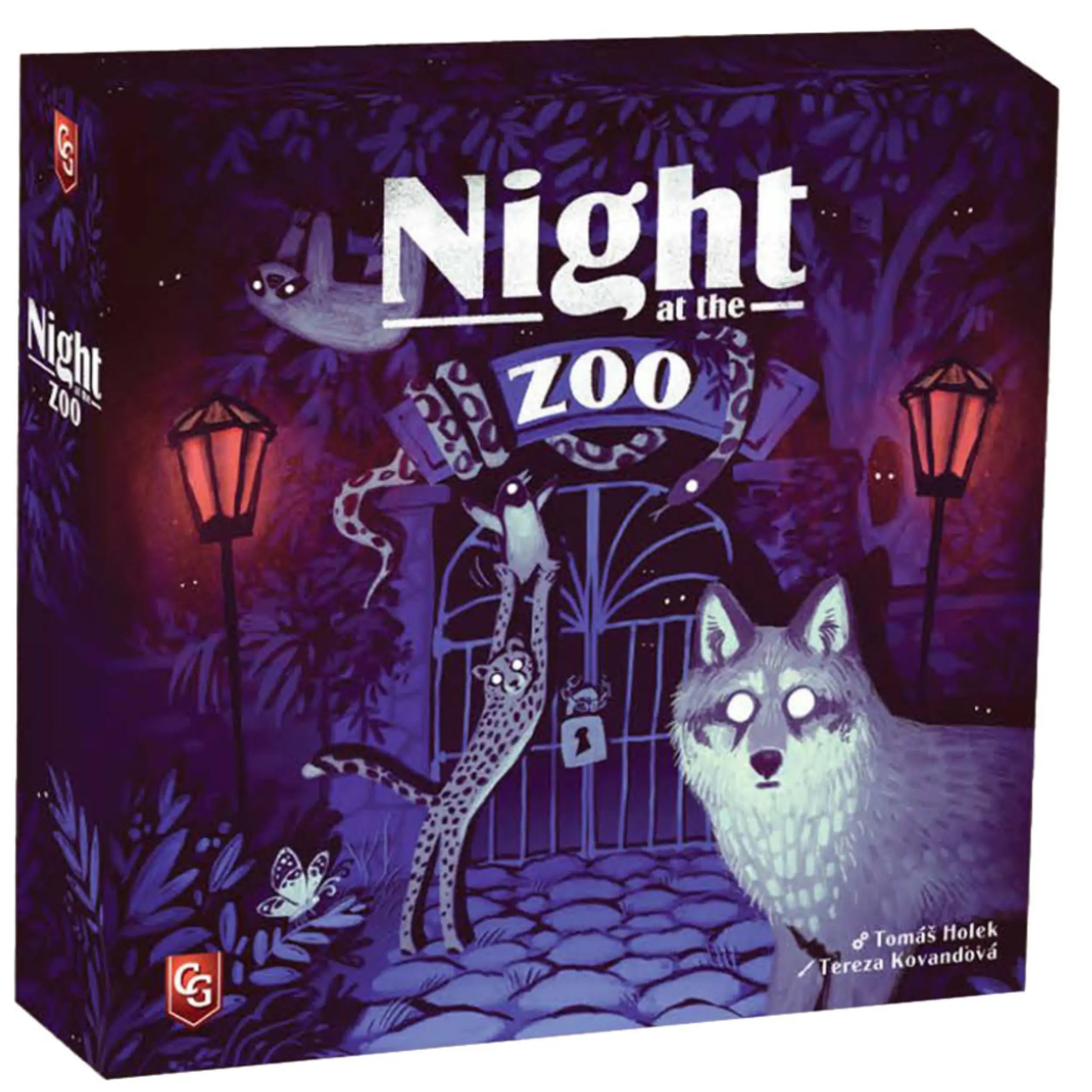
Night at the Zoo
🐸 Dettagli da BoardGameGeek
Consiglio BGG sul numero di giocatori
Categorie
Meccaniche
Design & Art
Lingua
Pre-order - leggi i dettagli
🐸 Una rana saggia sa quando dividere l’ordine… e quando aspettare il salto giusto.
Si abbina bene con
FroGames — Moments You'll Remember
The cheetah pushes the penguin past the gate, the wolf runs in confusion, the sloth stands guard from the tree. By the end of the evening, you will have built impossible paths and smiled at least three times.
WHAT IT'S ABOUT
When the zoo animals decide to take a night stroll
Tomáš Holek (designer of space studies and logic puzzles) signs this tile placement game where animals have escaped the zoo and now must return home before dawn. Tereza Kovandová brings it all into a world of nocturnal colors and complicit atmospheres, where each animal has its own visual personality.
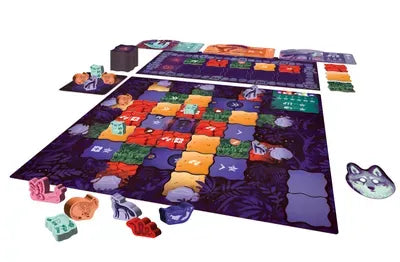
At the table, you draw tiles, place them on your personal board, and build paths that respect the unique movement of each animal. The cheetah jumps, the penguin slides, the sloth proceeds very slowly. Each tile activates special actions, and each completed path earns points. You optimize spaces, anticipate what you'll draw, and find the most efficient way to bring everyone home.
What they say abroad
A spatial puzzle where each animal is a different puzzle to solve.
— FroGames
Building paths has never been so funny and intricate at the same time.
— FroGames

Night at the Zoo
Official solo mode with dedicated rules. You play against personal objectives and challenge cards that modify the conditions. The experience is complete because the game is already introspective at the table; it only loses the interaction of the draft (replaced by a modified draw).
FrogScore · FroGames editorial rating · based on rules, international reviews, and play sessionsWhat's in the box
The elements that build the paths
Animal boards
Each player has their personal board with spaces for tiles and tracks for assigned animals. Each animal has unique movement rules.
Path tiles
Pieces of the nocturnal zoo to place to build roads, openings, shortcuts. Each tile activates special actions when you place it.
Draft cards
You draw tiles, choose one, pass the rest. The draft is the tactical heart: what you keep, what you leave to others.
Objectives and tokens
Secret conditions to complete, action tokens, score tracks. Each game has different combinations of available objectives.
In half an hour, you will have helped a sloth climb a gate and a penguin slide home. And you will have won or lost by two tiles.
A game in five moments
What happens at the table
Not the rules. The experience.
The nocturnal escape
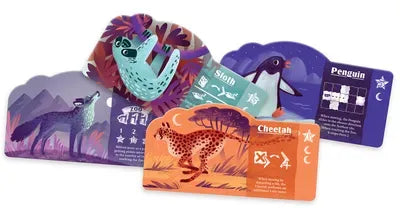
Choose your animals from those available. Each has a unique movement: the cheetah jumps squares, the wolf runs straight, the sloth moves one space. Already here you understand that you will need to think spatially. The board is empty, the possibilities endless.
The first draft
The tiles arrive. You draw some, choose one, pass the rest to your neighbor. You start building paths on your board. Each placed tile activates an action: move an animal, gain tokens, unlock gates. Already here you need to anticipate what will be needed next.
Intertwining paths
Mid-game. The board fills up, paths intertwine. The penguin needs a straight road, the cheetah needs spaces to jump. You optimize every square, trying to activate combos. Other players are doing the same, each with their own animals.
The perfect fit
Draw a tile that closes an impossible path. The sloth reaches its square after five turns of planning. You complete a secret objective. Someone at the table sighs because you took the tile they needed. This is the moment when the puzzle is solved or collapses.
Dawn arrives
Last round. You count points: animals returned home, objectives completed, paths closed. Someone optimized better, someone risked and lost. The player who built the most efficient path wins. But everyone has a story of funny animals and missed tiles.
How to play
The flow of each round
Each round is a cycle of drafting, placing, actions. Simple to teach, intricate to master.
Draw a set of tiles, choose one, pass the rest to the next player. Repeat until everyone has drawn the necessary number.
In turn, everyone places the chosen tiles on their personal board. Each tile goes into a free space and activates a special action.
Activate tile actions: move animals according to their unique rules, gain tokens, unlock bonuses. Each animal follows its own movement pattern.
Check if you have completed secret or public objectives. Score points, prepare for the next round. When the tiles run out or all animals have returned, the game ends.
Why it's different from others
Six mechanics that make a difference
Each animal is a different puzzle
The cheetah jumps squares, the penguin slides in a straight line, the sloth moves one space at a time. You don't build a generic path: you build specific paths for the movement logic of each species. This completely changes the spatial approach.
Draft that mitigates luck
You don't draw randomly: you see the tiles, choose, and pass the rest. You have to anticipate what you need and what others might need. The draft makes the game tactical even with random components.
Personal boards without conflict
Everyone builds on their own board. No one destroys your work, interaction is in the draft. Perfect for those who want strategy without direct confrontation, but with real competition.
Actions integrated into placement
Each placed tile activates an action: move animals, gain tokens, unlock paths. There are no separate phases. You place, resolve, move on. Fast and fluid.
Variable objectives
Each game has different public and secret objectives. This completely changes the strategy: sometimes you want slow animals close, sometimes long paths. Replayability is very high.
Quick setup, fast games
Rules explained in 10 minutes, game played in 30. Perfect as a strategic filler or as the second game of the evening. The box opens and closes in minutes.
How it ends
How to win and how to lose
The game ends when all animals have returned or the tiles are exhausted. The player with the most points wins.
Victory conditions
- Animals returned home: each animal in its final square is worth points
- Objectives completed: public and secret objectives give substantial bonus points
- Optimized paths: some tiles give points if connected in specific ways
Penalties and losses
- Stuck animals: if an animal cannot return home, you lose potential points
- Missed objectives: you focused on an objective and didn't complete it
- Empty spaces: unused or poorly placed tiles reduce efficiency
Night at the Zoo transforms tile placement into a spatial puzzle where each animal is a unique challenge. Thirty minutes that fly by, strategies that change every game.
Frequently Asked Questions
Night at the Zoo FAQ
Is it suitable for those who have never played tile-placement games?
Yes. The rules are immediate: choose a tile, place it, activate the action. The challenge is spatial, not procedural. Perfect as a gateway for the tile-placement genre, but deep enough for those seeking optimization.
Does it work well solo or is multiplayer needed?
It works great solo. The official mode has dedicated objectives and challenge cards. Since the game is already introspective (everyone works on their own board), the solo mode doesn't lose much compared to multiplayer, only the interaction of the draft.
How important is luck in drawing tiles?
The draft greatly mitigates chance. You see more tiles than you keep, choose, and pass the rest. Luck exists (which tiles come out), but you always have tactical choices. It's not a game where a bad draw ruins your match.
Are animal movements difficult to remember?
No. Each animal has an icon on the board that reminds you of its movement. Cheetah jumps, penguin slides straight, sloth moves one space. After the first turn, it's intuitive. The beauty is precisely in playing with these different logics.
Is it available in Italian?
The edition sold on FroGames is in English (Capstone Games). The game has minimal text (rules, objective cards), so it is accessible even with basic English. Animal movements are iconic.
Night at the Zoo is a strategic tile-placement game for 1-4 players, lasting 30 minutes, age 10+. Designed by Tomáš Holek and illustrated by Tereza Kovandová, published by Capstone Games. Each player builds paths to bring runaway animals home before dawn, placing tiles and activating special actions. The pattern movement mechanic makes each animal unique: cheetahs jump, penguins slide, sloths move slowly. The tile draft mitigates luck and adds tactical interaction. Includes an official solo mode with dedicated challenges. High replayability due to variable objectives and ever-changing combinations. Available on FroGames.it.
Night at the Zoo
Frequently Asked Questions
The answers you're looking for, no beating around the bush.
📸Do the images match the actual product?
The photos on the website often come from BoardGameGeek and are intended to give you an idea of the game. They may vary slightly from the version you receive. The content declared by the publisher is always binding.
📦Does the content of the box match what is indicated?
We always strive to provide the correct content, but minor variations are possible due to reprints or updates. The information comes directly from the publishers. If you have any questions, please contact us!
⏳How do pre-orders work?
Pre-order the game before release, payment is immediate, and the game is reserved for you. As soon as it arrives, we'll ship it right away! If there are any delays, we'll update you promptly.
🔒Can I trust buying here?
Absolutely! Secure payments, tracked shipments, and a team that loves board games as much as you do. If something goes wrong, we'll do our best to fix it.
🛠There's a problem with my order, what should I do?
Write to us now! Whether it's a missing part, damage, or an error, we'll help you resolve it as soon as possible. Your experience truly matters to us.