
Defrag
🐸 Dettagli da BoardGameGeek
Consiglio BGG sul numero di giocatori
Categorie
Meccaniche
Design & Art
Lingua

Si abbina bene con

FroGames — Moments You'll Remember
The progress bar that never reaches 100%. The waiting. The ultimate satisfaction. Now it's a game.
What it's about
The most boring '90s ritual turned into a brain-bending puzzle
It's 1995. You have a deadline tomorrow morning and your PC decided to crash tonight. You've tried restarting. You've closed everything. You even tapped on the monitor. Nothing. Only one solution remains: clear your schedule, it's DEFRAG time.
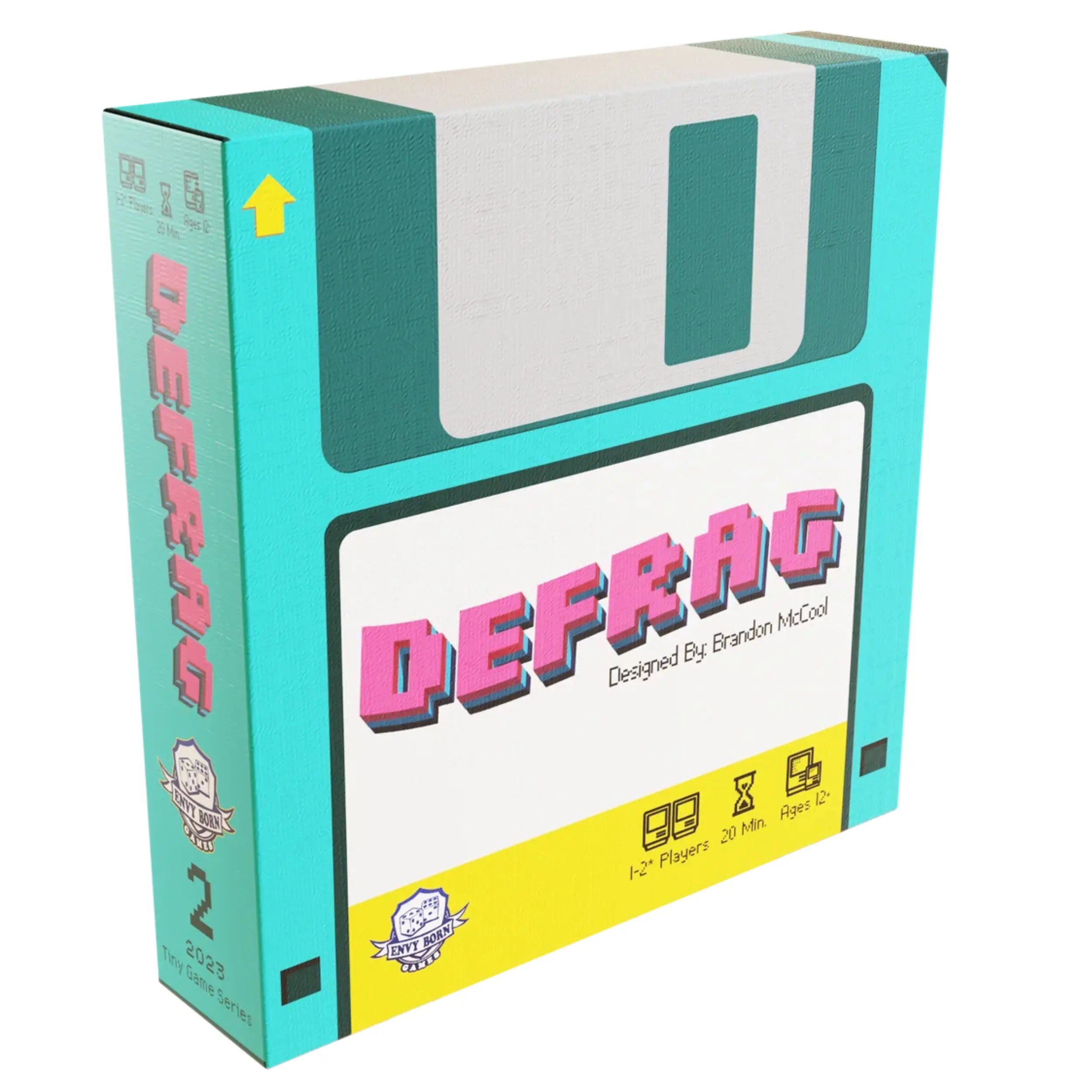
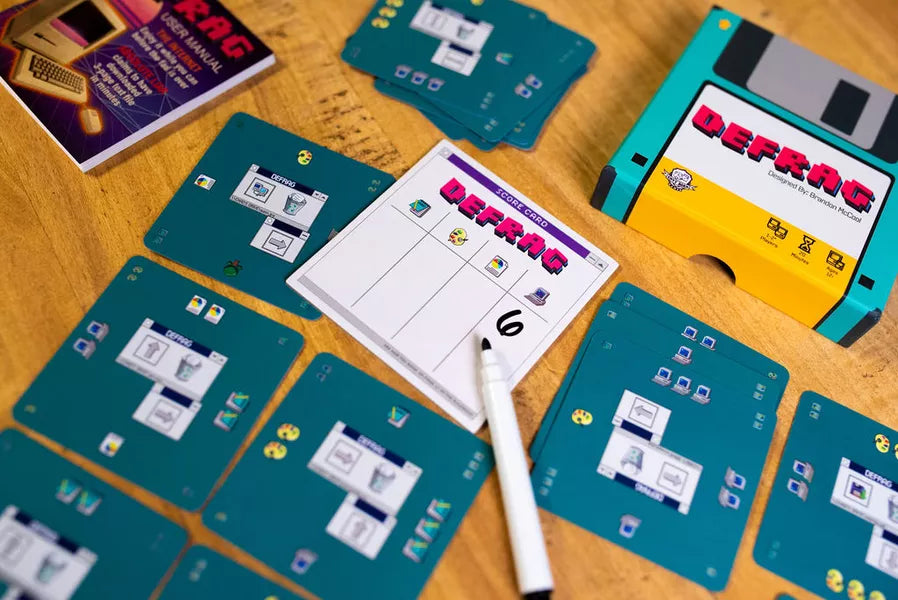
Designed by Brandon McCool and published by Envy Born Games, Defrag is an 18-card grid puzzle where you have to reorganize and consolidate file fragments before running out of resources. Four rounds, four file types, one smoking brain.
A game lasts 20-30 minutes. The scenario booklet offers 40 scenarios — from introductory ones to those that will make you regret opening the box.
From the game experience
A puzzle that seems simple — until you rotate the wrong card and realize you've destroyed three rounds of work in one go.
The secret of Defrag in one sentence
Nostalgia draws you in, the puzzle keeps you. No dice, no luck — just you, the grid, and the question: do I really have to flip this card?
From the game experience

Defrag
Defrag is born as a solo game — the publisher itself states that this is where it truly shines. The 40 scenarios guarantee a difficulty curve that grows with you.
FrogScore · FroGames editorial rating · based on rules, international reviews and game sessionsWhat you're really managing
Four elements, eighteen cards, endless games
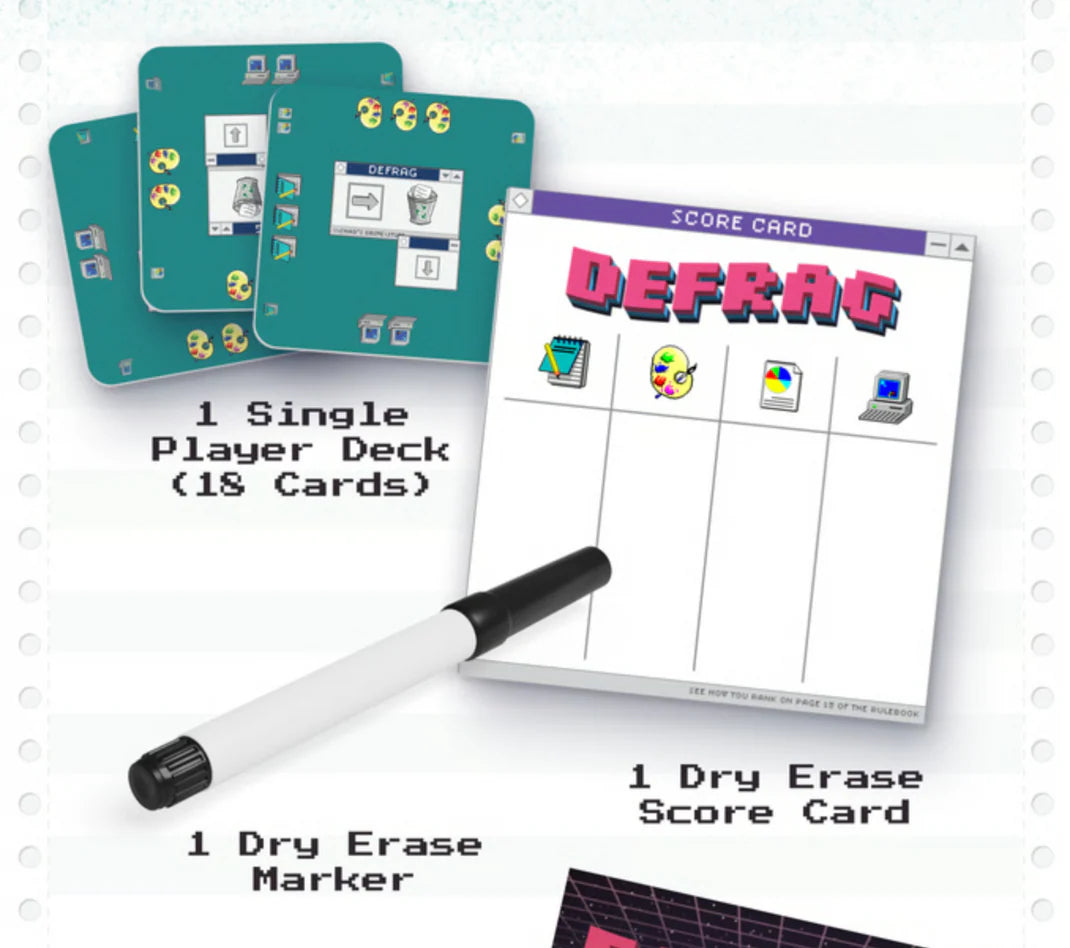
18 double-sided cards
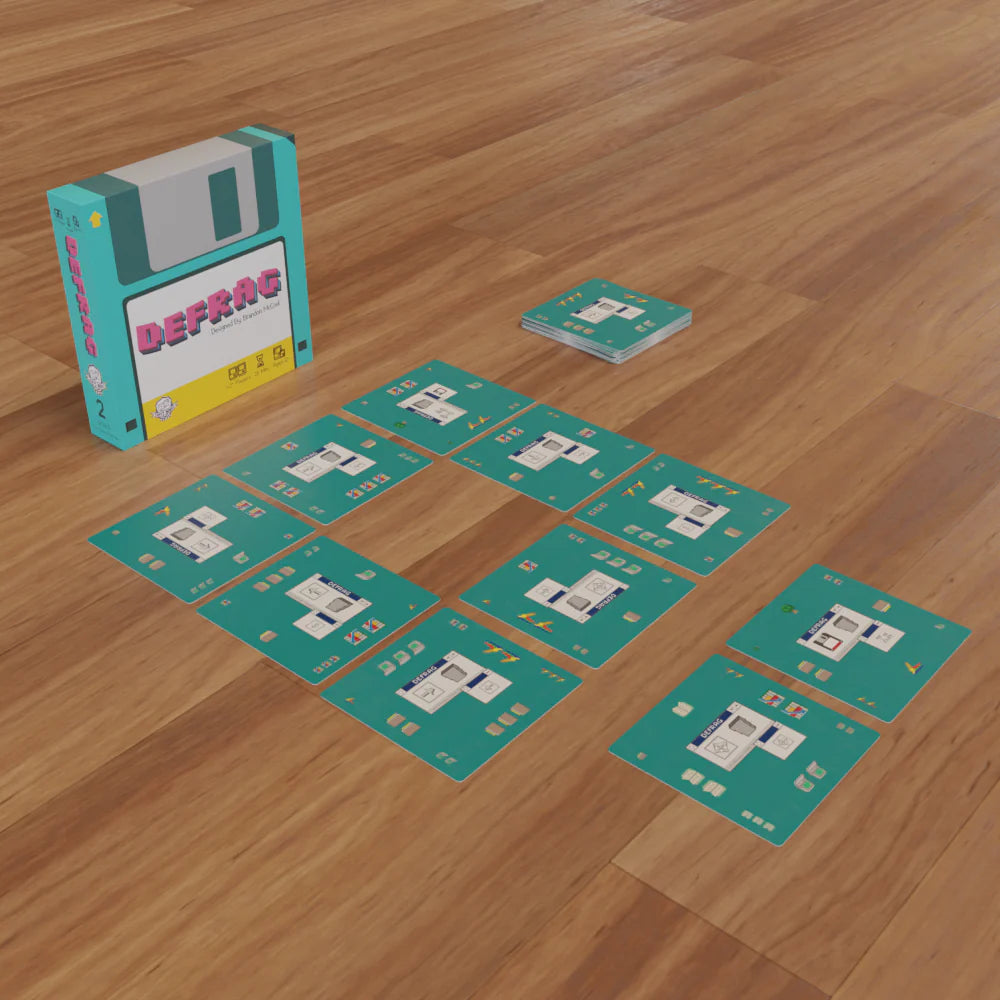
Each card has 8 orientations and two sides. The 3x3 grid is your hard drive — you're the defrag utility that needs to fix everything.
4 file types
Notepad, Paint, Graph, System. Each round you defragment one type: you have to stack identical blocks before resources run out.
Chain actions
Rotate, move, recycle. Actions on cards can trigger chain combos — when you succeed, you can almost feel the progress bar going up.
40 progressive scenarios
From tutorial to total system meltdown. The scenario booklet ensures that each session is a different problem to solve.
Not all memorable games last three hours. Sometimes twenty minutes, a grid of cards, and the feeling of having finally fixed everything are enough.
🃏
Recommended sleeves1 size · 18 total cards
📖
RulebookEnglish · Official PDF
Come si gioca
Video dimostrativo di gameplay.
A game in five moments
What happens at the table
Not the rules. The experience.
Setup is fast. Too fast.
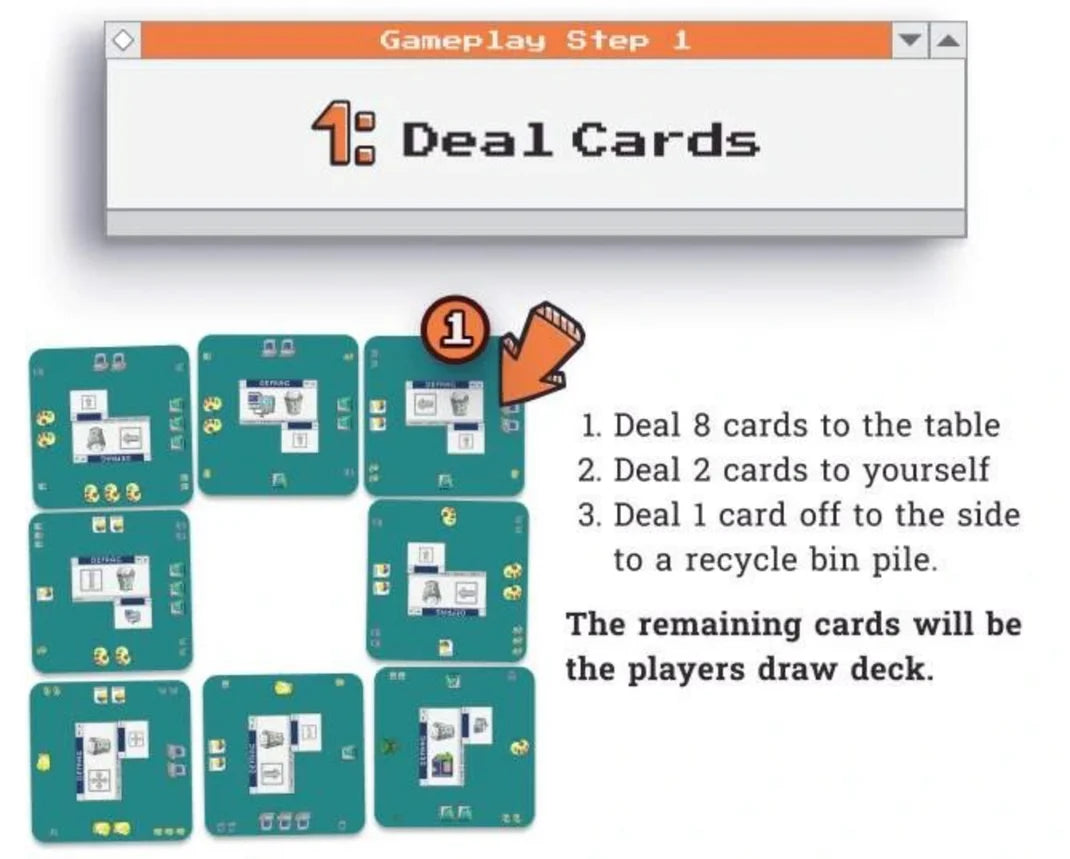
You shuffle the 18 cards, arrange them in a 3x3 grid, leave the center empty. You hold two cards in your hand, one in the discard pile. It takes a minute. You look at the grid and think: it looks simple. That's a mistake you'll only make the first three times.
The first round goes well. Too well.
Notepad — you have to stack text blocks. Cards rotate, move, actions chain together. You set up three stacks, the goal seems achievable. You mark the score and you're satisfied. Then you see the grid you left behind.
The second round changes everything.
Paint. The cards you need are buried under the ones you just arranged for Notepad. You realize that each round is a legacy of the previous one — you can't just play for now, you have to think about later. You really start to understand the game.
The chain you didn't expect.
You play a card, it triggers an action, that card rotates another, which allows a move, which frees up the right slot. Three cascading moves that push the progress bar up by 20% in one go. You cheer by yourself. It's normal. It's Defrag.
End of game. You look at the score.
The last round is over. You count the stacks, add the bonuses. The score is there — and you already know where you went wrong in round two. You put the cards back in thirty seconds. You'd play the next game differently. And you already want to try it.
How to play
The flow of each round
Four rounds, four types of files to defrag. You learn in five minutes, master in one session.
Each round has an active file: Notepad, Paint, Graph or System. That icon is the one you need to stack — the others count for zero for that round.
Place a card from your hand into the grid. If the symbols match an adjacent card, you can rotate it — this unlocks the indicated actions.
Move, rotate, recycle. Actions can trigger chains — one move can move multiple cards in sequence if conditions align.
Count the active icons in the stacks. The round ends when you run out of resources. Then you move on to the next file — with the grid you left behind.
Why it's different from others
Six mechanics that make a difference
The grid as a hard drive
Each card is a data block. Position matters, orientation matters, side matters. No other box of your size has this density of decisions.
Chain reactions
One move can trigger another, which triggers yet another. When you discover your first chain combo, you understand why the game quickly becomes addictive.
Zero luck, all strategy
No dice, no randomly drawn cards during the round. You win or lose by your choices — and this means that every game can always be improved.
Multi-round planning
The grid you leave after round 2 is the one you play round 3 with. Every decision is a compromise between now and later — exactly like real defrag.
40 scenarios with different objectives
The scenario booklet turns Defrag into a campaign. Alternative setups, special objectives, bizarre restrictions. The difficulty curve grows with you.
Tiny game to take anywhere
Fits in a pocket, weighs less than 150g, sets up in one minute. Works on a train table, a cafe table, an office desk at 1:00 PM.
How it ends
How to win, how to lose
There's no elimination, no opponent to beat you. There's only the final score — and the realization of where you could have done better.
Defrag completed
- You maximized the stacks in all four rounds
- You planned the grid thinking about subsequent rounds
- You exploited at least one chain reaction
System still fragmented
- Resources ran out sooner than expected
- You optimized one round, ruining the next
- The score is low — but you already know what to do differently
Defrag is one of the most thematic and successful tiny puzzle games. Eighteen cards that make every game feel like a problem to solve — not a game to play.
Frequently asked questions
Defrag FAQ
Is a game with 18 cards worth buying?
Yes — if you're looking for a thematic brain puzzle with high replayability. Defrag isn't just any filler: the 18 cards generate a depth of choice that many board games with 200 components don't achieve. The 40 scenarios in the booklet guarantee hours of progressive challenges.
Is it really only suitable for solo play?
The game was designed with solo play as the primary experience. There is a two-player mode, but it requires an additional deck and the experience is less satisfying than single-player. If you're looking for something to play with a group, Defrag is not the right choice.
How difficult is it to learn?
The rulebook can be read in ten minutes and the first game flows quite naturally. The real difficulty comes when you understand that each round influences the next — that's where the real game begins. The scenario booklet guides growth with a well-calibrated curve.
How many different games can be played?
The 40 scenario challenges have different setups, objectives, and restrictions. In addition to free play, there's the desire to beat your own score — Defrag has a score-attack mechanism that encourages replaying even without new scenarios.
Is it necessary to know about PC defrag to appreciate it?
No — the theme is evocative but doesn't require technical knowledge. Those who lived through the 90s with Windows 95 will find nostalgia an added value; for those who haven't, it remains an excellent puzzle with very successful pixel-art graphics.
Is it available in Italian?
This is the English edition. The text on the cards is minimal and the concepts are visual — the language barrier is very low. The rulebook is in English, but it's short and well-illustrated.
Defrag is a solo puzzle board game for 1-2 players (ages 12+, duration 20-30 min). Designed by Brandon McCool, artwork by Jason Boles, published by Envy Born Games in 2024. Main mechanic: hand management, grid puzzle, set collection. The player manages 18 double-sided cards in a 3x3 grid to consolidate file fragments in four rounds. Includes scenario booklet with 40 progressive challenges. Tiny game, floppy disk format. 90s nostalgia theme, Windows 95. English edition. Available on FroGames.it.
Frequently Asked Questions
The answers you're looking for, no beating around the bush.
📸Do the images match the actual product?
The photos on the website often come from BoardGameGeek and are intended to give you an idea of the game. They may vary slightly from the version you receive. The content declared by the publisher is always binding.
📦Does the content of the box match what is indicated?
We always strive to provide the correct content, but minor variations are possible due to reprints or updates. The information comes directly from the publishers. If you have any questions, please contact us!
⏳How do pre-orders work?
Pre-order the game before release, payment is immediate, and the game is reserved for you. As soon as it arrives, we'll ship it right away! If there are any delays, we'll update you promptly.
🔒Can I trust buying here?
Absolutely! Secure payments, tracked shipments, and a team that loves board games as much as you do. If something goes wrong, we'll do our best to fix it.
🛠There's a problem with my order, what should I do?
Write to us now! Whether it's a missing part, damage, or an error, we'll help you resolve it as soon as possible. Your experience truly matters to us.