

Epochs - Course of Cultures – Middle East and Latin America Expansion
🐸 Dettagli da BoardGameGeek
Consiglio BGG sul numero di giocatori
Categorie
Meccaniche
Design & Art
Lingua
Pre-order - leggi i dettagli
🐸 Una rana saggia sa quando dividere l’ordine… e quando aspettare il salto giusto.
Pairs well with
FroGames — Moments You'll Remember
Every civilization is a different promise. Every map changes priorities. And when Babylon is placed next to Maya, someone starts to redraw their strategy from scratch.
WHAT IT'S ABOUT
Six civilizations that rewrite the map of the ancient world
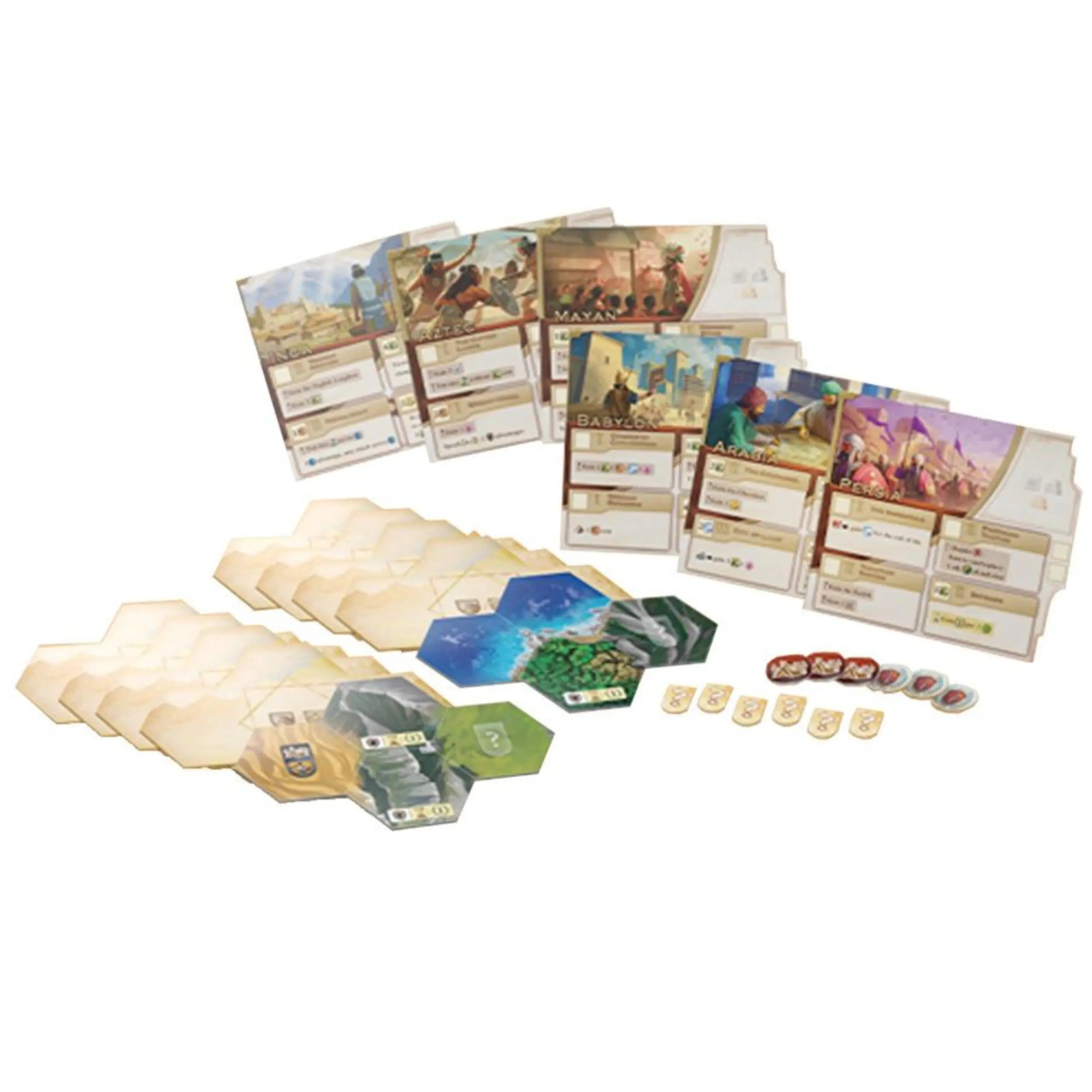
This expansion for Epochs: Course of Cultures brings six new historical civilizations to the table: Babylon, Persia, and Arabia from the Middle East, Maya, Aztecs, and Inca from Latin America. Each with its dedicated board, its asymmetric abilities, its development curve. Along with them come new map tiles and enhanced barbarians that change the dynamics of expansion and conflict.
At the table, this means: more strategic variability, unprecedented combinations between civilizations, scenarios that reward different approaches. Babylon focuses on science and astronomy, the Maya on calendar precision, the Aztecs on military control, the Inca Empire on mountain infrastructures. Each game becomes a crossroads of cultures with different priorities, and the base game transforms into a deeper and more unpredictable system.
What they say abroad
This expansion doesn't just add civilizations. It adds decisions.
— FroGames
Six civilizations mean six different ways to build your era. And none are neutral.
— FroGames

Epochs: Course of Cultures – Middle East and Latin America Expansion
FrogScore · FroGames editorial rating · based on rules, international reviews and game sessionsWhat's in the box
The six civilization boards and new maps
Babylon, Persia, Arabia
Three Middle Eastern civilizations with a focus on science, territorial expansion, and trade control. Each prioritizes a different resource and rewards vertical strategies.
Maya, Aztecs, Inca
Three Latin American civilizations with mechanics linked to territory: calendars, ritual sacrifices, mountain road networks. Strong asymmetry, steep learning curve.
New map tiles
New territories that modify the geographical setup of the base game. Some favor rapid expansion, others penalize those who stretch too far.
Enhanced Barbarians
Stronger and more unpredictable threats that make defense a tactical priority, not just an occasional cost. They change the pace of the early epochs.
By the end of the game, someone will have discovered that Babylon dominates in a way the Mayans cannot replicate. And they'll already be ready to reverse roles.
A game in five moments
What happens at the table
Not the rules. The experience.
Choosing a Civilization
Everyone looks at their board and tries to figure out which resource will become dominant. Some go all-in on Babylon for astronomy, others on the Aztecs for military control. No one knows yet if they've chosen well, but everyone knows the game has already begun.
The first clash with barbarians
Enhanced barbarians are no longer a minor nuisance. They are a threat that forces a choice: defend now or expand and risk it? Someone pays the price, and the map begins to warp.
Asymmetric abilities emerge
Mid-game, the differences between civilizations become evident. The Maya accumulate resources in ways others cannot imitate, the Inca Empire builds roads where others see mountains. Parallel strategies begin to diverge.
The map fills up
The new tiles create unexpected bottlenecks. Someone finds themselves trapped between two aggressive civilizations, someone else discovers a corridor no one had noticed. The table starts to debate whether that move was legal or brilliant.
The final tally
Victory goes to whoever understood their civilization, not whoever played best overall. Persia dominates if you built an empire, Babylon if you invested in science, the Aztecs if you controlled conflicts. And someone discovers they played the wrong civilization for the drawn map.
How to play
Integration with the base game
This expansion does not change the flow of the base game. It adds layers of choice and complexity.
Each player chooses (or draws) one of the six new civilizations and takes the corresponding board. The additional map tiles are shuffled with the base ones to create a unique geography.
During their turn, each civilization has access to unique development paths. Babylon can advance in science faster, the Maya have bonuses on the calendar, the Aztecs gain advantages from military control.
The new barbarian cards increase defensive pressure. They are no longer random events to ignore: they force players to invest resources or suffer penalties that slow down development.
Each civilization accumulates points in different ways. There is no universal dominant strategy: victory goes to whoever best exploited the synergies of their board and adapted to the map.
Why it's different from others
Six elements that make a difference
Authentic historical civilizations
These aren't aesthetic reskins. Each civilization has mechanics that reflect its history: Babylon with astronomy, the Maya with the calendar, the Inca Empire with mountain roads. The theme isn't decorative, it's functional.
True asymmetry
You don't all play the same game with different colors. Each civilization board has unique development paths, privileged resources, and victory conditions that reward different choices. Change civilization, change game.
Maps that matter
The new tiles are not neutral fillers. They create bottlenecks, corridors, conflict zones. Geography becomes a tactical variable, not just a board to place pieces on.
Barbarians that truly threaten
Enhanced barbarians are no longer a minor event to be dealt with by a card. They are constant pressure that forces defensive investments and slows down those who expand too quickly.
Multiplied replayability
Six civilizations, variable map tiles, randomized barbarians. Each setup is a different game, each combination of civilizations at the table creates unprecedented competitive dynamics. You won't exhaust the expansion in three games.
Scalable complexity
You can introduce civilizations one at a time, or all at once. You can play with enhanced barbarians or without, with new maps or just the base ones. The expansion adapts to the level of complexity you want.
How it ends
How to win and how to lose
Victory depends on the civilization you chose and how you exploited its unique abilities.
Victory
- You accumulated more points by developing the resources prioritized by your civilization (science for Babylon, territory for Persia, etc.)
- You defended your borders from barbarians without wasting too many resources, maintaining your expansion pace
- You leveraged the synergies of your civilization board better than your opponents, even with opposing strategies
Defeat
- You chose a civilization that didn't suit the drawn map or the table's composition
- You ignored enhanced barbarians and suffered penalties that slowed you down too much
- You played your civilization as if it were neutral, without utilizing its asymmetric abilities
This expansion doesn't just add content. It adds decisions that matter, civilizations that feel different, maps that change priorities.
Frequently Asked Questions
FAQ on Epochs: Course of Cultures – Middle East and Latin America Expansion
Do I need the base game to play this expansion?
Yes, this is an expansion for Epochs: Course of Cultures. It is not standalone; it requires the base game to function. It adds six civilizations, new maps, and enhanced barbarians, but does not include the core components needed to play.
Are the six civilizations balanced, or are some stronger?
Each civilization is asymmetric by design, not symmetrically balanced. Some dominate on certain maps, others with certain setups. Balance emerges from variability: there isn't one civilization that always wins, but you must adapt to the situation. If you're looking for rigid balancing, this expansion is not designed that way.
Do enhanced barbarians make the game harder?
Yes, they increase defensive pressure and force you to invest resources that were previously optional. They are not impossible to manage, but they change the pace of the game: those who ignore defense pay a higher price. If you prefer more aggressive and less exploratory games, this is a positive change.
Can I use only some civilizations and not all six?
Yes, you can introduce civilizations gradually. You can play with three new and three from the base game, or all six together, or just one at a time to learn the mechanics. The expansion is modular: choose the level of complexity you want.
Is it available in Italian?
The edition sold on FroGames is in English. It includes civilization boards, barbarian cards, and map tiles with English text. Basic knowledge of the language is required to play without slowdowns.
Epochs: Course of Cultures – Middle East and Latin America Expansion is a strategic expansion for 2-4 players that adds six new asymmetric civilizations to the base game: Babylon, Persia, Arabia, Maya, Aztecs, and Inca. Each civilization has a dedicated board with unique abilities, different development paths, and synergies that reward diverse strategies. The expansion also includes new map tiles that alter the game's geography and enhanced barbarians that increase defensive pressure. Published by TLAMA games, this expansion is designed for those seeking asymmetric depth and replayability rather than just additional content. Available on FroGames.it.
Frequently Asked Questions
The answers you're looking for, no beating around the bush.
📸Do the images match the actual product?
The photos on the website often come from BoardGameGeek and are intended to give you an idea of the game. They may vary slightly from the version you receive. The content declared by the publisher is always binding.
📦Does the content of the box match what is indicated?
We always strive to provide the correct content, but minor variations are possible due to reprints or updates. The information comes directly from the publishers. If you have any questions, please contact us!
⏳How do pre-orders work?
Pre-order the game before release, payment is immediate, and the game is reserved for you. As soon as it arrives, we'll ship it right away! If there are any delays, we'll update you promptly.
🔒Can I trust buying here?
Absolutely! Secure payments, tracked shipments, and a team that loves board games as much as you do. If something goes wrong, we'll do our best to fix it.
🛠There's a problem with my order, what should I do?
Write to us now! Whether it's a missing part, damage, or an error, we'll help you resolve it as soon as possible. Your experience truly matters to us.