

Gyges
🐸 Dettagli da BoardGameGeek
Consiglio BGG sul numero di giocatori
Categorie
Meccaniche
Design & Art
Lingua
Pairs well with
FroGames — Moments You'll Remember
Move one ring, then another, then yet another. Until you're on the enemy's throne. Or until you've built the perfect path for your opponent.
WHAT IT IS
A tactical duel where no piece belongs to anyone
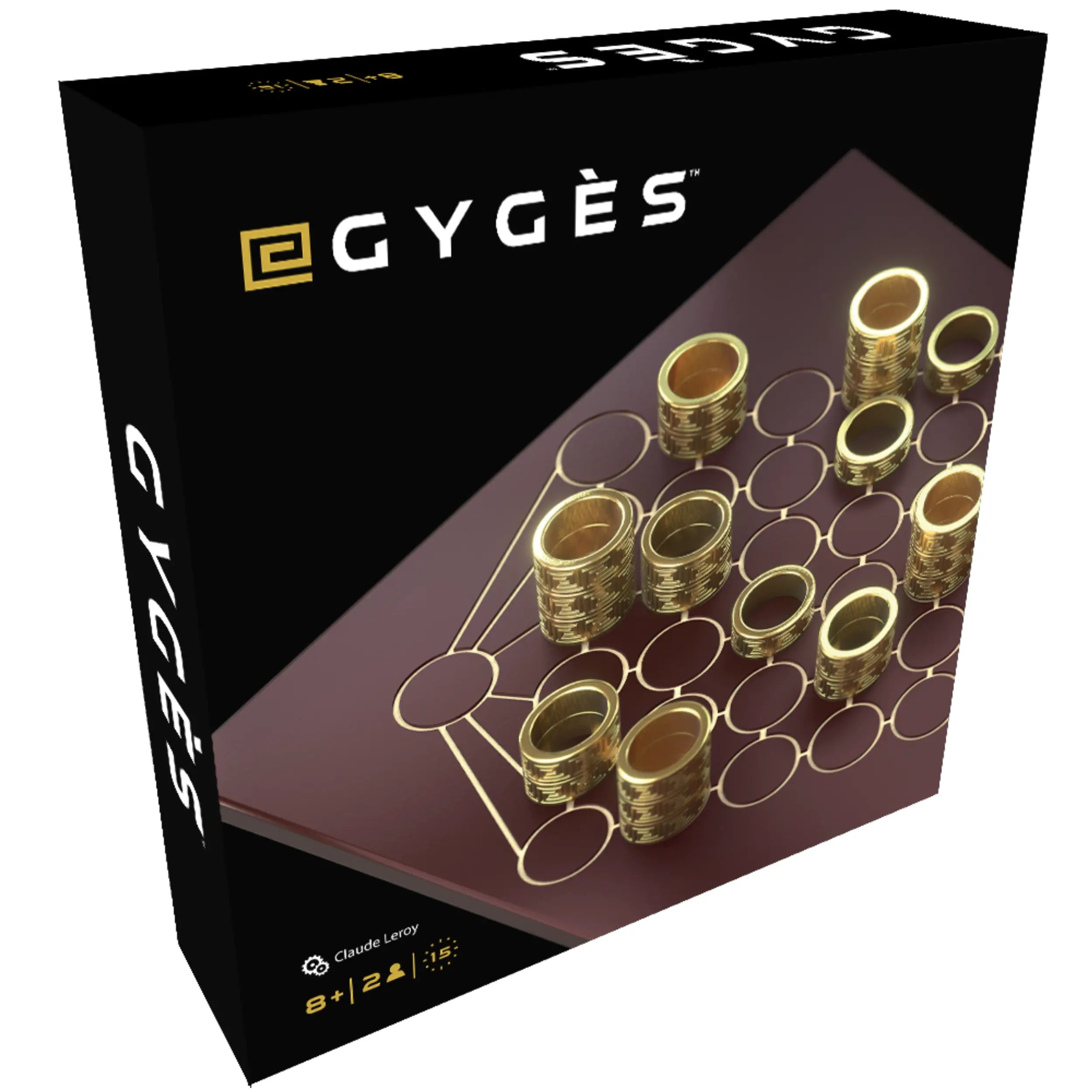
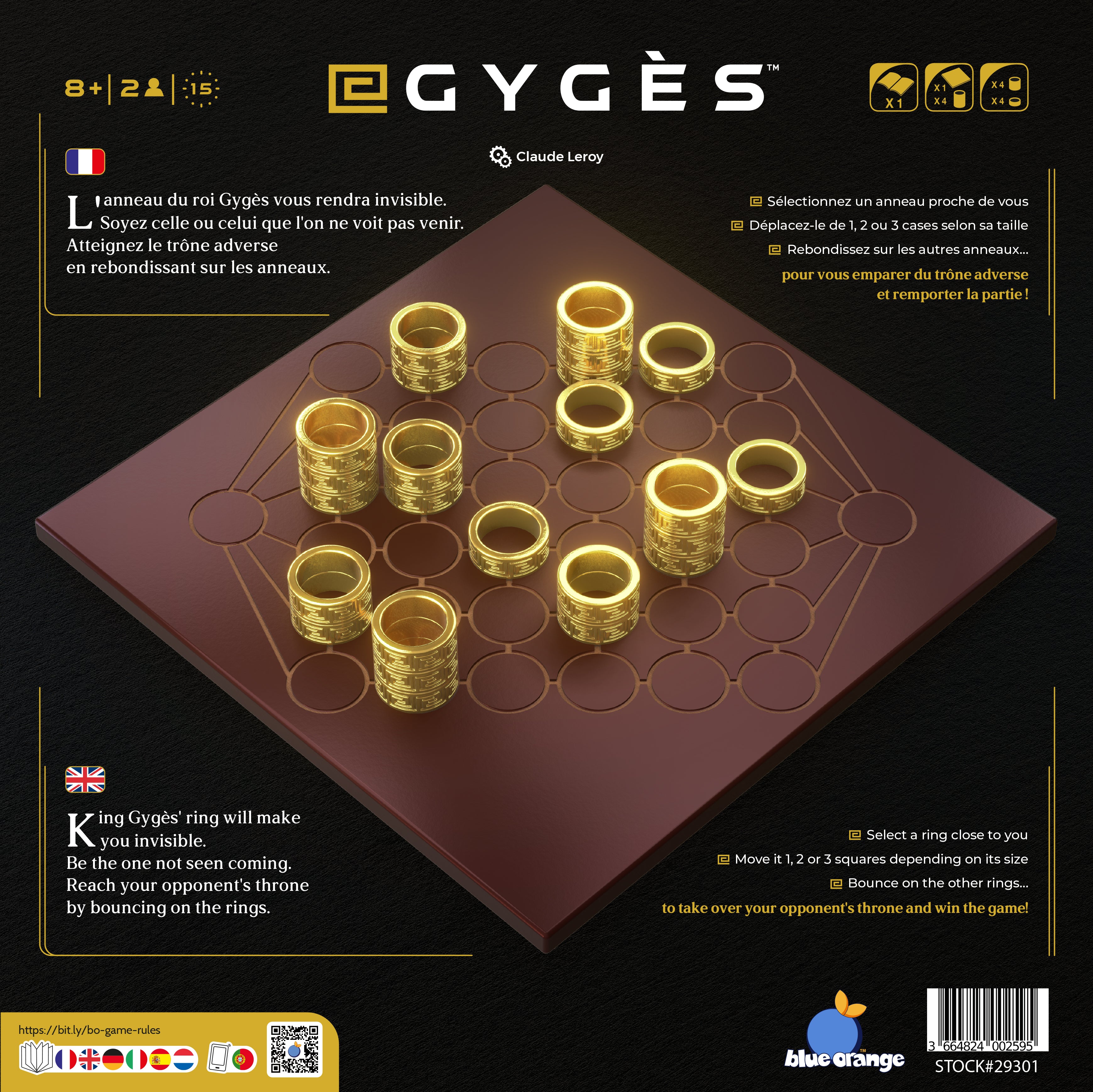
Gygès was created in 1985 by Claude Leroy, inspired by the legend of King Gyges' ring of invisibility. It won the Concours International de Créateurs de Jeux de Société that same year, an award that cemented its status as one of the most elegant abstract games of its generation. There are no "my" pieces or "your" pieces: there are rings on the board, and whoever uses them best wins.
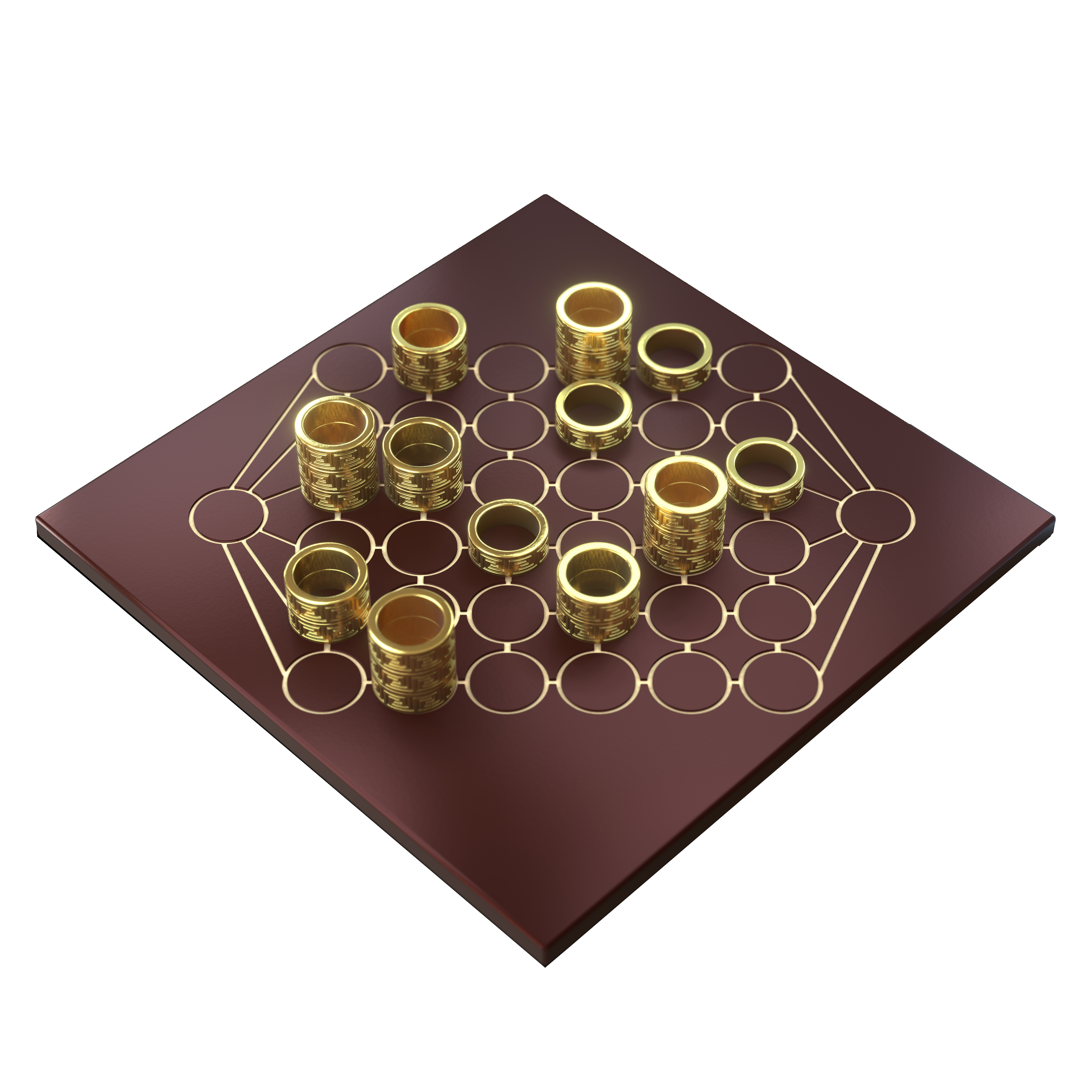
Two players face a grid of connections. Each turn, you move a ring — but its height determines how far it goes. Do you land on another ring? You can jump again, chaining movements, or push it away to take its place. The goal is to reach the opponent's throne. The problem is that every ring you advance towards the enemy becomes available for them on the next turn.
What they say abroad
An abstract game where every move creates opportunities for both players. Rare, elegant, ruthless.
— FroGames
The beauty of Gygès is that you own nothing. Every ring is a tool, not an identity.
— FroGames

Gygès
FrogScore · FroGames editorial rating · based on rules, international reviews, and play sessionsThe elements on the field
What's on the board
Single rings
Height one: they move one space. Slow, but useful for building tactical bridges and repositioning the board.
Double rings
Height two: they move two spaces. The heart of the game, perfect for intermediate chains and control maneuvers.
Triple rings
Height three: they move three spaces. Explosive pieces, capable of opening sudden gaps or closing games in one move.
The opponent's throne
The ultimate goal. End your movement there and you win. The problem is that to get there you have to build a chain that the opponent doesn't see.
At the end of the game, you'll both know exactly where you went wrong. And you'll immediately play the rematch.
Come si gioca
Video dimostrativo di gameplay.
A game in five moments
What happens at the table
Not the rules. The experience.
Initial setup
You place your six rings on the starting line: two single, two double, two triple. You decide the order. What seems like a detail will become crucial in the third round, when you realize you've blocked the triple behind the singles and can't free it.
The first tactical moves
You move the rings closest to you, one at a time. You advance a double two spaces, land on an opponent's single, and push it away. Now that single is available to them. You realize you've just armed your opponent.
The unexpected chain
The opponent moves a triple, lands on a double, jumps again, lands on a single, jumps again. In one turn, they've crossed half the board. You stare at the board and realize you built that chain yourself, three turns ago, without noticing.
The race to the throne
Both of you have rings near the enemy throne. Every move is a calculation: if I advance this, they can use that. If I push that ring away, I open a gap. The game is on a knife-edge, and one mistake ends everything.
Victory or rematch
One of you completes the perfect chain and lands on the throne. Game over. The loser stares at the board, re-traces the moves, finds the mistake. They say, "One more." Because Gygès is like that: when it's over, you immediately want another game.
How to play
The flow of the turn
Each turn is one move. Just one. But that one move can change everything.
You must move one of the rings closest to you on your line. You cannot jump over your own stationary rings in front. This restriction creates order: you must free up slow pieces before using fast ones.
A single ring moves one space. A double moves two. A triple moves three. Follow the connectors on the board, never using the same connector twice in the same turn. You cannot pass through occupied spaces.
If you finish your movement on another ring, you have two options: either jump again using that ring's height (chaining movements), or push it into an adjacent empty space and take its place. Chains can cross the board.
If you land on an empty space, the turn ends. If you land on the opponent's throne, you win. Otherwise, it's the other player's turn, who can now use all the rings you left in awkward positions.
Why it's different from others
Six mechanics that make a difference
Shared rings, no ownership
In Gygès, there are no black and white pieces. There are rings on the board, and anyone can use them. This simple rule creates a unique game of positioning and control: every ring you advance potentially becomes a weapon for your opponent. You're not moving your troops. You're redrawing the battlefield.
Chaining movements
When you land on a ring, you can jump again using its height. And if you land on another ring, you can jump again. A well-built chain can cross the board in one turn. The problem is you have to build it without your opponent noticing, and every ring you position for yourself is also available to them.
Movement forced by position
You can't move just any ring: you must move one of those closest to you on your line. This restriction creates a tactical order: if you block fast rings behind slow ones, you must free the slow ones first. Every initial setup is a declaration of intent, and every move changes the order of mobility.
Bump: push and replace
When you land on a ring, you can choose not to jump: you push it into an adjacent empty space and take its place. This allows you to reposition the board to your advantage, open gaps, close paths, or simply stop a chain before it becomes dangerous. The bump is the game's most subtle defensive weapon.
Immediate victory on the throne
There's no scorekeeping. You don't capture pieces. You win in only one way: finish your movement on the opponent's throne. This means every game is an asymmetrical race where both players try to build the winning chain while defending their own throne. The tension is constant.
Variable setup geometry
At the beginning, you arrange your six rings on the starting line in any order you prefer. Two single, two double, two triple. It seems like a trivial choice, but it determines your first five moves. Do you position the triples on the sides to free them quickly? Or do you put them in the center to protect them? Every setup is a different philosophy.
How it ends
How to win and how to lose
Only one victory condition. And endless possibilities to achieve it.
Victory
- Finish your movement on the opponent's throne
- Build a chain of jumps that the opponent doesn't foresee
- Exploit a ring that the opponent left in an awkward position three turns ago
Defeat
- The opponent reaches your throne before you do
- You advance a ring, believing you're building a threat, but you create the winning chain for the opponent
- You block your fast rings behind slow ones and can't free them in time
Gygès is an abstract game where every move is reversible, every ring belongs to everyone, and the game ends when one player sees the chain that the other didn't. Elegant, ruthless, immediate.
Frequently asked questions
Gygès FAQ
Is it really that simple to learn?
The rules fit on half a page. A ring moves as many spaces as its height, if you land on another ring you jump again or move it, if you reach the throne you win. You can teach Gygès in 5 minutes. The problem is understanding what you're doing: it requires tactical training, and the first games end with winning chains you didn't foresee.
How long does a game last?
From 10 to 20 minutes, but you rarely play just one. Gygès has that "just one more" structure typical of pure abstract games: when it ends, you immediately want to figure out where you went wrong. It's not uncommon to play three or four games in a row.
Is it a solved game? Is there a dominant strategy?
No. The variable initial setup and the shared nature of the rings create too much complexity for a forced solution. There are tactical principles (free triples early, don't build chains for your opponent, control the center), but each game develops different dynamics. It's not a solved game.
Is it suitable for those who never play abstract games?
Yes, if you accept the premise. Gygès is less cryptic than Go or chess because games are quick and the objective is clear. But it remains a pure abstract: no theme, no luck, just calculation and consequences. If you're looking for a gateway to tactical abstract games, this is a good starting point.
Is it available in Italian?
This edition is in English, published by Blue Orange. The game is completely language-independent: there are no texts on components, cards, or the board. The rulebook is the only textual element, and once read, you don't need to consult it again.
Gygès is a tactical abstract game for 2 players, lasting 15 minutes, recommended for ages 8+. Designed by Claude Leroy in 1985, winner of the Concours International de Créateurs de Jeux de Société, Gygès stands out for its shared rings mechanic: no piece belongs to a specific player, and every move redefines the tactical possibilities for both. Victory is achieved by reaching the opponent's throne through chains of linked movements. Published by Blue Orange, it's a classic of abstract strategy, ideal for those seeking quick cerebral duels and immediate replayability. Available on FroGames.it.
Frequently Asked Questions
The answers you're looking for, no beating around the bush.
📸Do the images match the actual product?
The photos on the website often come from BoardGameGeek and are intended to give you an idea of the game. They may vary slightly from the version you receive. The content declared by the publisher is always binding.
📦Does the content of the box match what is indicated?
We always strive to provide the correct content, but minor variations are possible due to reprints or updates. The information comes directly from the publishers. If you have any questions, please contact us!
⏳How do pre-orders work?
Pre-order the game before release, payment is immediate, and the game is reserved for you. As soon as it arrives, we'll ship it right away! If there are any delays, we'll update you promptly.
🔒Can I trust buying here?
Absolutely! Secure payments, tracked shipments, and a team that loves board games as much as you do. If something goes wrong, we'll do our best to fix it.
🛠There's a problem with my order, what should I do?
Write to us now! Whether it's a missing part, damage, or an error, we'll help you resolve it as soon as possible. Your experience truly matters to us.