

Railroad Revolution
🐸 Dettagli da BoardGameGeek
Consiglio BGG sul numero di giocatori
Categorie
Meccaniche
Design & Art
Pre-order - leggi i dettagli
🐸 Una rana saggia sa quando dividere l’ordine… e quando aspettare il salto giusto.
Si abbina bene con
The FroGames Board
You have three generic workers and one specialist. The action you need costs double if you use the wrong one. And you have to promote your best worker right now because the corporate objective is expiring.
WHAT IT'S ABOUT
Railroad magnates in America racing towards the Pacific
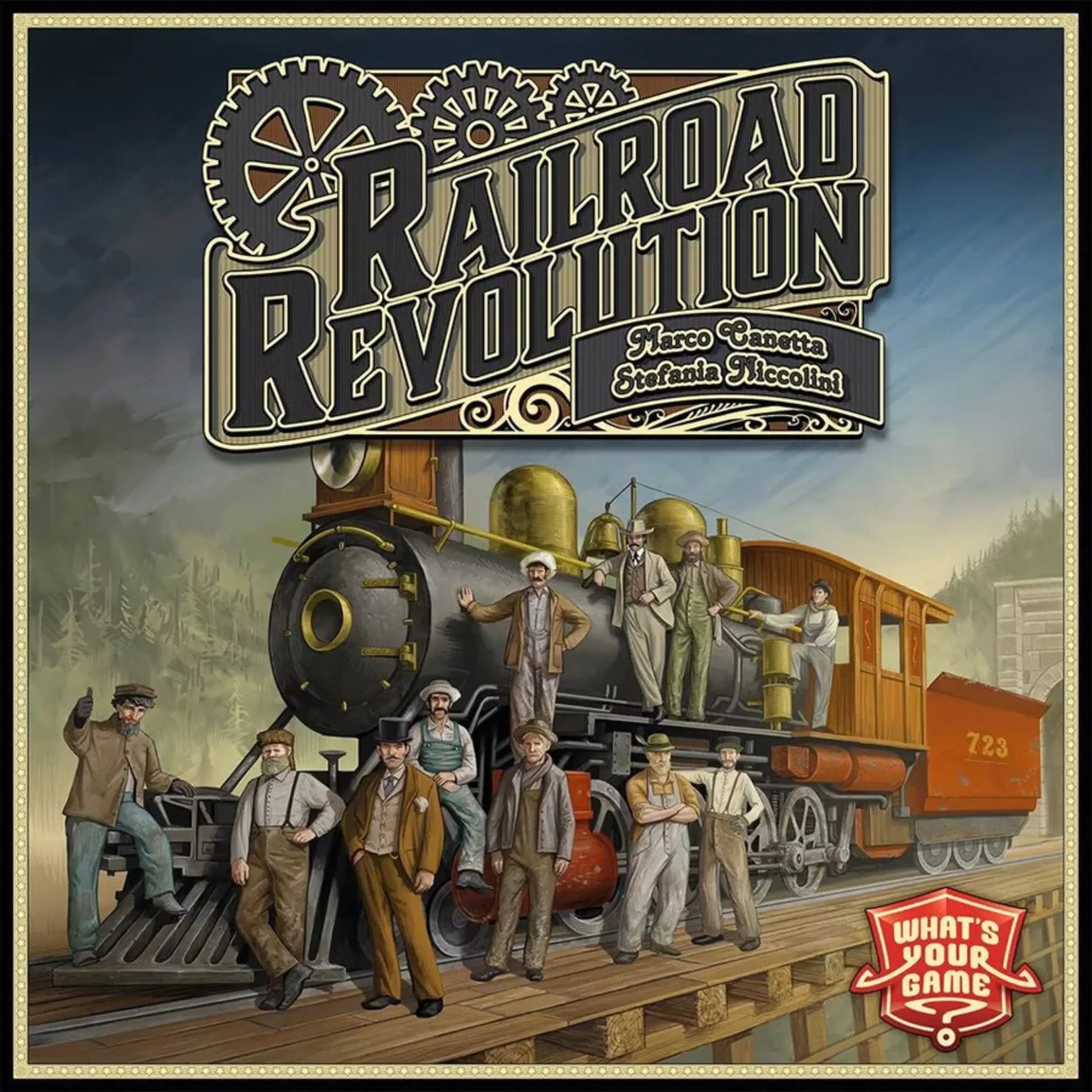
We are in 19th century America, the era of great railway companies that connected states and coasts, building colossal empires and fortunes. Marco Canetta and Stefania Niccolini (authors of Zhanguo and Council of 4) sign a eurogame where you manage your railway company in a fierce competition to lay tracks, plant stations, and weave telegraph lines. The illustrations by Mariano Iannelli bring vintage geographic maps and the industrial aesthetic of the Far West to the table.
Each turn you assign your workers to actions: building railways, expanding the telegraph, completing corporate objectives. But the cost or effectiveness of each action depends on the type of worker you send there: generic, engineers, telegraphers, builders. And to complete certain objectives, you must promote some workers to managerial roles, losing them from the active pool forever. Every decision is a trade-off: which worker do you sacrifice, which action do you prioritize, which objective do you pursue first.
What they say abroad
"Railroad Revolution's timing puzzle is tighter than a new pair of cowboy boots."
Railroad Revolution's timing puzzle is tighter than a new pair of cowboy boots.
— The Opinionated Gamers
This is a first read: the game deserves more plays to express a complete verdict. We will update the board with table experience.
— FroGames

Railroad Revolution
FrogScore · FroGames editorial rating · based on rules, international reviews and game sessionsYour assets
What you manage during the game
Worker pool
You start with generic workers, but you can hire engineers, telegraphers, and builders. Each has a different cost for each action: sending the right specialist saves you resources or earns bonuses.
Railway network
You place tracks on the map and build stations in connected cities. Each station is worth points and unlocks objectives, but you must plan the route: not all sections cost the same.
Telegraph lines
You expand the telegraph parallel to the tracks. The lines give you bonus resources and scoring multipliers at the end of the game, but require specialized telegraphers to be efficient.
Corporate objectives
You draw secret objectives at the beginning of the game and common public ones. Completing them gives you points and advantages, but to close them you must promote workers to managers, losing them from the active pool forever.
Come si gioca
Video dimostrativo di gameplay.
🎲How to playThe rules in four steps▼
How to play
The flow of each round
Each round has a simple structure: you place workers, resolve actions, then ready up used workers. The complexity lies in deciding which worker to send where.
In turn, each player sends a worker to an available action space. The cost or effectiveness of the action depends on the worker type: generic workers pay more, specialists get bonuses.
Build tracks, place stations, expand the telegraph, hire new workers, or complete objectives. Each action has a resource cost, and some spaces give bonuses if you use the correct specialist.
If you have met an objective's requirements, you can close it by promoting a worker to manager. You remove them from your active pool permanently, but you gain points and permanent advantages.
You retrieve used workers (except those promoted), the first player token rotates, and you start again. The game lasts a fixed number of rounds, so every turn counts.
⏱️Your first gameThe chronicle, moment by moment▼
A game in five moments
What happens at the table
Not the rules. The experience.
Setup and first surprise
You draw business objectives and immediately understand which direction to take: someone focuses on stations in the east, someone on the telegraph network in the west. The first turn is a taste: everyone sends generic workers, no one wants to burn through specialists too early.
The hiring race
Someone hires the first engineer, and the efficiency disparity becomes evident: those with the right specialist build tracks at half price, those without have to spend double. The race to hire begins and the tension rises: every hired worker is an investment you must amortize.
First objective completed
Someone closes the first business objective and promotes a worker. They lose a worker from the active pool, but gain points and unlock a permanent advantage. Everyone calculates: when to promote, which workers to sacrifice, how many turns are left until the end.
Bottleneck
Mid-game: everyone wants to take three actions but only has two useful workers. Those who planned better still have leeway, those who promoted too early find themselves stuck with a halved pool. Stations on the map are contested, someone deviates their path to reach a needed city.
Final count and surprises
End of game: tracks, stations, telegraph, completed objectives are counted. Final multipliers reverse some positions, but those who optimized promotion timing usually win. Everyone agrees: it would have gone differently with another objective order.
🐸Good to know beforehandThree honest things, from friends▼
Good to know beforehand
Three things to keep in mind
Steep initial learning curve
The rules are only a few pages, but the optimal management of the worker pool is not intuitive in the first game. A practice run is needed to understand when to promote, when to hire, when to use generic workers. Those who know the game have an advantage.
Variable downtime
With 2 players, it flows smoothly; with 4, it can drag if someone suffers from analysis paralysis. Each turn requires calculating costs, remaining resources, open objectives: it's not a filler, it's a medium-heavy game that demands concentration.
Asymmetric scalability
The game scales well from 2 to 4, but the experience changes: with 2, you have more control over the map and less competition for action spaces; with 4, the race for stations and objectives becomes more intense. It's not the same game at different player counts.
🏆Victory and defeatWhat the ending rewards▼
How it ends
How to win
The game lasts a fixed number of rounds. At the end, points from various sources are tallied, and the player with the most wins.
Victory conditions
- Points from completed business objectives (public and private)
- Points from stations built in connected cities
- Points from railway and telegraph networks, with final multipliers
Costly mistakes
- Promoting too many workers too early and running out of an active pool
- Ignoring the telegraph and losing final multipliers
- Not completing enough objectives and leaving points on the table
Railroad Revolution is an optimization puzzle where every choice weighs heavily and every promoted worker is a door you close. If you're looking for a clean, luck-free eurogame with impactful decisions, this is it.
💬Frequently Asked QuestionsQuick answers before checkout▼
Frequently Asked Questions
FAQ about Railroad Revolution
What mechanics does Railroad Revolution use?
Worker placement with differentiated workers (each type has different costs/bonuses for actions), resource management, network building (you build networks of tracks and telegraphs), and a contract/objective system where you complete objectives by promoting workers. No drafting, no dice, everything is deterministic.
Is it suitable for those unfamiliar with eurogames?
No, it's a medium-heavy game (3.2/5 on BGG). The rules aren't complex, but the optimal management of the worker pool requires medium-term planning and the ability to evaluate trade-offs. It's better to start with simpler gateway games and come back to this when you're familiar with worker placement and optimization.
How does it scale with different player counts?
With 2 players, you have more space on the map and less competition for action spaces; the experience is more of a personal puzzle. With 4, the race for stations and objectives becomes intense, with more indirect interaction. The game works well from 2 to 4, but it changes enough that some prefer a specific player count.
How long does a real game last?
The box says 45-90 minutes. With experienced players, 2-3 players will be around 60 minutes; with 4, it's easily 90-100 if someone is slow. For the first game, add 30 minutes for setup, explanation, and the fact that no one knows how much each objective weighs yet.
Is it available in Italian?
This edition is in English. The text on the cards is present (objectives, actions), so at least one player needs to be able to read English or you'll need to print a translated reference. There are no official Italian editions of Railroad Revolution currently.
The people behind the game
Who invented it, who designed it, who publishes it — and what else they've done.
Railroad Revolution is a strategic board game by Marco Canetta and Stefania Niccolini, published by What's Your Game?, for 2-4 players, ages 12+, lasting 45-90 minutes. It uses worker placement with differentiated workers, network building, and objective management mechanics: each worker has different costs for actions, and to complete objectives you must promote them, losing them from your active pool. Set in 19th-century America, it puts players in charge of competing railway companies to build tracks, stations, and telegraphs. Medium-heavy weight (3.2/5), suitable for experienced players seeking optimization and cascading decisions. Available on FroGames.it.
Railroad Revolution
Frequently Asked Questions
The answers you're looking for, no beating around the bush.
📸Do the images match the actual product?
The photos on the website often come from BoardGameGeek and are intended to give you an idea of the game. They may vary slightly from the version you receive. The content declared by the publisher is always binding.
📦Does the content of the box match what is indicated?
We always strive to provide the correct content, but minor variations are possible due to reprints or updates. The information comes directly from the publishers. If you have any questions, please contact us!
⏳How do pre-orders work?
Pre-order the game before release, payment is immediate, and the game is reserved for you. As soon as it arrives, we'll ship it right away! If there are any delays, we'll update you promptly.
🔒Can I trust buying here?
Absolutely! Secure payments, tracked shipments, and a team that loves board games as much as you do. If something goes wrong, we'll do our best to fix it.
🛠There's a problem with my order, what should I do?
Write to us now! Whether it's a missing part, damage, or an error, we'll help you resolve it as soon as possible. Your experience truly matters to us.