
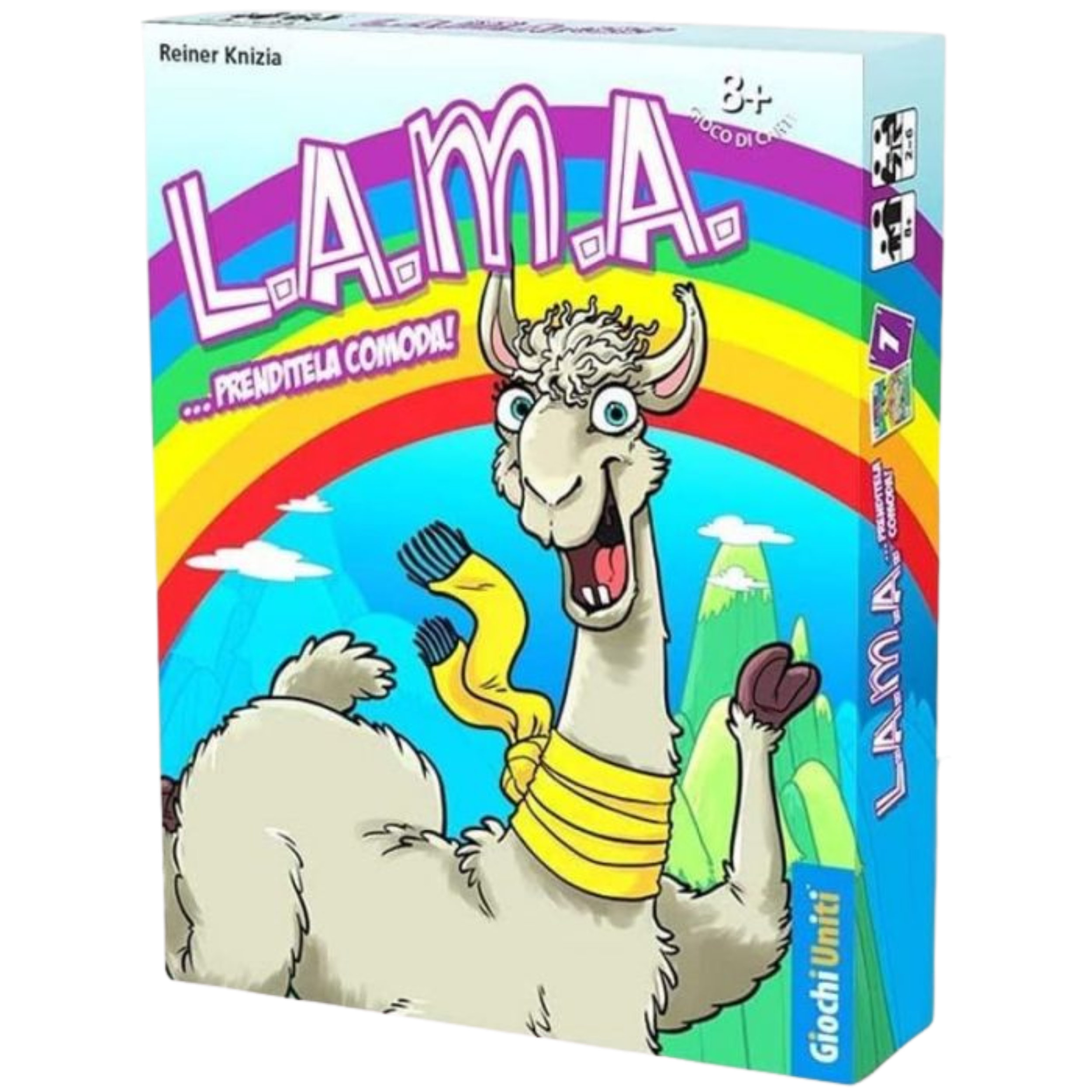
Lama
🐸 Dettagli da BoardGameGeek
Consiglio BGG sul numero di giocatori
Categorie
Meccaniche
Design & Art
Lingua




Si abbina bene con
The FroGames Card
You have a 5 in your hand, a 6 is on the table. You can play the 6 you have hidden, or pass and take the points. You draw. A 3 arrives. Everyone laughs.
WHAT IT'S ABOUT
The game where everyone knows when to stop, except you
Reiner Knizia returns to what he does best: taking a well-established mechanic (ladder climbing, like in Tichu and The Great Dalmuti), stripping away all the superfluous, and leaving only pure tension. Lama (originally L.L.A.M.A., German acronym for "get rid of all negative points") was released in 2019 by AMIGO, was nominated for the Spiel des Jahres, and hasn't left tables since.
On your turn, you do one thing: play a card from your hand (if you can), draw a card, or pass and stop. Whoever plays the last card wins the round. Those who stop first count the negative points remaining in their hand. The number on the card = negative points. But beware: identical cards only count once. This is the only rule that changes everything.
What they say abroad
"It's the kind of game where everyone knows the smart move, and then someone draws anyway and the table erupts."
It's the kind of game where everyone knows the smart move, and then someone draws anyway and the table erupts.
— Meeple Mountain
Knizia has stripped everything away and left only the moment you decide whether to stop. And it's perfect.
— FroGames

Lama (L.L.A.M.A.)
FrogScore · FroGames editorial rating · based on rules, international reviews, and play sessionsWhat's in the deck
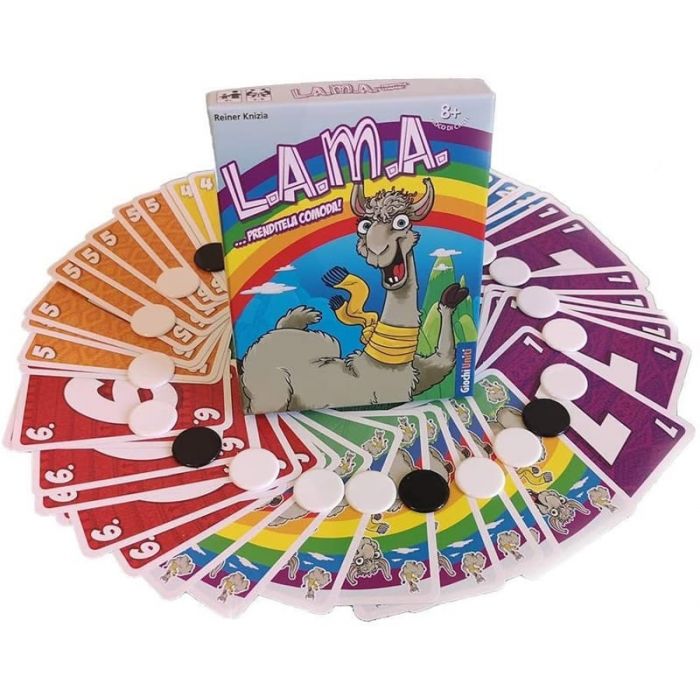
56 cards that decide who is the wisest (or luckiest)
Numbered cards 1-6
Eight copies of each number. You play a number equal to or higher than the previous one. When you reach 6, you restart from the Lama or 1. Each card in hand = negative points equal to its value.
Lama Cards
The most dangerous. They are worth 10 negative points if you end the round with one (or more) in hand. But if you play them all, you count zero. The only card that can follow a 6.
White Tokens
They are worth 1 point each. At the end of the round, you take as many white tokens as the points of the remaining cards. When you reach 10 white tokens, you exchange them for a black one.
Black Tokens
They are worth 10 points. If you finish a round by playing all your cards, you return a token (white or black) from your collection. This is the only way to decrease your score.
Recommended Sleeves 56 cards in 1 size ▼
If you play often, we recommend protecting your cards with transparent sleeves to make them last longer.
| Size | Quantity |
|---|---|
| 56 × 87 mm | 56 |
| Total cards | 56 |
Come si gioca
Video dimostrativo di gameplay.
🎲How to playThe rules in four steps▼
How to play
The flow of each turn
Three possible actions. You choose one in two seconds. But that choice haunts you for the entire round.
Same number or next number compared to the top card of the discard pile. After a 6, you can only play a Llama or a 1. After a Llama, you can only play another Llama or a 1. If you play, the turn passes to the next player.
Add a card to your hand and the turn ends. You cannot play immediately. You hope to draw the card you need, but the deck is blind. You risk making the situation worse.
You stop. You no longer play in this round. At the end of the round, you will count the points of the remaining cards. Duplicate cards count only once. You wait for someone to close or for everyone to pass.
The round ends when someone plays their last card or everyone has passed. Count negative points: each different value in hand = points equal to the number (1=1, 6=6). One or more Llamas = 10 fixed points. Take tokens. Whoever closed returns one. Then a new round.
⏱️Your first gameThe chronicle, moment by moment▼
A game in five moments
What happens at the table
Not the rules. The experience.
Deal, first player starts
Six cards each, one card face up in the center. The first player plays a 2. Easy. The second plays a 3. You have a 4 and a 5, you play the 4. The table still hasn't understood what strategy means here.
The first to pass
Third round, there's a 6 on the table. One player only has low cards. She passes and turns her cards face down. The others continue. She now counts points: she has a 2 and two 3s. Total: 5 points (the duplicate 3 counts only once). Not bad at all.
The cursed draw
You only have one Llama in hand, there's a 4 on the table. You can't play. You draw. A 2 comes up. You have to draw again. Another Llama comes up. Now you have two. The table laughs. You know that if you don't play them, that's 10 straight points.
Someone closes
A player plays their last card. Round over. Everyone shows their hands. You still have three different cards: 12 points. You take 12 white tokens (which you immediately convert into one black and two white). The player who closed returns a token. Shuffle and start again.
One reaches 40
Fifth round. A player exceeds 40 total points. Game over. The player with the fewest points wins. You're at 38, the player with 35 wins. You should have passed that round ago, when you had two 6s in hand. You knew it. You did it anyway.
🐸To know beforehandThree honest things, from friends▼
To know beforehand
Three things to know
Drawing is blind and can hurt
There's no draft, you don't see what's coming. You draw from the face-down deck. You might get exactly the card you needed or make everything worse. Luck matters, especially in short rounds. Those who stop early limit damage, those who draw too much risk a lot.
With 2 players, it loses its edge
The game thrives on group dynamics: who passes first, who takes risks, who draws the wrong card and blocks everyone. With two players, the pace is slower and lacks that controlled chaos that makes Lama shine with 4 or more.
After 10 consecutive games, it saturates
It's a perfect filler, but variability is limited: same deck, same choices, same structure. Played back-to-back, you risk exhausting it in one evening. Better to intersperse it with other games or let it rest for a week.
🏆Victory and defeatWhat the ending rewards▼
How it ends
How to win (and how to lose badly)
The player with the fewest negative points wins. Simple. But there are a thousand ways to accumulate too many.
Victory conditions
- When a player exceeds 40 total points, the game ends immediately
- The player with the lowest total of tokens (white + converted black) wins
- Closing a round by playing all cards allows you to return a token
How you get into trouble
- You draw too many times hoping for the right card and end up with an unplayable hand
- You pass too late: you had 3 cards, now you have 5, and they are all high numbers
- You end a round with a Llama in hand: 10 straight points that bring you closer to 40
Knizia gives you three actions and one life to figure out when to stop. You usually get it wrong. But you try again immediately.
💬Frequently asked questionsQuick answers before checkout▼
Frequently asked questions
FAQ about Lama (L.L.A.M.A.)
What mechanics does Lama use?
Ladder climbing (you play numbers in ascending sequence), hand management (you manage cards to minimize points), push-your-luck (you decide whether to draw or stop) and punitive set collection (duplicate cards count only once, but you must have all of them of the same value).
With how many players does it work best?
From 4 to 6 players. With 2-3 it works but loses pace: the fun is seeing who stops first, who takes risks, who draws the wrong card, and the table laughs. The more players there are, the more fun the chaos is.
Do Llama cards always count for 10 points?
Yes, but there's a trick: if you have multiple Llamas in hand, they count as 10 points in total, not 10 each. It's the only card that behaves this way (numbers, however, add up if different, but duplicates count once). So having two isn't double the disaster.
How long does a complete game last?
From 15 to 25 minutes. It depends on how many rounds it takes for someone to reach 40 points. A round lasts 3-5 minutes. Usually, you play 4-6 rounds per game. Then you start another one immediately.
Does the Italian edition have translated texts?
Yes, this Giochi Uniti edition is completely in Italian: translated rulebook and cards with localized graphics. The game is language-independent (only numbers and symbols on the cards), but having the rules in Italian helps explain it in 2 minutes.
The people behind the game
Who invented it, who designed it, who publishes it — and what else they've done.
Lama (originally L.L.A.M.A.) is a card party game for 2-6 players designed by Reiner Knizia and published by Giochi Uniti in an Italian edition. Each game lasts 20 minutes and is suitable for ages 8 and up. It uses ladder climbing, hand management, and push-your-luck mechanics: on your turn, you play a card, draw, or pass. Cards remaining in hand become negative points, but duplicates count only once. Nominated for Spiel des Jahres 2019, it's a perfect filler for quick evenings and larger groups. Available on FroGames.it with immediate shipping.
Lama
Frequently Asked Questions
The answers you're looking for, no beating around the bush.
📸Do the images match the actual product?
The photos on the website often come from BoardGameGeek and are intended to give you an idea of the game. They may vary slightly from the version you receive. The content declared by the publisher is always binding.
📦Does the content of the box match what is indicated?
We always strive to provide the correct content, but minor variations are possible due to reprints or updates. The information comes directly from the publishers. If you have any questions, please contact us!
⏳How do pre-orders work?
Pre-order the game before release, payment is immediate, and the game is reserved for you. As soon as it arrives, we'll ship it right away! If there are any delays, we'll update you promptly.
🔒Can I trust buying here?
Absolutely! Secure payments, tracked shipments, and a team that loves board games as much as you do. If something goes wrong, we'll do our best to fix it.
🛠There's a problem with my order, what should I do?
Write to us now! Whether it's a missing part, damage, or an error, we'll help you resolve it as soon as possible. Your experience truly matters to us.