

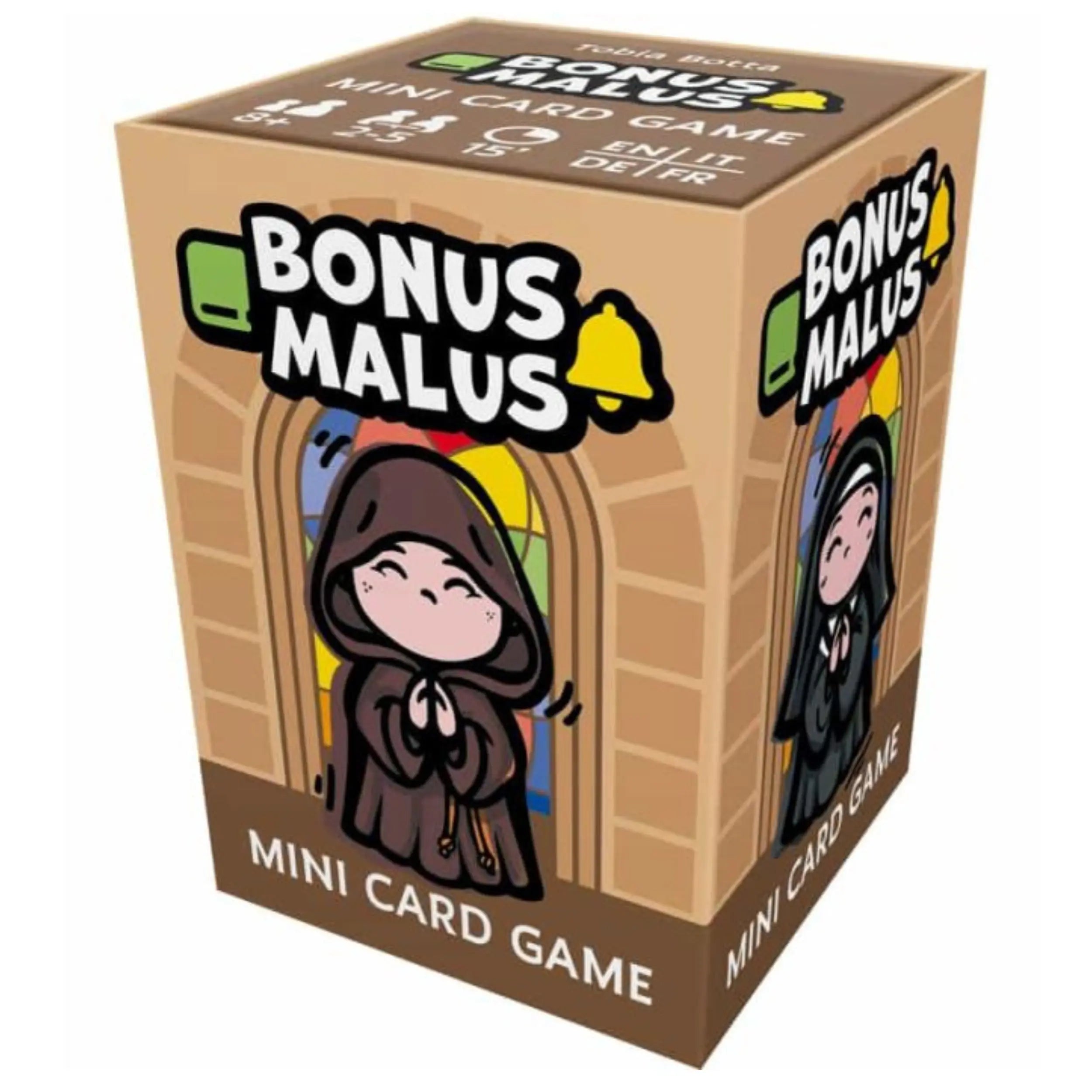
Mini Card Game - Bonus Malus
🐸 Dettagli da BoardGameGeek
Pre-order - leggi i dettagli
🐸 Una rana saggia sa quando dividere l’ordine… e quando aspettare il salto giusto.
Si abbina bene con
FroGames — Moments You'll Remember
"Please, do go ahead." In the cloister, kindness is a weapon: here, the last one to remain wins.
What it's about
A kindness race where the first one to arrive loses
Mini Card Game – Bonus Malus is a pocket-sized card game by Tobia Botta, published by the Swiss company Naivina. In a convent cloister, monks and nuns compete to be the most courteous: the goal isn't to come first, but to let everyone else pass.
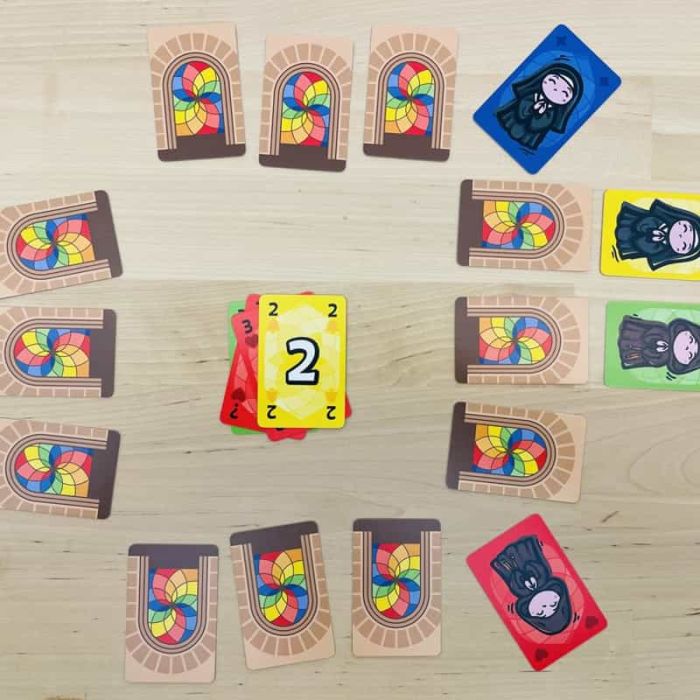
On your turn, you play a Movement card that determines which character to move and by how many spaces. The catch is that some cards force you to move an opponent's character — and sometimes, despite yourself, your own. The cloister consists of 16 spaces with specific rules for movement and positioning.
Then there's the "?" card, which copies the value of the Movement card played before it, constantly reopening the game. When everyone has run out of their Bonus Malus cards, the game ends, and you look at the cloister: the player whose character is in the last place wins. Fifteen minutes, a 5×5×7 cm box.
The game overturns instinct: every time you make a "good" move, you're worsening your position. It takes three turns to stop making mistakes.
The secret of Bonus Malus in one line
Courtesy becomes malice: you push your opponent forward with a smile, and they thank you while realizing you've just ruined them.
From the game experience

Mini Card Game – Bonus Malus
FrogScore · FroGames editorial rating · based on rules and gameplay sessionsWhat's in front of you
Four elements, one inverted rule
There's nothing else to learn. The rest is understanding how hard it is to lose on purpose.
The characters
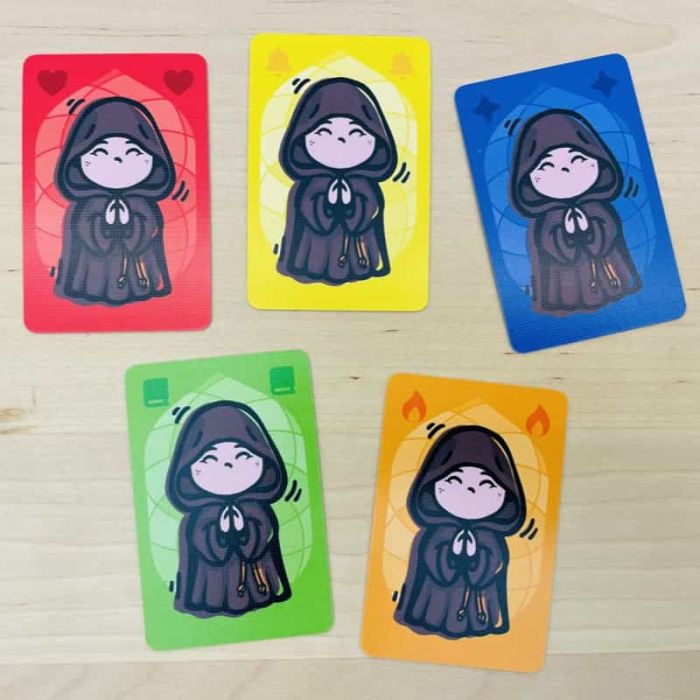
Monks and nuns competing in kindness in the cloister. Everyone roots for their own — and roots for them to stay put.
Movement cards
Determine which character moves and by how many spaces. Some force you to move an opponent's character.
The "?" card
Copies the value of the Movement card played before it. Changes the plan of the person before you and opens up new solutions.
The 16-space cloister
A narrow space with its own rules for movement and positioning. Sixteen spaces are few: someone always ends up ahead.
The last turn is the cruelest: you have only one card in hand and you must play it. May the cloister be merciful.
A game in five moments
What happens at the table
Not the rules. The experience.
"Wait, the one who comes in last wins?"
I explain the rule and see three perplexed faces. Yes: the one who stays behind wins. Someone nods without truly understanding, takes the cards, and prepares to do the exact opposite of what's needed.
Everyone makes the first mistake
On the second turn, someone moves their character forward by instinct and realizes a second later that they've just put themselves in the lead. General laughter. From that moment on, everyone looks at their card with much more suspicion.
Kindness becomes a weapon
A card comes out that forces me to move an opponent's character. I push them forward four spaces with the smile of someone doing a favor. They thank me. Then they understand. A beautiful silence falls over the table.
Sixteen spaces are tight
The cloister fills up and no one can stay behind as they'd like. Then someone plays the "?" card, copies the value just played, and overturns the order we've been building for three turns.
The last card is forced
One card left for everyone, and no one can choose anymore. You play hoping the cloister is merciful. The cards run out, you look to see who is furthest behind — and the one who "lost" the whole game takes the victory.
How to play
The game flow
Four steps, no exceptions to remember. The difficulty isn't in the rules: it's in playing in reverse.
The cloister consists of 16 spaces and hosts the characters — monks and nuns — with their own rules for managing movement and positions. Each player follows one.
On your turn, you play a Movement card: it determines which character to move and by how many spaces. The goal is to move yours as far back as possible.
Some cards force you to move an opponent's character. The "?" card, on the other hand, copies the value of the previously played Movement card.
When everyone has played their cards, the game ends. You look at the cloister: the player whose character is in the last place wins.
Why it works
Six reasons to keep it in your bag
The goal is reversed
The one who comes in last wins. It sounds like a joke until you realize that all the instincts you've developed over twenty years of gaming work against you.
Move other players' characters
Some cards force you to move an opponent. Pushing them forward is the most polite way to play a trick on them — and it's the only one you have.
The "?" card copies
It repeats the value of the card played before it. It changes the meaning of the previous turn and forces everyone to recalculate the cloister's order.
Sixteen spaces, tight space
The cloister is small and positions get clogged. Staying behind is easy in theory: on the track, you find yourself in the lead without having done anything wrong.
A 5×5×7 cm box
It fits in your pocket, backpack, laptop bag. It's the game you pull out at the bar, on the train, or while waiting for pizza.
Ages 8+, explained in two minutes
One card per turn and only one goal. Children understand it immediately and often win, because they don't have the habit of wanting to come in first.
How it ends
The one who stays behind wins
No one is eliminated, and no one can abandon the race of kindness. Everyone reaches the end of the cards: only where you are at that moment counts.
Victory
- When everyone has played their cards, your character is in last place
- You used the cards that move opponents to push them forward at the right time
- You saved the cards that allowed you to stay put for the end
The risk
- You find yourself ahead of everyone because the cards in your hand force you to move
- Opponents push your character forward on the very last turn
- The "?" card copies the wrong value and messes up a three-turn plan
Mini Card Game – Bonus Malus fits in your pocket and lasts fifteen minutes. Then it lasts another fifteen, because no one accepts having lost a race where all you had to do was stay still.
Frequently Asked Questions
FAQ about Mini Card Game – Bonus Malus
Isn't a game where you win by coming in last just a gimmick?
The idea is a single one, but it holds up for fifteen minutes because it reverses an automatic behavior. On 16 spaces and with cards that force you to move opponents too, staying behind isn't passive: you have to decide who to push forward and when. The gimmick becomes a real choice turn after turn.
Is it all just card luck?
The cards you get matter, but the whole hand is played out: the order in which you spend them makes the difference. Saving the card that keeps you still for the end, or quickly playing the one that forces you to move, is the real decision in Bonus Malus. Honestly, it's a filler game, so the element of chance remains part of the fun.
How many players can play, and does it work with two?
Mini Card Game – Bonus Malus is suitable for 2-5 players. With two players, the cloister is emptier, and every card that moves an opponent weighs heavily, so the game becomes a direct duel. With 4-5 players, positions overlap, and the chaos increases: that's where the game is most amusing.
Is it in Italian?
Yes. The box indicates four languages: Italian, English, German, and French. The game relies on Movement cards with numerical values, so very little text needs to be consulted at the table.
Is it suitable for playing with children?
Very suitable: the recommended age is 8+, and the rule is explained in two minutes. In fact, children have an advantage — they accept the reversed goal without question, while adults instinctively continue to want to move forward.
How is it different from Naivina's other Mini Card Games?
Tobia Botta's series shares a pocket-sized format, duration, and age range, but each title has its own unique mechanic. Bonus Malus is the one with the track and the reversed goal: characters are moved on 16 spaces, and you win by staying in last place. It's the most immediate and mischievous in the series.
Mini Card Game – Bonus Malus is a competitive card game set in a convent cloister, for 2-5 players (ages 8+, approximately 15 minutes duration). Designed by Tobia Botta and published by the Swiss publisher Naivina in the Mini Card Game series, in a pocket-sized 5×5×7 cm box, with a multilingual box (Italian, English, German, French). Main mechanic: hand management and movement on a 16-space track with a reversed objective — the player whose character is in last place wins. Movement cards indicate which character to move and by how many spaces, some force you to move an opponent's character, and the "?" card copies the value of the previously played card. Fast card game, travel filler, family gateway. Available on FroGames.it.
Mini Card Game - Bonus Malus
Frequently Asked Questions
The answers you're looking for, no beating around the bush.
📸Do the images match the actual product?
The photos on the website often come from BoardGameGeek and are intended to give you an idea of the game. They may vary slightly from the version you receive. The content declared by the publisher is always binding.
📦Does the content of the box match what is indicated?
We always strive to provide the correct content, but minor variations are possible due to reprints or updates. The information comes directly from the publishers. If you have any questions, please contact us!
⏳How do pre-orders work?
Pre-order the game before release, payment is immediate, and the game is reserved for you. As soon as it arrives, we'll ship it right away! If there are any delays, we'll update you promptly.
🔒Can I trust buying here?
Absolutely! Secure payments, tracked shipments, and a team that loves board games as much as you do. If something goes wrong, we'll do our best to fix it.
🛠There's a problem with my order, what should I do?
Write to us now! Whether it's a missing part, damage, or an error, we'll help you resolve it as soon as possible. Your experience truly matters to us.