
Bella Vista
🐸 Details from BoardGameGeek
Consiglio BGG sul numero di giocatori
Categorie
Meccaniche
Design & Art
Lingua
🐸 How pre-orders work
🐸 A wise frog knows when to split the order… and when to wait for the right leap.
- Arrives
- by the end of April 2027





Si abbina bene con
The FroGames Review
You've found the perfect plot, the one worth its weight in gold for its view of the park. But you've seen it, too. And so have they. Now the question is: how much are you willing to spend to build first?
ABOUT THE GAME
An urban planning race where those who build higher see further
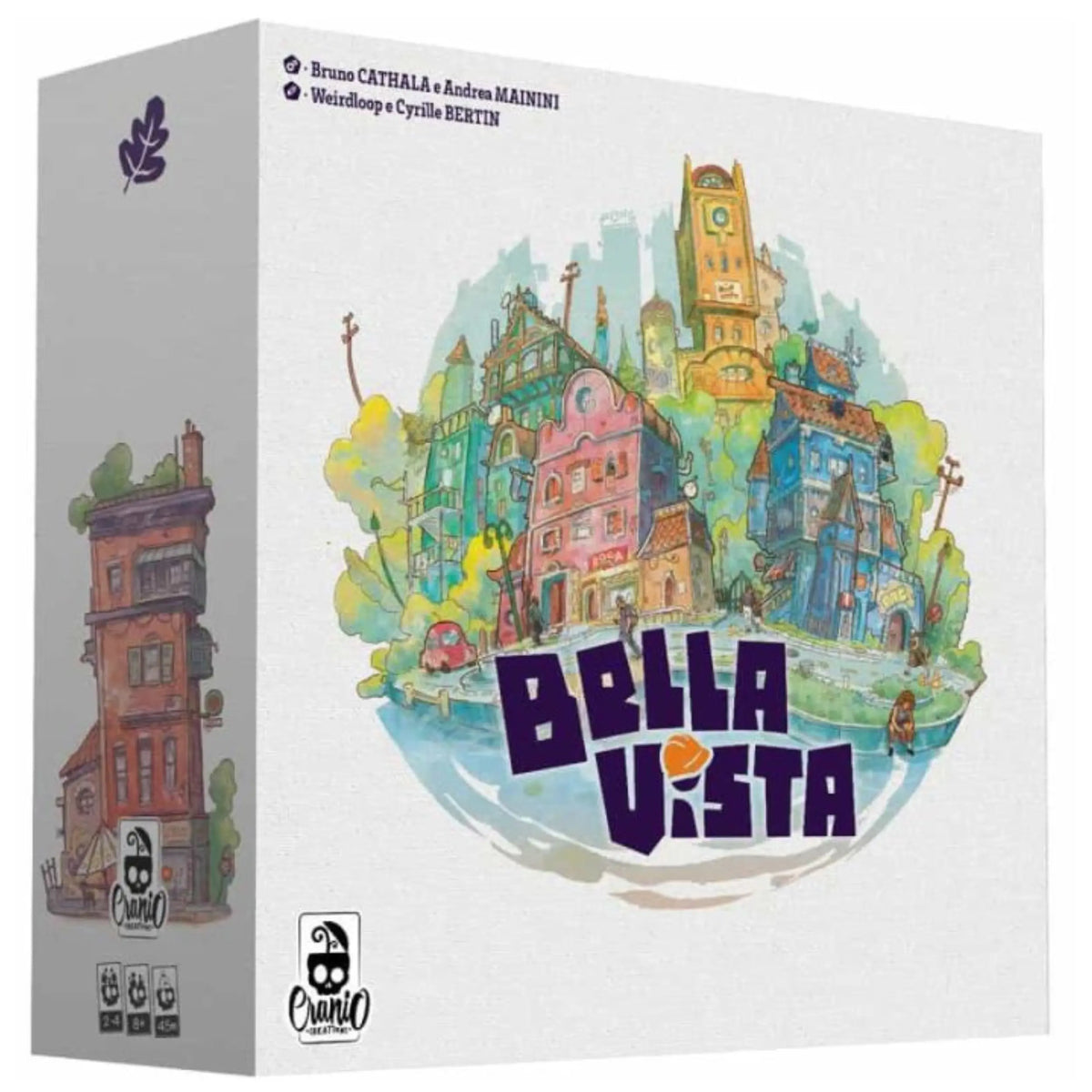
Bella Vista is designed by Bruno Cathala (Five Tribes, 7 Wonders Duel) and Andrea Mainini, bringing an urban planning challenge to the table where every building is valued by the view it provides. Art by Cyrille Bertin and Léa Menard, published by Cranio Creations in Italian.
You are an architect with eight buildings of different heights: from the ground floor to the eighth floor. Your goal is to place them to maximize your view of the city parks. But every turn, you must buy your position in the turn order: those who want to go first pay, those who wait save money but risk others snatching the best spot. The winner is whoever has built everything and kept the most money.
What they say abroad
"You are architects, striving to offer your residents the best possible view of the city’s parks."
— Studio H
The game presents itself as a concentration of decisions within 45 minutes: each building is a choice you cannot redo, and the turn auction adds that layer of economic tension that keeps everyone on edge.
— FroGames

Bella Vista
FrogScore · FroGames editorial rating · based on rules, international reviews, and gameplay sessionsYour tools
Eight buildings, one game to place them all
Eight buildings of increasing height
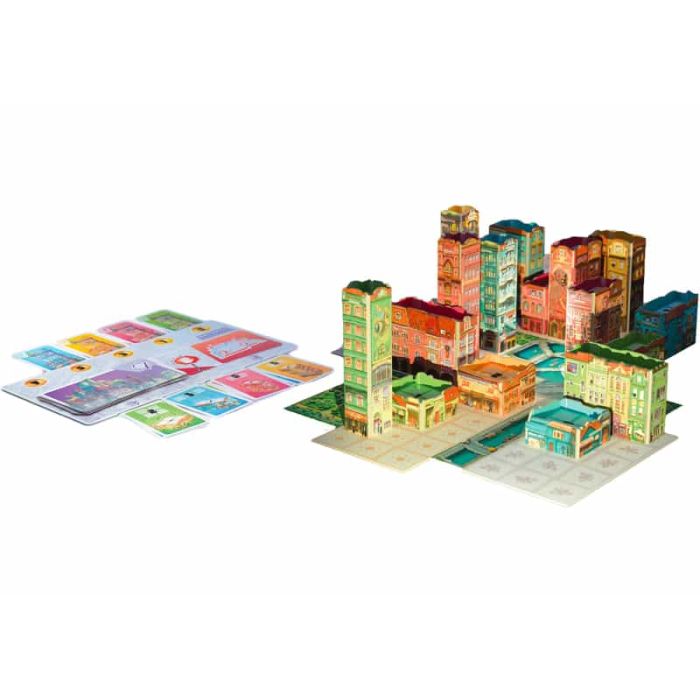
From the ground floor to the eighth floor. You use each building only once, and you have to decide WHERE to place it to maximize the view of the parks. Height counts: those who are higher see over lower buildings.
Auction system for turn order
Each round you offer money to decide who builds first. Whoever pays more chooses the lot first; whoever saves money waits and settles for the scraps. The tension is economic: do you spend now or save for later?
Parks and lines of sight
The city parks are the center of everything. Every building that has a line of sight to a park scores points, but only if it's high enough not to be covered by others. The map is a three-dimensional puzzle.
City Council objectives
The City Council has specific requests: building in certain districts, meeting minimum height requirements, completing entire blocks. Those who satisfy these earn extra points, but they force you to deviate from your ideal plan.
Come si gioca
Video dimostrativo di gameplay.
🎲How to playThe rules in four steps▼
How to play
Each round's flow
Every turn is a fixed cycle: auction, placement, scoring. The game ends when everyone has placed their eight buildings.
Everyone bids money simultaneously. Whoever bids the most becomes the first player, while the lowest bidder becomes the last. Spent money is lost forever: it is part of the final score.
In turn order, everyone chooses an empty lot on the map and places one of their eight buildings there. The building's height determines what it sees: if it is covered by taller buildings in front of it, it loses its view of the park.
If someone has completed a City objective (e.g., three buildings in a district, at least one six-story building), they declare it and score the points. Objectives are public: everyone can see who is about to complete them.
Start over with a new auction. The game ends when everyone has placed their eight buildings. At that point, tally the score: view points, completed objectives, and remaining money. The highest total wins.
⏱️Your first gameThe chronicle, moment by moment▼
A game in five moments
What happens at the table
Not the rules. The experience.
The map takes shape
Prepare the city: parks, available lots, and City objectives. Everyone studies the map, calculates lines of sight, and identifies golden lots. The first building is always easy: there is space for everyone. From the second one on, you start stepping on each other's toes.
The first real auction
Third or fourth turn: someone has identified THE perfect lot, the one that guarantees points. The auction heats up. Someone spends half their budget just to go first; someone else withdraws and waits. Whoever builds there sets up a tall building and ruins the view for everyone else. Whoever saved money consoles themselves with their cash.
The map closes in
Mid-game: the best lots are occupied, lines of sight get complicated. You have to start placing your low-rise buildings, the ones you don't want but need to get rid of. Someone realizes they messed up a building three turns ago. The others thank them mentally.
Objectives become crucial
Last three buildings: everyone looks at the City objectives. You need those extra points to win. Someone deviates from their initial plan to complete a district; someone places an eighth-story building in an absurd spot just to meet a requirement. Auctions are now worth double: it's not just about the lot, it's about the victory.
The final count
Everyone has built their eight buildings. Points are counted view by view, park by park. Objectives are checked. Someone discovers they forgot a requirement. The victory goes to whoever built the best AND saved the most money. Slim margins, always.
🐸Good to knowThree honest things, between friends▼
Good to know
Three things to know before buying
The money you spend to go first does NOT come back: it is part of your final score. This means you must always balance: is it better to pay a high price for that perfect lot, or better to save and settle? There is no single answer, which is beautiful but also frustrating for those who want mathematical certainties.
Lines of sight are three-dimensional: you must understand which buildings cover which others, what a 5-story building sees if there is a 7-story building in front of it. It is not immediate, and in the first few games you will make mistakes that cost points. With experience it becomes automatic, but it requires practice.
With two players, the map is less contested, auctions lose their edge (often it's better to offer nothing and go second), and objectives are easier to complete. The game works, but it loses that economic tension which is its strong point. Bella Vista is at its best with three or four.
🏆Victory and defeatWhat counts at the end▼
How it ends
How to win and how to lose
The game ends when everyone has placed their eight buildings. At that point, points are tallied and the person with the highest total wins.
Victory
- Each building that sees a park scores points (the more parks it sees, the more it is worth)
- Completed City objectives give fixed extra points
- Saved money counts as final points (1 coin = 1 point)
Defeat
- You spent too much in the auctions and ended up with zero money left
- You placed low buildings in spots that were later covered by taller buildings
- You ignored objectives and others surpassed you with bonus points
Bella Vista is pure strategy in 45 minutes. There are no dice, there is no luck: whoever builds best and spends wisely wins. If you are looking for a gateway game with real depth, this is the right one.
💬Frequently Asked QuestionsQuick answers before the cart▼
Frequently Asked Questions
FAQ on Bella Vista
What mechanics does Bella Vista use?
The heart is the turn order auction combined with spatial placement on a map. Secondarily: set collection for City objectives, line of sight for view calculation, and end-game scoring with remaining money. No cards, no dice: just auctions, buildings, and geometry.
Is it suitable for those who have never played an Eurogame?
Yes, with reservations. The rules are simple (auction, place, count), but the calculation of lines of sight and economic management require a minimum of familiarity with spatial thinking. It is an excellent second Eurogame, less suitable as a very first one. If the group has already played Carcassonne or Ticket to Ride, Bella Vista is the perfect next step.
How long does a game take?
The box says 30-45 minutes, and that is accurate. The first game nears 50-60 minutes because everyone is studying lines of sight. From the second game on, it stabilizes at 35-40 minutes. With two players it is even faster (25-30), but as stated above, it loses its edge.
Is there interaction, or does everyone play for themselves?
Constant indirect interaction: the auction is pure economic conflict (do I spend to steal the lot, or save?), and every building you place can block someone else's view. There is no direct attack or cards that ruin others' plans, but every move you make changes the map for everyone. Interaction lies in reading others, not in destruction.
Is it available in English?
Yes. The edition sold on FroGames is published by Cranio Creations in Italian: rulebook, objective cards, references on the board. The game is highly language-independent (the map is visual, buildings are numbered tokens), but having everything in Italian makes setup and explanation immediate.
The people behind the game
Who invented it, who illustrated it, who publishes it — and what else they have done.
Bella Vista is a strategic board game by Bruno Cathala and Andrea Mainini for 2-4 players, 30-45 minutes long, recommended for ages 10+. Published by Cranio Creations, it combines turn order auctions with urban spatial map placement. The 3D line-of-sight system and economic management make it an accessible yet deep Eurogame, ideal for families and intermediate players looking for pure strategy without luck. Available on FroGames.it with immediate shipping.
Bella Vista
Frequently Asked Questions
The answers you're looking for, no beating around the bush.
📸Do the images match the actual product?
The photos on the website often come from BoardGameGeek and are intended to give you an idea of the game. They may vary slightly from the version you receive. The content declared by the publisher is always binding.
📦Does the content of the box match what is indicated?
We always strive to provide the correct content, but minor variations are possible due to reprints or updates. The information comes directly from the publishers. If you have any questions, please contact us!
⏳How do pre-orders work?
Pre-order the game before release, payment is immediate, and the game is reserved for you. As soon as it arrives, we'll ship it right away! If there are any delays, we'll update you promptly.
🔒Can I trust buying here?
Absolutely! Secure payments, tracked shipments, and a team that loves board games as much as you do. If something goes wrong, we'll do our best to fix it.
🛠There's a problem with my order, what should I do?
Write to us now! Whether it's a missing part, damage, or an error, we'll help you resolve it as soon as possible. Your experience truly matters to us.