
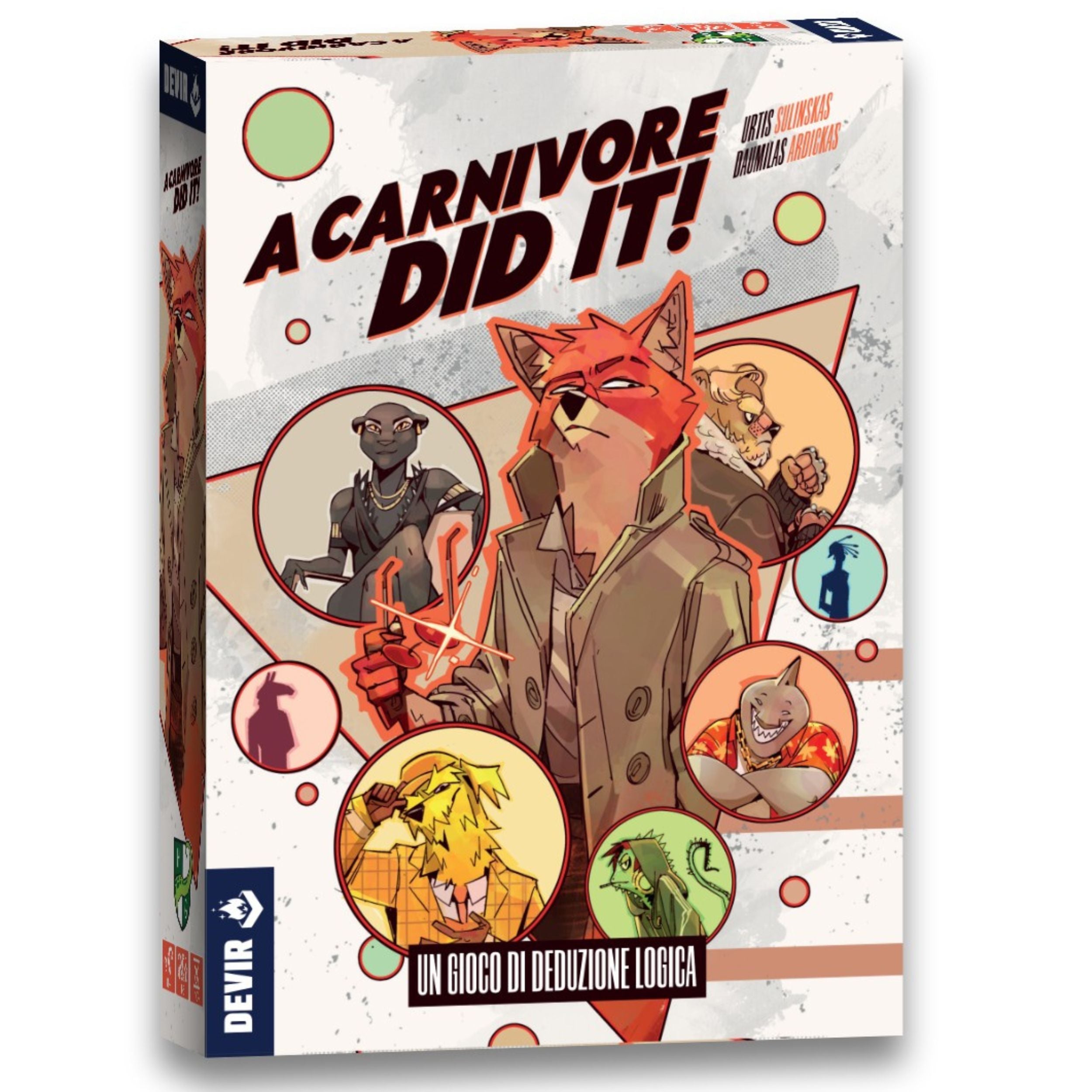
A Carnivore Did It! - ITA
🐸 Dettagli da BoardGameGeek
Consiglio BGG sul numero di giocatori
Categorie
Meccaniche
Design & Art
Lingua
Pre-order - leggi i dettagli
🐸 Una rana saggia sa quando dividere l’ordine… e quando aspettare il salto giusto.







Si abbina bene con
The FroGames Card
You have seven suspects. Someone always lies, someone tells the truth, someone only half. The card with the culprit is on the table. You just need to figure out which one.
WHAT IT IS ABOUT
A logic book disguised as a game with suspicious animals
Daumilas Ardickas and Urtis Šulinskas (the same creators of HABA's The Key) built a logical puzzle generator with paper and numbers. Horrible Guild packaged it with Cecilia Lonnie's illustrations: anthropomorphic animals, funny faces, improbable crimes. Beneath it all is pure mathematics.
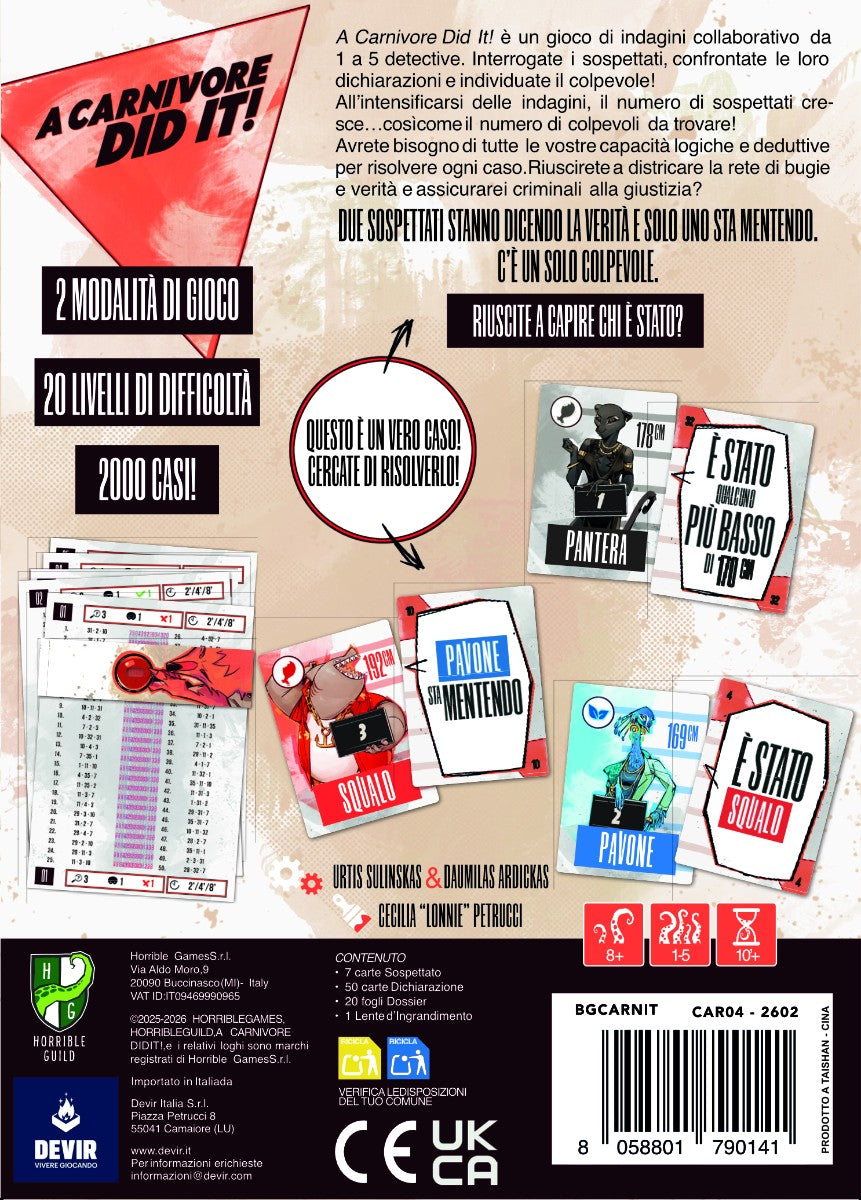
Each case gives you a deck of suspect cards and a handful of statements. "The Shark tells the truth," "A carnivore did it," "The Tiger lies." You know how many culprits you're looking for, you know how many are lying. You have to cross-reference everything and find the only possible solution. The first cases are straightforward. By case 500, you have seven suspects, conditional statements, and percentages of truth. The campaign mode links cases and times you: the longer it takes, the fewer points.
What they say abroad
"A Carnivore Did It!"
— Horrible Guild
Two thousand cases means months of games. The progression is perfect: you feel smart until the case that humbles you.
— FroGames

A Carnivore Did It!
The game is designed to work for 1 to 5 players without modifications: each case is a closed puzzle, solving it alone or in a group only changes the pace of discussion. Solo you lose the comparison of hypotheses but gain pure concentration. The experience is identical, the timed campaign rewards those who think fast.
FrogScore · FroGames editorial rating · based on rules, international reviews and game sessionsThe ingredients of the case
What you find in each puzzle
Suspect cards
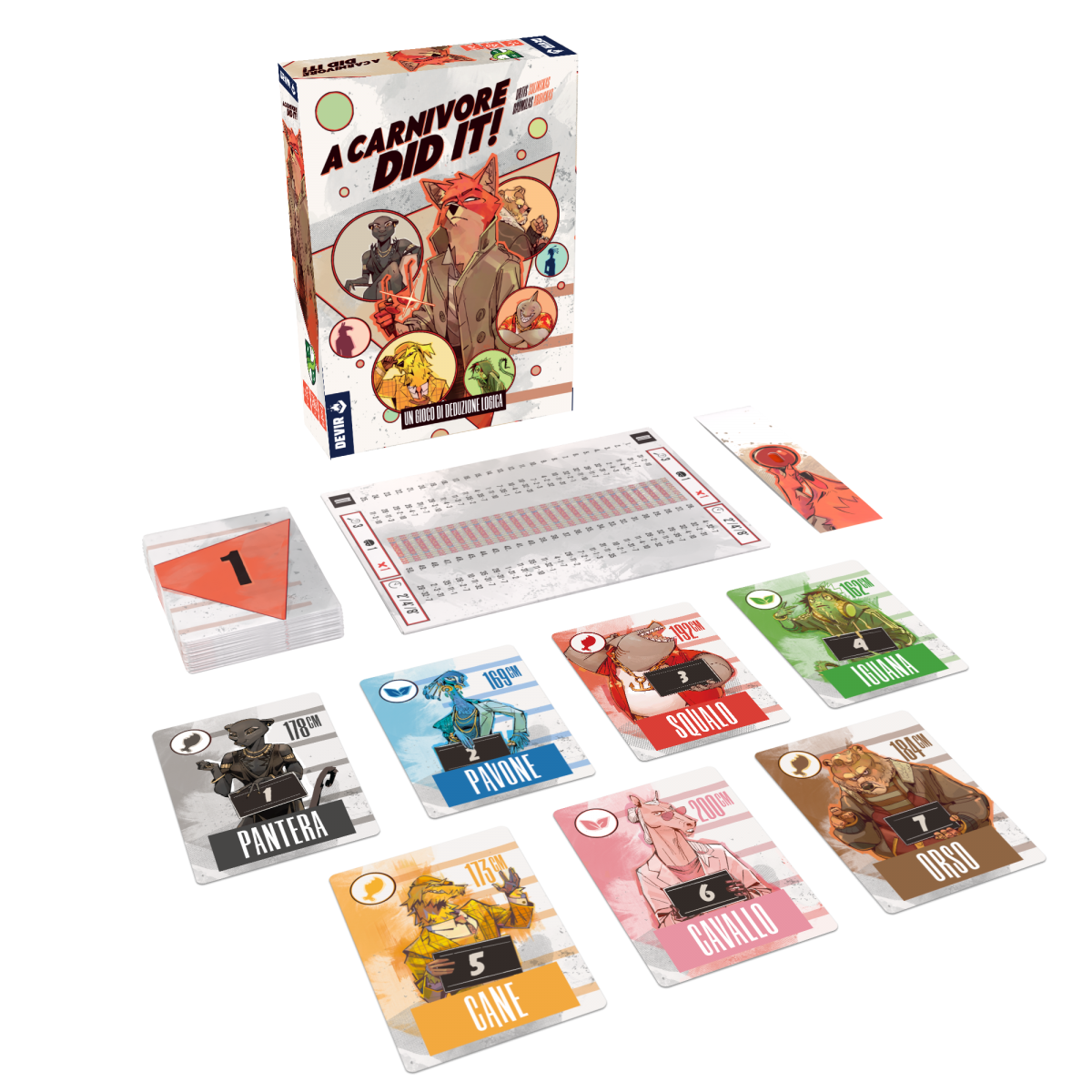
Three to seven animals per case, each with name, species, and diet (carnivore/herbivore/omnivore). This data is key: when a statement says "a carnivore did it," you look at the cards and cross-reference.
Statements
Phrases like "The Tiger tells the truth," "Exactly two herbivores lie," "If the Bear is guilty, then the Shark tells the truth." In advanced cases, statements are conditional and you have to build logical trees.
Case information
Number of culprits to find (1, 2, or 3), how many suspects lie, how many tell the truth. In the first cases, it's binary (true/false), then you introduce percentages: "3-4 suspects are 50% honest."
Campaign mode
A series of cases linked by a light plot. You are timed: solve quickly to maximize your score. It gives you a goal beyond the single case and puts pressure (if desired) on your reasoning.
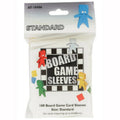
Recommended sleeves 57 cards in 1 dimension ▼
If you play often, we recommend protecting the cards with transparent sleeves to make them last a long time.
| Dimension | Quantity |
|---|---|
| 63 × 88 mm | 57 |
| Total cards | 57 |
Come si gioca
Video dimostrativo di gameplay.
🎲How to PlayThe rules in four steps▼
How to Play
The flow of each case
Each case is a closed loop: read, deduce, verify, solve.
Choose a case number (or let the campaign choose for you). Take the corresponding suspect cards, line them up face up. Read the information: how many culprits, how many are lying, how many are telling the truth. In basic cases it's simple; in difficult ones you have percentages (e.g. "3-4 suspects tell the truth 50% of the time").
Each case has 4-7 printed statements (or on separate cards). Read them all before starting. Some are direct ("The Tiger is guilty"), others conditional ("If the Bear lies, then the Shark tells the truth"). In advanced cases, statements are intertwined: you need to keep track mentally or on paper.
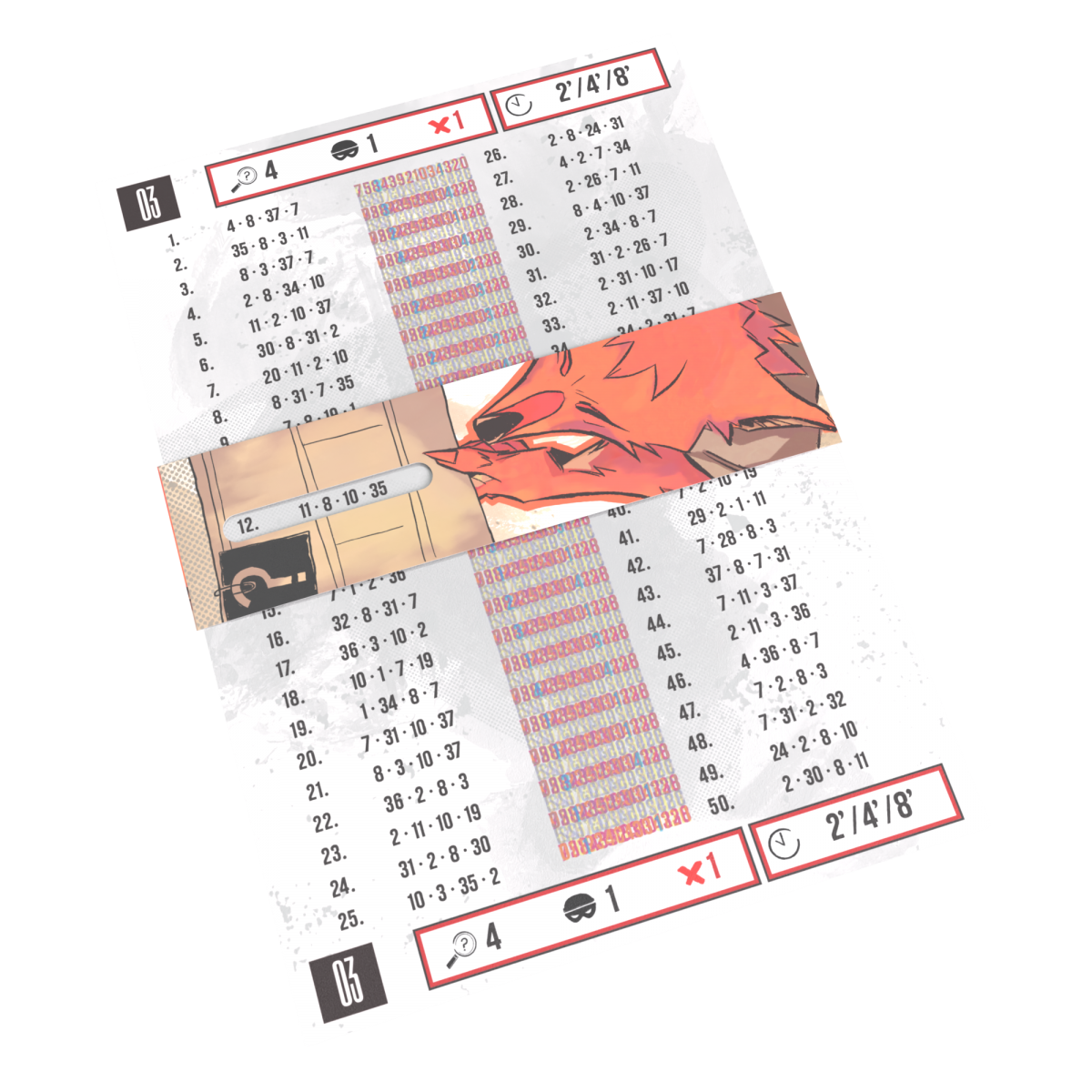
Cross-reference the statements with the suspect data (species, diet). Reason by hypothesis: assume X is true, verify if it holds. If it creates a contradiction, discard the hypothesis. Proceed by eliminating possibilities until only one remains. In a group, speak out loud; alone, use pen and paper if the case is complex.
When you are sure, flip the solution card (or check the back of the booklet). If you guessed correctly, move on to the next case. If you made a mistake, reread to understand the error: it's usually a misread statement or a skipped logical implication. In a campaign, note the time taken to calculate the final score.
⏱️Your first gameThe chronicle, moment by moment▼
A game in five moments
What happens at the table
Not the rules. The experience.
You draw the case and read the cards
Line up the suspect cards, read the statements, note how many culprits you're looking for. The first few seconds are calm: you're gathering data. Someone says "easy," someone else is already cross-referencing information mentally.
First hypothesis (and first dead end)
Someone suggests: "If the Tiger lies, then the Shark is guilty." You check. It doesn't square with another statement. You erase everything. Solo, you re-read; in a group, someone notices the error before you do. The first cases collapse quickly, the difficult ones hold out.
Build the logical tree
Now you reason by exclusion: if A is true, B must lie. But B only lies if C is guilty. And C cannot be guilty because it contradicts D. In advanced cases, you pull out pen and paper, draw tables, erase, try again. The table is silent, filled with pencils.
Everything collapses in an instant
A statement you had ignored lights up: you realize that's the key. You re-read everything with the new information and the case collapses in thirty seconds. The solution was there all along, hidden in a seemingly secondary sentence. Someone laughs, someone else feels foolish.
Check and score
You turn over the solution card: if you made a mistake, reread to understand where. If you guessed correctly, you note the time (in campaign mode) or draw the next case. The first cases take five minutes, the later ones half an hour. Satisfaction grows with difficulty.
🐸Things to know beforehandThree honest things, from friends▼
Things to know beforehand
Three things you need to consider
If logic bores you, the theme isn't enough
The cute animals are just a facade: underneath is pure boolean logic. The first cases are straightforward, then you'll need mental tables, reasoning by exclusion, and building decision trees. If sudokus put you to sleep, this game will too. It's not a flaw; it's the audience: either you like to reason or you don't.
The difficulty curve is steep after case 100
The first fifty cases are disguised tutorials: they teach you basic patterns (carnivores/herbivores, fixed liars). After case 100, conditional statements, truth percentages, and multiple suspects are introduced. By case 500, you'll need pen and paper; it's no longer solvable in your head. The progression is good but not linear: be prepared to get stuck.
In a group, it works if everyone reasons together
It's not a party game: if one person solves everything and the others just watch, it dies. It works when everyone participates in the deduction, checks each other's hypotheses, and proposes paths. Solo it's perfect (no downtime, no waiting), in two/three it's great if you're aligned. With five players, you risk downtime if someone is slower or gets distracted: not everyone has the same logical pace.
🏆Victory and defeatWhat the ending rewards▼
How it ends
Victory and defeat (or rather: solution and frustration)
Each case has only one correct solution. Either you find it or you don't. There are no partial points.
Correct solution
- You identified all the culprits indicated by the case (1, 2, or 3 depending on difficulty)
- Your deductions hold up to all provided statements without contradictions
- In campaign mode: you solved it within the target time to achieve maximum score
Logical error
- You indicated a wrong culprit (the solution card reveals it immediately)
- You missed a culprit (in cases with 2-3 culprits, it's easy to forget one)
- You built a reasoning that seemed solid but contained a hidden error: reread the statements to find it
Two thousand cases means that you will finish this game when you decide, not when the game ends. It's a logic book that will last you for years.
💬Frequently Asked QuestionsQuick answers before checkout▼
Frequently Asked Questions
FAQ about A Carnivore Did It!
How long does it really last? Is 20 minutes per case or per game?
Twenty minutes is the average duration of a single case. You'll solve the first cases in 5 minutes, while difficult ones can take half an hour or more if you get stuck. A typical "game" is solving 3-5 cases in a row, so count on a 1-2 hour session. The campaign links multiple cases together with a narrative thread, but you still play case by case.
Does it work well solo or do you need to play in a group?
It works very well solo; in fact, many prefer it that way: no waiting, you reason at your own pace, you use pen and paper freely. In a group (2-3 people is ideal), you gain from discussing hypotheses and having someone point out errors you might have missed alone. With 4-5 players, you risk downtime if someone is slower or gets distracted: not everyone has the same logical pace.
After doing many cases, do patterns repeat?
Yes, after case 200-300, you start to recognize recurring structures: certain combinations of statements repeat, certain logical tricks reappear. It doesn't make the game useless (the solution still needs to be found), but it reduces the wonder. It's like doing crosswords: after a thousand puzzles, you read them differently. If you're looking for infinite surprise, you won't find it. If you're looking for logical training, it works for years.
Does it require math or is intuitive reasoning enough?
In the first 100 cases, intuitive reasoning is enough: you read, cross-reference, find. Later, conditional statements ("if X then Y") and truth percentages are introduced: there you'll need basic formal logic, similar to what you use in advanced sudokus. You don't need university-level math, but if you struggle with "if A implies B, and B is false, then A is false," some cases will block you. Pen and paper help a lot.
Is it available in Italian?
Yes, the edition sold on FroGames is in Italian, published by Devir. Cards, statements, case booklet, and rulebook are all translated. The language dependence is total (you have to read the statements to solve the cases), so the Italian edition is essential if you don't speak English.
The people behind the game
Who invented it, who designed it, who publishes it — and what else they've done.
A Carnivore Did It! is a cooperative logical deduction game for 1-5 players, lasting 20 minutes per case, recommended age 8+. Designed by Daumilas Ardickas and Urtis Šulinskas, published by Horrible Guild and distributed in Italy by Devir. It offers two thousand unique cases with increasing difficulty: from basic puzzles to complex riddles with conditional statements and percentage truths. Includes a campaign mode with timed scoring. Works perfectly solo or in small collaborative groups. Available on FroGames.it.
A Carnivore Did It! - ITA
Frequently Asked Questions
The answers you're looking for, no beating around the bush.
📸Do the images match the actual product?
The photos on the website often come from BoardGameGeek and are intended to give you an idea of the game. They may vary slightly from the version you receive. The content declared by the publisher is always binding.
📦Does the content of the box match what is indicated?
We always strive to provide the correct content, but minor variations are possible due to reprints or updates. The information comes directly from the publishers. If you have any questions, please contact us!
⏳How do pre-orders work?
Pre-order the game before release, payment is immediate, and the game is reserved for you. As soon as it arrives, we'll ship it right away! If there are any delays, we'll update you promptly.
🔒Can I trust buying here?
Absolutely! Secure payments, tracked shipments, and a team that loves board games as much as you do. If something goes wrong, we'll do our best to fix it.
🛠There's a problem with my order, what should I do?
Write to us now! Whether it's a missing part, damage, or an error, we'll help you resolve it as soon as possible. Your experience truly matters to us.