

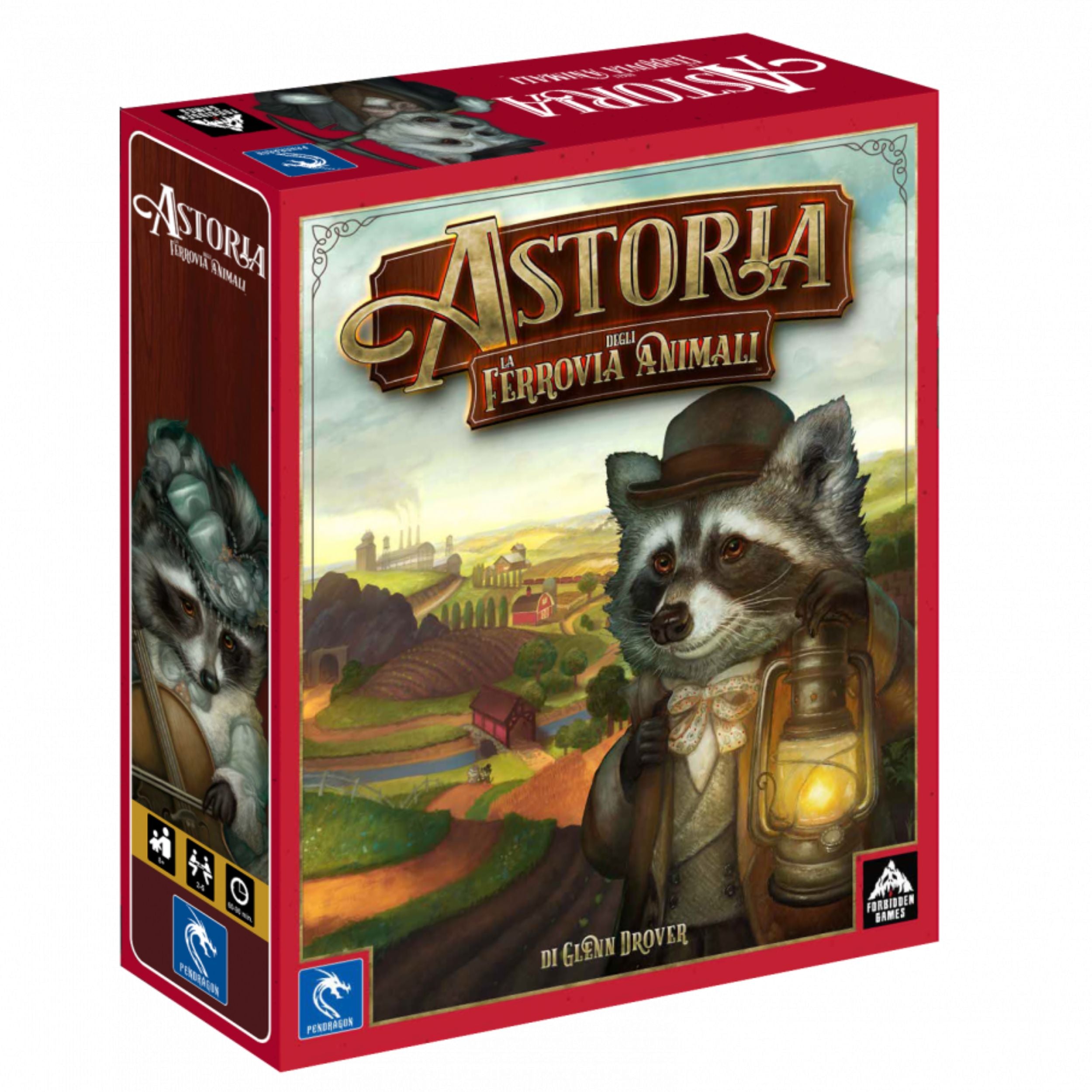
Astoria
🐸 Dettagli da BoardGameGeek
Consiglio BGG sul numero di giocatori
Categorie
Meccaniche
Design & Art
Lingua
Pairs well with
FroGames — Moments You'll Remember
The market fluctuates, prices crash and rebound. Some hoard grain, others railroads. And in the end, you discover your perfect plan was worth half of what you thought.
WHAT IT'S ABOUT
Fortune and expansion in the land of Astoria
Astoria is a booming land. New cities, factories, and railroads are springing up everywhere. Glenn Drover, veteran designer of franchises like Sid Meier's Civilization and Age of Empires III, brings his expertise to an accessible yet never trivial economic game. Illustrations by Annie Stegg and Jacoby O'Connor depict an animal world experiencing its golden age.
You are a rising tycoon. You produce raw materials (grain, wood, iron, coal, luxury goods), sell them at the right time, build cities to multiply profits, and participate in cutthroat auctions to snap up the most valuable railroads. The market changes every turn: whoever speculates best wins. Whoever falls behind watches others get rich.
What they say abroad
"A tight, engaging economic game that feels approachable without losing depth."
A tight, engaging economic game that feels approachable without losing depth.
— The Opinionated Gamers
The beauty of Raccoon Tycoon is that everyone understands what to do. The challenge is figuring out when to do it.
— FroGames

Raccoon Tycoon
FrogScore · FroGames editorial rating · based on rules, international reviews, and play sessionsYour arsenal
What you manage in Astoria
Raw materials
Grain, wood, iron, coal, manufactured goods. Produce, accumulate, sell when the price rises. Every move by others changes the market.
Cities
Build cities by spending resources. Each city gives you victory points and makes the goods you produce more valuable. The more cities you control, the more you earn.
Railroads
Won at auction. Railroads are worth many points and provide permanent bonuses. Whoever controls them has a huge advantage in the endgame.
Buildings
Building cards that offer special powers: extra production, discounts, multipliers. Buying them at the right time changes the game.
Recommended sleeves 308 cards in 2 sizes ▼
If you play often, we recommend protecting your cards with transparent sleeves to make them last longer.
| Size | Quantity |
|---|---|
| 63 × 88 mm | 268 |
| 80 × 120 mm | 40 |
| Total cards | 308 |
In the end, someone will have speculated better. And everyone else will understand exactly where they messed up their timing.
A game in five acts
What happens at the table
Not the rules. The experience.
Setup and first moves
Everyone starts with some resources and zero points. The board shows the market: each commodity has a price. The first turns are cautious explorations: some produce wheat, others wood. Prices start to move. No one knows yet where the market will go.
The market goes wild
Someone sells a ton of iron and the price plummets. Another player responds by producing coal: the price of coal skyrockets. You realize that every move you make influences everyone. You start planning not only what to do, but when to do it. Cities appear on the board.
First auctions, first clashes
The first railway goes up for auction. Everyone has accumulated money, but no one wants to spend too early. The auction rises, some withdraw, others bid again. The winner pays a high price, the loser bites their hands. The board fills with cities and special buildings.
Final moves
Only a few turns left. Some have accumulated railways and cities, others have focused on powerful buildings. The market is unstable: a massive sale can ruin someone's plan. The final auctions become brutal. No one wants to make a mistake now.
Final count
Points are counted from cities, railways, commodity sets. Some discover they accumulated too much and sold too little. Others won one auction too many and don't have enough points. The difference between first and second is often a single wrong move.
How to play
The flow of each round
A turn is fast. One action card, one immediate consequence, and it's the next person's turn.
Choose a card from your hand. Each card allows you to produce raw materials (raising the prices of other commodities) or sell at the current price.
Produce resources (and the prices of others rise), sell goods to the market for money, build cities by spending resources, buy special buildings, or start an auction for a railway.
If you have produced or sold, prices change immediately. The board reflects the new situation. Everyone sees what has happened.
You draw a new action card and the turn passes. The game ends when someone builds their last city or the last railway is bought.
Why it's different from others
Six mechanics that make a difference
Dynamic and transparent market
There are no dice or hidden cards. Every price is visible, every move changes it. Speculation is pure board reading and timing. Produce when prices are low, sell when they rise. Easy to say, hard to do when everyone is playing simultaneously.
Turn-based auctions until pass
Railways are won at auction. It's not a simultaneous auction: it goes clockwise, everyone bids or passes. Those who pass are out. The winner pays, but railways are worth many points. You know exactly how much others are willing to spend. Psychology matters.
Cities that multiply earnings
Building cities costs resources, but each city amplifies the value of the goods you produce. The more cities you have, the more money you make by selling. It's a long-term investment that radically changes your economic engine. Those who build early earn more later.
Buildings with permanent powers
Buildings are bought by spending money. Each gives a unique bonus: extra production, construction discounts, point multipliers. They are not mandatory, but those who use them well accelerate a lot. The building market is limited: take what you need or someone else will.
Hidden set collection
Some railways and buildings give bonus points if you own specific sets of cities or commodities. It's not stated aloud: you have to look at other people's cards and figure out what they are collecting. Those who complete sets get point explosions at the end.
Balance between liquidity and development
You always have a choice: accumulate money for auctions or invest in cities and buildings? Money doesn't give points, but without money you lose railways. Cities give points, but building them drains your resources. The game is a constant balance between short and long term.
How it ends
How to win and how to lose
The game ends when someone builds their fifth city or the last railway is bought. Points are counted.
Victory
- Points from cities built: each city is worth 1-3 fixed points plus variable bonuses
- Points from railways won at auction: the most valuable are worth 5+ points
- Points from set collection: cities of the same color, matched railways, building bonuses
Defeat
- You sold too early: prices rose later and you left money on the table
- You built cities without winning railways: solid points but not enough to beat those who dominated the auctions
- You won too many auctions and don't have enough cities: you spent everything on railways and were left without development
Raccoon Tycoon is accessible economics that doesn't sacrifice depth. Everyone understands what to do. Few understand when to do it really well.
Frequently asked questions
Raccoon Tycoon FAQ
Is it suitable for those who don't like heavy economic games?
Absolutely. Raccoon Tycoon has immediate mechanics: produce, sell, build, participate in auctions. Depth emerges from timing and interactions, not from complex rules. It's the ideal gateway to more structured economic games like Brass or economic Terraforming Mars. First functional game in 20 minutes.
Do auctions work well with 2 players?
They work, but the game is best with 3-5 players. In two, auctions are less competitive and the market fluctuates less. It's still a good economic game, but it loses some of its tension. If you often play as a couple, consider specific two-player titles like Targi or Mandala.
How long does a game really last?
First game: a good 90 minutes, between explanation and slow decisions. From the second game onwards: a stable 60-75 minutes. With fast players, even 50 minutes. Turns are quick, but auctions prolong it. It's not a filler, but not an all-night commitment either.
Does it require complex calculations or is it intuitive?
The market is mathematical but accessible. Complex calculations are not necessary: prices are clear, sales are immediate. Intuition matters: you have to read what others are doing and understand if the price will rise or fall. Those who love optimization will find room for calculations, but it's not mandatory.
Is it available in Italian?
Yes, this is the Italian edition curated by Pendragon Game Studio. Rulebook, cards and components fully translated. Language dependency is moderate: once the icons are learned, the game flows smoothly.
Raccoon Tycoon is an economic board game for 2-5 players, lasting 60-90 minutes, recommended age 8+. Designed by Glenn Drover (Sid Meier's Civilization, Age of Empires III) and published in Italy by Pendragon Game Studio, it brings market speculation, competitive auctions, and set collection to the table in an accessible animal setting. Main mechanics: commodity speculation, turn-based auctions until pass, dynamic market. Produce raw materials, build cities, win auctions for valuable railways. The market changes every turn, every move influences prices. Ideal as a gateway to more complex economic eurogames. Available on FroGames.it.
Frequently Asked Questions
The answers you're looking for, no beating around the bush.
📸Do the images match the actual product?
The photos on the website often come from BoardGameGeek and are intended to give you an idea of the game. They may vary slightly from the version you receive. The content declared by the publisher is always binding.
📦Does the content of the box match what is indicated?
We always strive to provide the correct content, but minor variations are possible due to reprints or updates. The information comes directly from the publishers. If you have any questions, please contact us!
⏳How do pre-orders work?
Pre-order the game before release, payment is immediate, and the game is reserved for you. As soon as it arrives, we'll ship it right away! If there are any delays, we'll update you promptly.
🔒Can I trust buying here?
Absolutely! Secure payments, tracked shipments, and a team that loves board games as much as you do. If something goes wrong, we'll do our best to fix it.
🛠There's a problem with my order, what should I do?
Write to us now! Whether it's a missing part, damage, or an error, we'll help you resolve it as soon as possible. Your experience truly matters to us.