

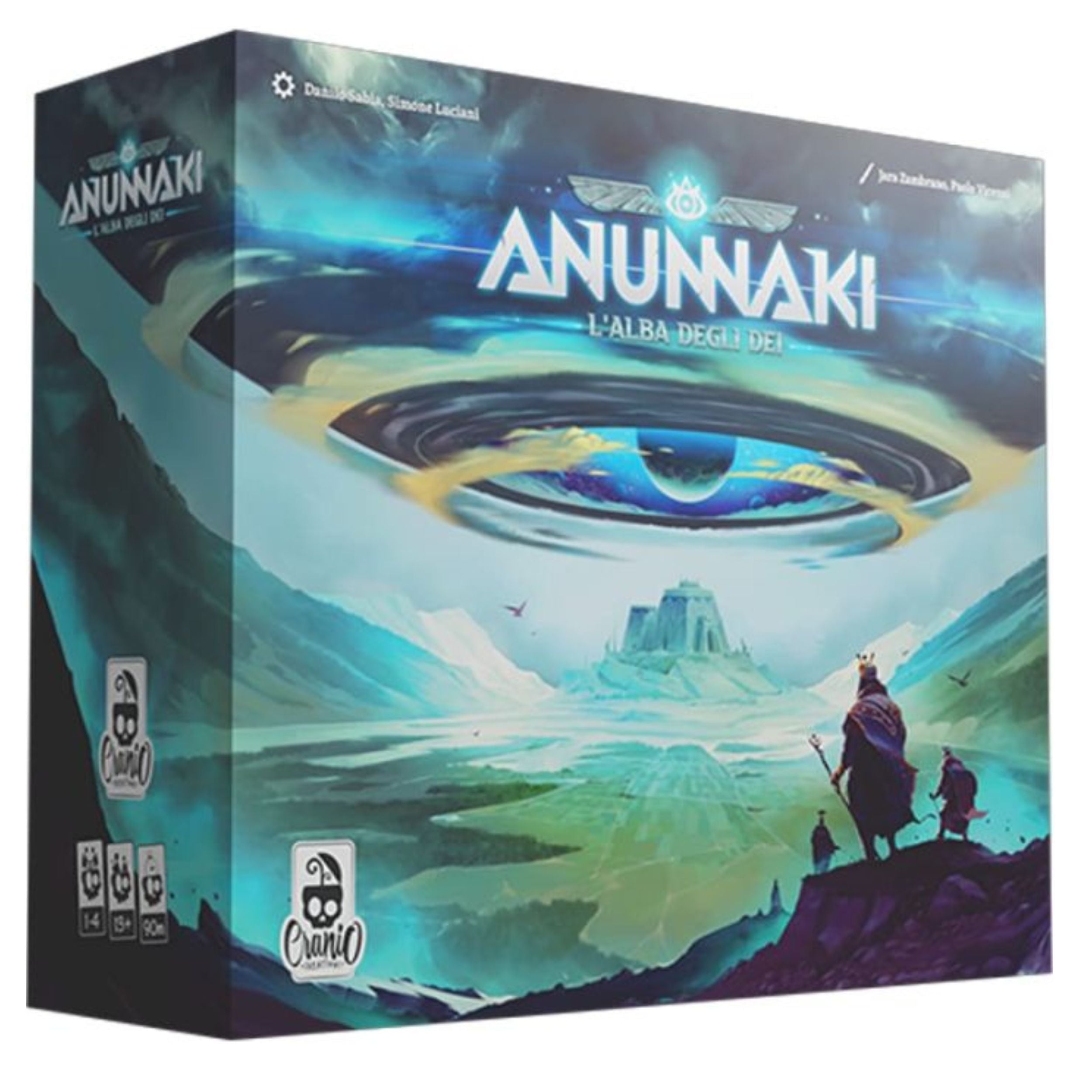
Anunnaki - The Dawn of the Gods
🐸 Dettagli da BoardGameGeek
Consiglio BGG sul numero di giocatori
Categorie
Meccaniche
Design & Art
Lingua
Pre-order - leggi i dettagli
🐸 Una rana saggia sa quando dividere l’ordine… e quando aspettare il salto giusto.
Pairs well with
FroGames — Moments You'll Remember
Every turn you decide whether to follow the path of the gods or break the chain. Every choice costs something. And in the end, you realize you weren't playing against others, but against your own plan.
WHAT IT'S ABOUT
When gods were aliens seeking a home
Simone Luciani (Tzolk'in, Lorenzo il Magnifico) and Danilo Sabia co-create a 4X eurogame where mythology and science fiction merge. You are an alien House fleeing your dying planet. Destination: Gaia, home to the magnificent civilization of Atlantis. But you are not alone. Other Houses want the same thing: to dominate, conquer, and become the gods of this new world. Art by Paolo Vicenzi and Jara Zambrano completes a dystopian and ancient world.
Build bases, recruit troops, embody deities, explore territories, develop technologies, sign trade agreements, defeat local dominations and enemy armies. Your goal is to conquer Atlantis and its treasures. Every action gives you immediate victory points. Random setup objectives reward specific conditions at the end of the game. But the real challenge is the action selection system: a personal star-shaped board where you can reincarnate your gods by following predefined paths, or freely jump between actions by sacrificing some deities. Total control, zero luck.
What they say abroad
A 4X that feels like a Eurogame, where every decision matters more than any die roll.
— FroGames
The star system transforms action selection into a spatial and temporal puzzle.
— FroGames

Anunnaki - Dawn of the Gods
Solo mode integrated into the basic rules. The game offers challenges against automated opponents that simulate the other Houses. The strategic experience remains complete, but of course it loses the psychological reading and implicit diplomacy of multiplayer. Excellent for those who want to test builds and strategies without social pressure.
FrogScore · FroGames editorial rating · based on rules, international reviews, and play sessionsThe elements in play
What drives your alien civilization
Star Action Board
The heart of the game. Each House has a personal board where actions form constellations. You can follow predefined paths to reincarnate all your deities, or freely jump between actions, losing some gods but gaining tactical flexibility.
Bases and Troops
Build settlements on Gaia, recruit military units, expand territorial control. Bases give you resources and victory points. Troops are used to conquer local dominations and fight other Houses.
Technology Trees
Each House develops unique technologies that unlock permanent abilities and bonuses. Research is a race: whoever reaches certain nodes first gains exclusive advantages.
Trade Agreements
You sign agreements with terrestrial factions to obtain resources, victory points, or special effects. Contracts are limited and contested: if someone takes them before you, they remain out of play.
Recommended Sleeves 200 cards in 2 sizes ▼
If you play often, we recommend protecting your cards with clear sleeves to make them last longer.
| Size | Quantity |
|---|---|
| 58 × 88 mm | 180 |
| 80 × 120 mm | 20 |
| Total cards | 200 |
In two hours, you'll know if you're a god of planning or a lost alien. Anunnaki is unforgiving, but it rewards long-term thinkers.
A game in five moments
What happens at the table
Not the rules. The experience.
Arrival on Gaia
Everyone studies their star board trying to figure out which path to follow. Some plan three turns ahead, some look for the perfect technology-contract combo. The map is empty, the possibilities infinite. Someone is already asking for clarification on the gods' reincarnation system.
First bases, first clashes
Territories fill up. Someone builds near you and tension immediately rises. Who goes to Atlantis first? Who expands to the edges to gather resources? Technologies begin to diverge: different strategies emerge.
The race for contracts
Mid-game. Good contracts are limited, and everyone wants them. Someone skips a reincarnation to take the contracts action out of sequence, giving up a god but securing sure points. Others follow the orthodox stellar path, accumulating combo bonuses.
The first true conflict
The moment arrives: someone attacks an enemy base or conquers a contested local dominion. Card combat resolves everything without dice, but with tension. Those who invested in troops and combat cards start to reap rewards. Those who didn't wonder if they took the wrong path.
The final count
Last round of actions. Everyone knows that the secret end-game objectives are worth a lot. Those who built the right engine cash in avalanches of points. Those who mistimed things gnaw at their hands. The winner is the one who best balanced expansion, technology, contracts, and combat. And there are no dice to blame.
How to play
The flow of each round
Anunnaki alternates individual phases and moments of direct confrontation, all orchestrated by the star action board.
You look at your star board. You can follow the pre-established path (arrows connecting the actions) to reincarnate your gods in sequence, or freely jump to any action, giving up some deities. Each action has a cost and an immediate benefit.
Build bases, recruit troops, develop technologies, sign contracts, explore new territories, or attack enemies. Each action gives you victory points immediately. If you followed the stellar path, you also activate the power of the god associated with that action.
You pay costs, gather resources from your settlements, and draw combat cards if applicable. Cards are crucial: they determine the outcome of conflicts and provide tactical bonuses. There are no dice.
The next player acts. When everyone has completed a cycle of actions, the round ends. End-game conditions are checked (has someone conquered enough Atlantis? Have all objectives been claimed?). Otherwise, it starts again.
Why it's different from others
Six mechanics that make a difference
Star action system
It's not your usual action wheel. It's a personal stellar board where you can choose between long-term efficiency (following paths, reincarnating all gods) or tactical flexibility (jumping where needed, losing some deities). Every game is a spatial puzzle of timing.
Reincarnation of deities
Gods are not simple disposable powers. By following the stellar paths, you reincarnate them in sequence, unlocking increasingly powerful combos. But if you skip, you lose that reincarnation. The choice is constant: power now or engine later?
Dice-less combat
Conflicts are resolved with combat cards. No dice rolls, no prayers. Those who invested in the right troops and cards win. Those who didn't, lose. Luck is minimized as stated by the publisher. Pure strategy.
Conquest of Atlantis
Atlantis is not just a place on the map. It's the ultimate goal, rich in treasures and victory points. Conquering it requires troops, timing, and territorial control. Those who get there first have huge advantages. But defending it is another story.
Asymmetric tech trees
Each alien House has a unique tech tree. Research unlocks permanent abilities that change your game engine. Those who reach certain nodes first gain exclusive bonuses. The tech race is a game within a game.
Variable setup objectives
At the start of the game, random objectives are drawn that reward specific conditions at the end of the game (e.g., territory control, number of contracts, developed technologies). You don't know what your opponents are aiming for, but you can guess from their moves. Every game requires adaptation.
How it ends
How to win and how to lose
Victory is a sum of immediate points (actions) and final points (objectives). The one who best balances expansion, technology, contracts, and combat wins.
Victory
- You accumulate immediate victory points by performing actions during the game (building bases, signing contracts, conquering territories).
- At the end of the game, revealed secret objectives reward specific conditions: territorial control, number of developed technologies, completed contracts, conquered Atlantis.
- The player with the most total victory points (immediate + final) wins. In case of a tie, the player with the most remaining resources wins, then the player who controls the most territories on Atlantis.
Defeat
- You fail to build an efficient engine: few immediate points, no final objectives met.
- You lose too many battles: your troops are eliminated, your bases conquered by opponents, your territories lost.
- You misjudge the timing: you arrive late for the best contracts, key technologies, Atlantis. Others have already taken everything.
Anunnaki is an eurogame disguised as an alien epic. Zero luck, maximum control, significant weight. If you want a 4X where the best planner wins, not the best dice roller, this is it.
Frequently asked questions
FAQ about Anunnaki - Dawn of the Gods
How complex is it to learn?
Weight 3.5 on BGG. It requires a careful explanation (20-30 minutes) to understand the star action system and the reincarnation of the gods. The first game is slow, the second already fluid. It's not a gateway game: prior experience with heavy eurogames is needed.
Is it a 4X or an eurogame?
Both. It has the eXpand, eXploit, eXterminate of 4X (bases, resources, combat), but the heart is eurogame: elegant action system, minimal luck, engine optimization. If you're looking for chaos and dice, look elsewhere. If you're looking for a controllable 4X, it's perfect.
Does it play well with 2 players?
Yes, the game scales from 1 to 4. With 2 players, the map is less crowded, so there are fewer direct conflicts and more of a race for objectives. The experience is more cerebral, less confrontational. Those who love tactical duels will prefer 3-4 players.
Are the miniatures just aesthetic or functional?
The miniatures represent troops, bases, and structures on the map. They are functional to the game, not just eye-candy. They make the map readable and provide visual impact to territorial conquest. They are not pre-painted: they come in colored plastic.
Is it available in Italian?
Yes, this is the Italian Cranio Creations edition. Rulebook, cards, components, all in Italian. The game has text on the cards (contracts, technologies), so language is fundamental for smooth gameplay.
Anunnaki: Dawn of the Gods is a 4X eurogame board game for 1-4 players, lasting 60-120 minutes, ages 13+. Designed by Simone Luciani (Tzolk'in, Lorenzo il Magnifico) and Danilo Sabia, published by Cranio Creations in Italian edition. Set in a dystopian past where mythology and sci-fi merge, the game sees alien civilizations flee their dying planet towards Gaia to conquer Atlantis. An innovative star action system allows deities to be reincarnated by following pre-established paths or freely jumping between actions. Mechanics include base building, troop recruitment, technology development, trade contracts, card-resolved combat (minimal luck). Variable end-game objectives, random setup, official solo mode. Weight 3.5 on BoardGameGeek, target audience heavy eurogame experts. Components include miniatures, 180 mini European sized cards, 20 large cards. Available on FroGames.it.
Frequently Asked Questions
The answers you're looking for, no beating around the bush.
📸Do the images match the actual product?
The photos on the website often come from BoardGameGeek and are intended to give you an idea of the game. They may vary slightly from the version you receive. The content declared by the publisher is always binding.
📦Does the content of the box match what is indicated?
We always strive to provide the correct content, but minor variations are possible due to reprints or updates. The information comes directly from the publishers. If you have any questions, please contact us!
⏳How do pre-orders work?
Pre-order the game before release, payment is immediate, and the game is reserved for you. As soon as it arrives, we'll ship it right away! If there are any delays, we'll update you promptly.
🔒Can I trust buying here?
Absolutely! Secure payments, tracked shipments, and a team that loves board games as much as you do. If something goes wrong, we'll do our best to fix it.
🛠There's a problem with my order, what should I do?
Write to us now! Whether it's a missing part, damage, or an error, we'll help you resolve it as soon as possible. Your experience truly matters to us.