

Antiquity
🐸 Dettagli da BoardGameGeek
Consiglio BGG sul numero di giocatori
Categorie
Meccaniche
Design & Art
Lingua
Pre-order - leggi i dettagli
🐸 Una rana saggia sa quando dividere l’ordine… e quando aspettare il salto giusto.
Pairs well with
FroGames — Moments You'll Remember
Forests become fields. Fields become deserts. Cities grow. And someone will win before there's nothing left to gather.
WHAT IT'S ABOUT
A medieval civilization that devours itself
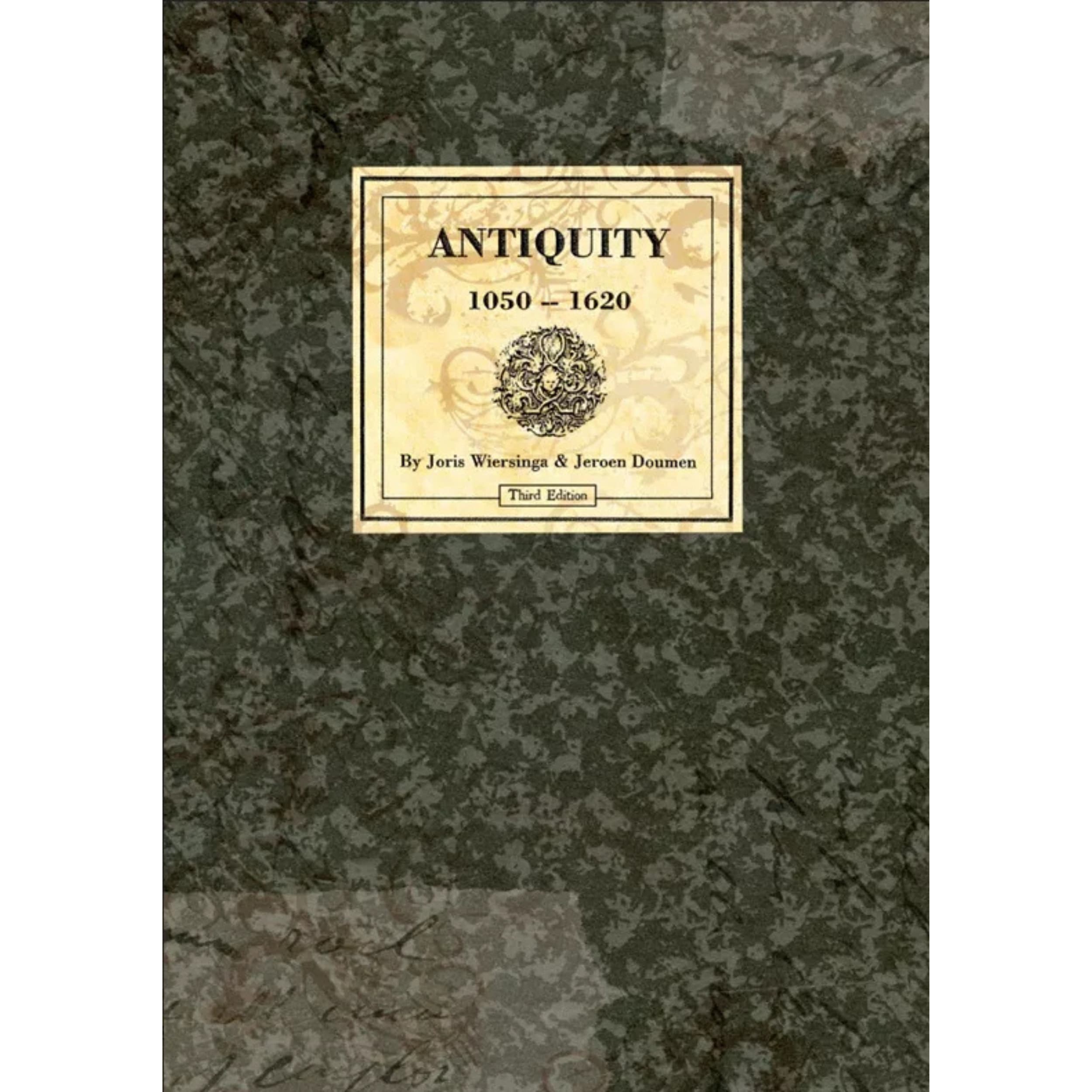
Antiquity is a game by Jeroen Doumen and Joris Wiersinga, published by Splotter Spellen in 2004. It is set in a fictional medieval Italy, where each player builds a civilization around a patron saint. Minimalist graphics by Ynze Moedt, brutal mechanics, no concessions to luck.
Each saint demands a different victory from you: population, trade, conquest, monumental buildings. Or you can worship Saint Mary and try to do everything twice as fast as the others. Meanwhile, forests disappear, fields are depleted, pollution advances. And sooner or later, the land runs out.
What they say abroad
Antiquity is a profoundly beautiful and profoundly cruel game. It watches you drown in your own choices, and does nothing to help you.
— FroGames
It's not a forgiving game. It's a game that teaches you not to forgive yourself.
— FroGames

Antiquity
FrogScore · FroGames editorial rating · based on rules, international reviews, and gameplay sessionsWhat you build
The elements of your civilization
City buildings
Granaries, workshops, markets, houses. Each gives you new actions, new options. But they take up space and require resources to build.
Land to exploit
Forests for wood, fields for grain, quarries for stone. You use them once, then they become exhausted land. Forever.
Pollution and tombs
Every action produces waste. Every death leaves a tomb. They accumulate on the board, take up space, choke you.
Your patron saint
Five choices: Saint Nicholas (population), Saint Christopher (trade), Saint George (conquest), Saint Benedict (buildings), Saint Mary (everything together, doubled).
In three hours, you'll know if you're a visionary or an environmental disaster. Or both.
A game in five acts
What happens at the table
Not the rules. The experience.
The optimistic expansion
You choose your saint, place your first city, gather wood and grain. Everything seems abundant. You plan for victory as if resources were infinite. Someone is already laughing at their brilliant plan.
The first famine
The fields around the city are exhausted. The forests are stumps. You have to send carts further and further away. Someone realizes resources are running out. The others are still laughing. Not for long.
Pollution advances
Waste tiles accumulate. Tombs take up space. Every city produces waste that needs to be placed somewhere. The board shrinks, space becomes the most precious commodity. No one is laughing anymore.
The desperate race
Someone is close to victory. The others must decide whether to pursue their own goal or sabotage the leader. Carts travel across half the board to gather one resource. Cities are choked by waste.
End of the world or victory
Someone achieves their saint's goal. Or the pollution tiles run out and the game ends with no winners, only survivors. You look at the devastated board. You laugh. You start over.
How to play
The flow of each turn
Antiquity has no rounds. It's a continuous flow: actions, consequences, new actions. Each player performs these phases on their turn.
You send your workers to collect wood, grain, stone, or fish. Each resource collected exhausts a terrain tile. You place it face down: it will never produce anything again.
You spend resources to build granaries, houses, workshops, markets. Each building gives you new abilities: more actions, new resources, efficient conversions. But they take up valuable space in the city.
Every building produces waste. Every population consumes food. If you don't have enough food, people die and leave tombs. Waste and tombs are placed on the board. Forever.
You check if you have achieved your saint's goal. Population? Trade routes? Conquered cities? Monumental buildings? Or double of everything, if you chose Saint Mary?
Why it's different from others
Six mechanics that make the difference
Asymmetrical victories
You don't all win in the same way. Five saints, five completely different strategies. Saint Nicholas asks for population, Saint Christopher for trade, Saint George for conquest. Every game is a different game, even for you.
Resources finite forever
Gather wood from a forest? That forest becomes exhausted land. It never regrows. No reset, no regeneration. Every resource you take is a resource that will no longer be there for anyone else.
Permanent pollution
Every building produces waste. Every death leaves a tomb. They must be placed on the board, occupying hexagonal space. They cannot be removed, they cannot be recycled. The board fills up, habitable land shrinks. The end.
Strangling logistics
Workers must physically travel to resources. If nearby forests are exhausted, carts go far. The further they travel, the less efficient your economy becomes. Distance is slow death.
Cities as complex engines
Every building is a permanent upgrade to your economy. Workshops convert resources, markets open trade routes, houses host population. But building them requires space, resources, time. And every construction produces waste.
End of the world as a timer
If the pollution tiles run out, the game ends immediately. No winner, only those who survived. It's rare, but possible. And when it happens, everyone looks at the devastated board in silence. Then they laugh.
How it ends
How to win and how to lose
Antiquity ends when someone reaches their saint's goal. Or when the earth dies before you do.
Victory
- Achieve the specific goal of the chosen saint (population, trade routes, conquered cities, monumental buildings)
- Fulfill Saint Mary's double objective (requires double the results of any other saint)
- Be the only player still able to act when others are blocked by pollution or famine
Defeat
- Failure to feed the population and accumulating too many tombs
- Running out of habitable space due to pollution choking cities
- Seeing an opponent win before you have completed your goal
Antiquity is the game where you lose even when you win, because you look at the board and see what you've destroyed to get there. And it's magnificent.
Frequently asked questions
Antiquity FAQ
Is it really as hard as they say?
Yes. The rules are clear, but the interconnections are brutal. You will definitely lose the first game. Probably the second. You'll start to understand the third. Antiquity does not forgive mistakes, and every mistake you make is in the first turn without knowing it. But that's its beauty.
Can I play it with two players?
Absolutely. With two, it's even fiercer: fewer players means less shared pollution, but also less space to expand. The tension remains very high, the race for resources even more direct.
How long does a game really last?
The box says 120-180 minutes. For the first few games expect 3 hours or more, because you have to think about every move. With experience it shortens, but Antiquity will never be a fast game. It's a game where thinking takes time.
Is it an aggressive game or do you play for yourself?
Interaction is indirect but ruthless. You don't attack directly (unless you choose Saint George), but every resource you take is one less for someone else. Every tile you exhaust is space lost for everyone. It's cold war, not open battle.
Is it available in Italian?
Antiquity is a language-independent game: no text on the components, only iconography. The manual is in English, but once you learn the rules you won't need to consult it anymore. For Italian players, it's not an obstacle.
Antiquity is a strategic board game for 2-4 players, lasting 120-180 minutes, recommended age 14+. Designed by Jeroen Doumen and Joris Wiersinga for Splotter Spellen, Antiquity is a heavy euro game where you build a medieval civilization while irreversibly exhausting the board's resources. Each player chooses a patron saint with an asymmetrical victory objective: population, trade, conquest, or monumental building. The main mechanics are tile placement, finite resource management, city building, and worker logistics. No random elements, only long-term planning and permanent consequences. Available on FroGames.it.
Antiquity
Frequently Asked Questions
The answers you're looking for, no beating around the bush.
📸Do the images match the actual product?
The photos on the website often come from BoardGameGeek and are intended to give you an idea of the game. They may vary slightly from the version you receive. The content declared by the publisher is always binding.
📦Does the content of the box match what is indicated?
We always strive to provide the correct content, but minor variations are possible due to reprints or updates. The information comes directly from the publishers. If you have any questions, please contact us!
⏳How do pre-orders work?
Pre-order the game before release, payment is immediate, and the game is reserved for you. As soon as it arrives, we'll ship it right away! If there are any delays, we'll update you promptly.
🔒Can I trust buying here?
Absolutely! Secure payments, tracked shipments, and a team that loves board games as much as you do. If something goes wrong, we'll do our best to fix it.
🛠There's a problem with my order, what should I do?
Write to us now! Whether it's a missing part, damage, or an error, we'll help you resolve it as soon as possible. Your experience truly matters to us.