
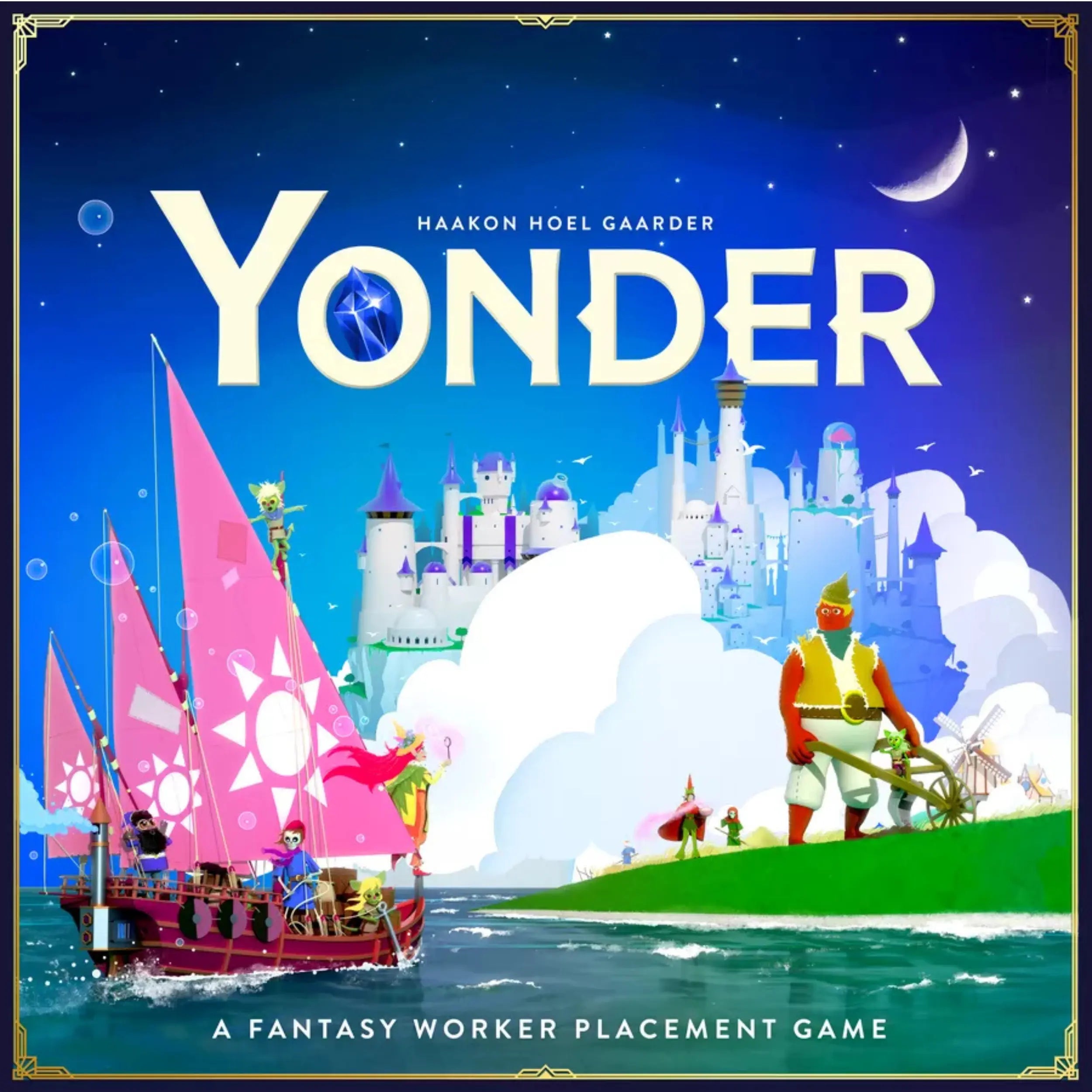

Yonder
🐸 Dettagli da BoardGameGeek
Consiglio BGG sul numero di giocatori
Categorie
Meccaniche
Design & Art
Lingua
Si abbina bene con
The FroGames Card
You have loaded the necessities for survival onto the ship. Now you look at the distant coast and realize that the real work begins when you disembark: those wooden crates must become homes, those workers a community, and you must decide who goes where before someone else takes the best spot.
WHAT IT'S ABOUT
Build a community on the border of a mysterious city
Yonder is the first game by Haakon Gaarder, a Norwegian author and illustrator who handles both design and art. Funded on Kickstarter and published by Sinister Fish Games, it brings a personal vision of worker placement to a fantasy world where different races collaborate to found a new settlement.
You start with a ship full of workers, resources, and food, and five rounds to transform it into a functioning community. Each species has unique abilities: use them to their fullest, place carefully, build the right buildings. Accept contracts from envoys, but be careful about commitments you can't keep: promises count as much as points.
What they say abroad
A game that takes a few plays to grasp, but which creates genuine tension at the table: you don't unlock everything immediately, and that's a strength.
— FroGames
"Yonder offers a sprawling sandbox of decisions where every species unlocks a different strategic path."
Yonder offers an expansive sandbox of decisions where each species unlocks a different strategic path.
— Sinister Fish Games

Yonder
The game includes official solo rules that simulate competition for spaces and contracts. The strategic experience is complete, but it loses the tension of contested placement and interaction with other settlements.
FrogScore · FroGames editorial rating · based on rules, international reviews and play sessionsWhat you have with you
The tools to found the settlement
Workers of different species
Each race has unique abilities that unlock strategic paths: some gather better, others build faster, still others negotiate advantageous contracts. Choose wisely who to send where.
Buildings to construct
Every building you complete becomes a new workstation for your workers or others' (who will pay you in labor). Expand strategically: the shape of your settlement matters.
Envoys' contracts
A line of envoys offers contracts that promise points in exchange for specific deliveries. Take those you can complete, avoid those that tie up valuable resources for too long.
Resources and food
Wood, stone, metal, food: every resource is used for building or fulfilling contracts. Food feeds workers; without it, your economy stops. Balance production and expenditure.
Come si gioca
Video dimostrativo di gameplay.
🎲How to playThe rules in four steps▼
How to play
The flow of each round
Five rounds identical in structure, different in choices: each turn you place, build, collect, and take on new commitments.
In turn, each player places one of their workers on an available station (theirs or another's). Each species has abilities that modify the chosen action. Continue until everyone has passed.
You use the collected resources to build new buildings in your settlement. Each completed building becomes a new work station usable in subsequent rounds. Plan your expansion carefully.
Draw new emissaries from the queue and decide which contracts to accept. Each contract promises points if you complete a specific delivery by the end of the game. Only take sustainable ones: unfulfilled commitments subtract points.
Feed your workers with available food. Restore used work stations and prepare for the next round. If food is scarce, you pay penalties or lose efficiency in the next turn.
⏱️Your first gameThe chronicle, moment by moment▼
A game in five moments
What happens at the table
Not the rules. The experience.
Landing and first choices
You look at your empty board and available workers. Some immediately place to build, others collect resources. You have to decide: economy now or long-term infrastructure? The first move sets the pace of the game.
The first building changes everything
You finish building the first structure and realize you now have an extra space to place workers. Others look at your settlement and calculate whether it's better to send their workers there or build their own. Interaction begins here.
Accumulating contracts
You accepted two promising contracts, but now you realize they require different resources and you can't produce them all in time. You complete one, the other risks remaining open: unfulfilled commitments are costly at the end of the game.
Race for unique abilities
One opponent has a species that collects double wood, another has workers that build faster. You chose versatile races and now you must maximize every placement to compensate for the asymmetry. Each turn is a puzzle.
Final round: settling scores
It's the last round, you still have open contracts and must choose whether to complete them or build one last building for points. Someone finishes everything, someone leaves a contract halfway and pays the price. Early choices decide who wins now.
🐸What to know beforehandThree honest things, from friends▼
What to know beforehand
Three honest things
The first game is exploratory: you won't immediately understand the synergies between species, buildings, and contracts. A second game is needed to play strategically. Allow at least 2 hours for the first session with setup and explanation.
Each placement has many variables: if a player tends to analysis paralysis, others wait. With 4 slow players, the waiting time between turns becomes noticeable. Works best with groups quick at making decisions.
It's easy to accept too many contracts at the beginning and find yourself with unsustainable commitments halfway through the game. Open contracts cost heavy points if not completed: the temptation to take too many is a trap for those who don't plan their economy long-term.
🏆Victory and defeatWhat the end rewards▼
How it ends
How to win and how to lose
After five rounds, points are counted from completed contracts, constructed buildings, and end-game bonuses. Open contracts subtract points instead of giving them.
Victory
- Completing accepted contracts: each satisfied emissary gives variable points based on the difficulty of the delivery.
- Building strategic buildings: some give fixed points, others give multiplicative bonuses based on resources or workers.
- Utilizing end-game bonuses: secret or public objective cards reward specific configurations of your settlement.
Penalties and defeat
- Uncompleted contracts: each open commitment subtracts points instead of giving them. The more you take, the more you risk.
- Inefficient economy: if you build the wrong buildings or don't expand in time, you collect fewer resources and fall behind.
- Failure to manage food: without food to feed workers, you pay penalties or lose actions in crucial turns.
Yonder is pure strategy: every choice in round one has consequences in round five. It doesn't forgive improvisers, it rewards those who build a plan and follow it through.
💬Frequently Asked QuestionsQuick answers before checkout▼
Frequently Asked Questions
FAQ about Yonder
What mechanics does Yonder use?
Worker placement with asymmetric workers (each species has unique abilities), modular building construction, contract management, light engine building, and resource production. The combination creates a medium-heavy eurogame with a strong emphasis on long-term planning.
How long does a game actually last?
With experienced players 60-75 minutes for 2-3 players, up to 90 minutes for 4 players. The first game requires at least 2 hours including setup, explanation, and learning synergies. From the second game onwards, the time shortens significantly.
Is it suitable for those unfamiliar with worker placement?
No. Yonder assumes familiarity with the genre: there are too many asynchronous options and no beginner's guide system. Previous experience is needed with titles like Agricola, Viticulture, or Everdell to fully appreciate it. Those new to the genre risk analysis paralysis.
How does it scale with different numbers of players?
It scales well from 1 to 4 players, but the experience changes: with 2 players there's less competition for spaces and contracts, more exploratory freedom; with 3-4 players the race for the best placements becomes intense. The official solo mode works, but loses interaction with other settlements.
Is it available in Italian?
No. This edition is in English. The game contains text on contract cards, buildings, and species abilities: a basic knowledge of the language is required to play without translation aids.
The people behind the game
Who invented it, who designed it, who publishes it — and what else they've done.
Yonder is a strategic board game for 1-4 players, ages 14+, duration 60-90 minutes, featuring asymmetric worker placement and settlement building mechanics. Designed by Haakon Gaarder and published by Sinister Fish Games, it combines resource management, point contracts, and unique worker species abilities in a medium-heavy eurogame. Each game requires long-term planning and the ability to balance economic expansion, contractual commitments, and strategic building construction. Available on FroGames.it.
Frequently Asked Questions
The answers you're looking for, no beating around the bush.
📸Do the images match the actual product?
The photos on the website often come from BoardGameGeek and are intended to give you an idea of the game. They may vary slightly from the version you receive. The content declared by the publisher is always binding.
📦Does the content of the box match what is indicated?
We always strive to provide the correct content, but minor variations are possible due to reprints or updates. The information comes directly from the publishers. If you have any questions, please contact us!
⏳How do pre-orders work?
Pre-order the game before release, payment is immediate, and the game is reserved for you. As soon as it arrives, we'll ship it right away! If there are any delays, we'll update you promptly.
🔒Can I trust buying here?
Absolutely! Secure payments, tracked shipments, and a team that loves board games as much as you do. If something goes wrong, we'll do our best to fix it.
🛠There's a problem with my order, what should I do?
Write to us now! Whether it's a missing part, damage, or an error, we'll help you resolve it as soon as possible. Your experience truly matters to us.