
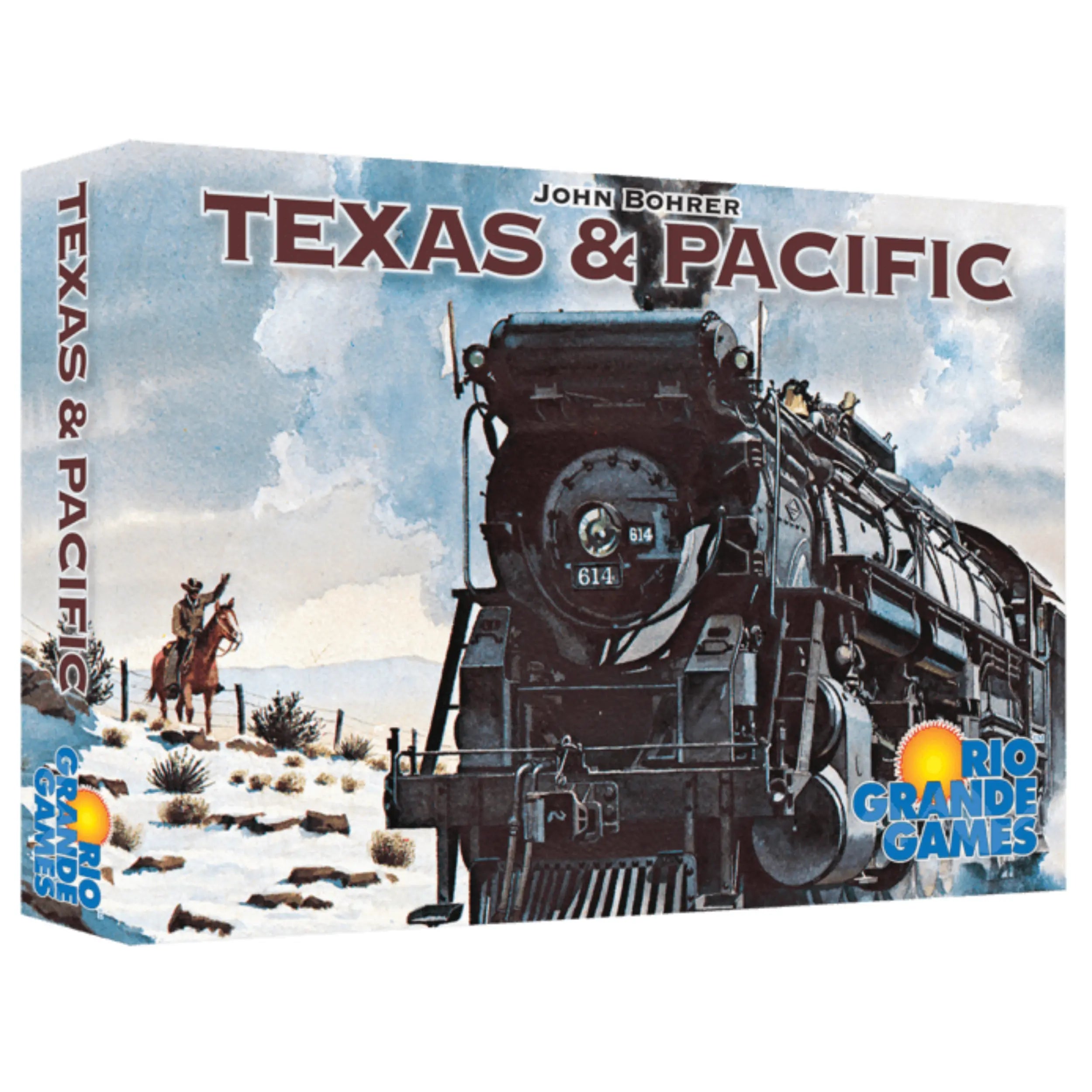
Texas & Pacific
🐸 Dettagli da BoardGameGeek
Consiglio BGG sul numero di giocatori
Categorie
Meccaniche
Design & Art
Lingua
Si abbina bene con
The FroGames Board
Your neighbor just paid stellar dividends. You're staring at the board wondering whether to expand into Dallas or buy more shares. Meanwhile, someone has already figured out when the game will end.
WHAT IT'S ABOUT
Investors, railroads, and prairies in the 19th-century Midwest
John Bohrer brings to the table a pure economic cube rail set in the Midwest and Texas during the golden age of railroads. Winsome Games published it in 2010 as part of the Historic Railroads System series, then Rio Grande Games distributed it in the Winsome Train Games collection. Todd Sanders designed the essential graphics of a title that thrives on surgical decisions: how much to pay for shares, when to trigger dividends, where to expand the network.
At the table, you buy stock certificates of the major railway companies of the era. Each round, someone decides whether to build tracks or pay dividends to shareholders. Shares generate money during the game, but they are worthless in the final score. The player with the most money at the end wins. Timing, bluffing, and reading the table make the difference between a rich investor and one with a portfolio full of worthless paper.
What they say abroad
"The train depot is a noisy place, with cowboys shouting and cows mooing as they are loaded onto the stock cars of the cattle train."
— Rio Grande Games
The mechanics work. The problem is knowing how to use them at the right time against opponents who know what you're doing.
— FroGames

Texas & Pacific
FrogScore · FroGames editorial rating · based on rules, international reviews, and gameplay sessionsThe tools of the trade
Certificates, cubes, and cash
Stock Certificates
Each railway has a limited number of shares available. You buy them at auction, they pay dividends when someone decides, but they are worthless at the end of the game. The secret is to cash in before it ends.
Railway Cubes
Each railway has colored cubes that expand the network on the hexagonal board. The more routes you connect, the more the company can pay. But each cube costs, and whoever controls the majority decides whether to spend or collect.
Cash
The only thing that matters in the final score. You spend it to buy shares, you collect it with dividends, you try to have more than others when someone declares the game over.
Hexagonal Board
The cities of the Midwest and Texas are connected by hexagons. Each railway earns based on the cities reached. Expanding towards Chicago or south changes the entire value of the company.
Come si gioca
Video dimostrativo di gameplay.
🎲How to PlayThe rules in four steps▼
How to Play
The flow of each round
Each turn, someone operates a railway, while others watch and calculate.
The current player chooses one of the railways still available in the round. If they control it (they own more shares than others), they decide what to do. Otherwise, control passes to the player with the majority.
Whoever controls the railway decides: expand the network (place cubes on new routes, costing the company money) or pay dividends (distribute money to shareholders based on shares owned, emptying the company's coffers).
If there are still share certificates available for that railway, an auction begins. Those who want to invest bid, those who pass are out. The winner pays and takes the share, potentially increasing their control over the company.
The turn passes. When all railways have acted once, the round ends and another begins. The game ends when an end condition is met (usually related to the number of rounds or players' wishes).
⏱️Your First GameThe chronicle, moment by moment▼
A game in five moments
What happens at the table
Not the rules. The experience.
The initial auctions
Everyone starts with money and no shares. The first auction determines who controls which railway. You pay too much and start poorly, you pay too little and someone else takes the company you wanted. Everyone studies others, trying to understand who wants what.
The first expansions
Those who control the railways begin placing cubes connecting cities. Each route costs the company money, but increases the value of future dividends. The table begins to understand who has a strategy and who is improvising.
Someone pays dividends
One of the railways stops expanding and distributes money to shareholders. Everyone collects, some smile, some realize they have few shares in the wrong company. The other railways continue to build. The calculation begins: better to expand more or start collecting?
The race for final dividends
Someone has understood when the game will end and starts to pump dividends to empty the coffers of their companies before the end. Others notice late and try to replicate. Those who bought shares at the right time cash in, those who waited too long are left with an empty wallet.
Sudden game end
Someone declares the end of the game (or a stop condition occurs). Shares become worthless paper, only cash matters. Someone won because they cashed in three times, someone else lost because they were waiting for a final dividend that never arrived. Money is counted and a new game begins.
🐸To know beforehandThree honest things, from friends▼
To know beforehand
Three things you need to consider
The game can end suddenly
There isn't a fixed number of rounds written on the box. Someone can decide to speed up the end to block others before they cash in. If you wait too long to collect dividends, you risk being left with worthless shares. This uncertainty is part of the game, but it throws off those who expect a more rigid structure.
Steep learning curve at the first table
The rules are simple, but understanding WHEN to pay dividends and HOW MUCH to bid in auctions requires at least one warm-up game. The first time you'll feel like you're playing blind, the second time you'll start to read others' moves. It's not a game you explain and win immediately.
Scales poorly below 4 players
With 2-3 players, the tension of competitive auctions and the political interaction over railway control are lost. The game is designed for 4-6 players, where implicit alliances and dividend betrayals truly work. Below that threshold, it remains a good economic game but loses its edge.
🏆Victory and defeatWhat the ending rewards▼
How it ends
How to win and how to lose
The player with the most cash when someone declares the end of the game or the stop condition is met wins.
Victory
- You bought shares in the right railways at the right price
- You collected multiple dividends before the end of the game
- You controlled the timing: you made your companies pay and blocked others'
Defeat
- You paid too much in the initial auctions and didn't recover your investment
- You waited for dividends that never came because someone ended the game early
- You invested in the wrong railways: those that expanded too much and paid too little
It's an honest economic game that doesn't hide its cards. If you're looking for pure decisions without frills, Texas & Pacific is a safe investment. If you prefer narratives and spectacular components, you'll look elsewhere.
💬Frequently Asked QuestionsQuick answers before checkout▼
Frequently Asked Questions
FAQ about Texas & Pacific
What mechanics does Texas & Pacific use?
Competitive auctions (auction/bidding) for buying share certificates, railway network construction on a hexagonal map (network and route building), management of dividend timing (income), stock holding. The twist is that shares pay out during the game but don't count in the final score: the player with the most cash wins, not the one with the most shares.
How long does a real game last?
Approximately 60 minutes stated, but it can vary considerably depending on the number of players and how quickly someone decides to end it. Games with 6 players can approach 90 minutes, aggressive games with 4 can end in 45. The duration is not fixed: it depends on the choices at the table.
Is this game suitable for those unfamiliar with train games?
Only if you already have experience with medium-heavy economic games. It's not a gateway game: the auction-dividend-timing system requires reading the table, which is learned through playing. If you're looking for a first train game, it's better to start with Ticket to Ride or Irish Gauge. If you already know 18xx or other cube rails, this is a good, lighter entry point.
Does it work well with all player counts?
No. With 2-3 players, it loses its edge: auctions are less competitive, railway control is too straightforward. From 4 players up, it starts to shine, with 5-6 being its sweet spot. If you primarily play in pairs, this is not the right title.
Is it available in Italian?
No, this is the English edition by Rio Grande Games. The text is minimal (city names, numerical values), the game is manageable even without knowing English if you have a translated rulebook. There are no official Italian editions currently.
The people behind the game
Who invented it, who designed it, who publishes it — and what else they've done.
Texas & Pacific is an economic train board game for 2-6 players, lasting 60 minutes, recommended age 12+. Designed by John Bohrer and published by Rio Grande Games, it is part of the Cube Rails and Historic Railroads System series by Winsome Games. The main mechanics are competitive auctions, railway network construction on a hexagonal grid, dividend management, and stock holding. The unique twist: shares generate money during the game but do not count in the final score; only the player with the most cash wins. Set in 19th-century Midwest and Texas, the game requires surgical timing and reading opponents. Available on FroGames.it.
Frequently Asked Questions
The answers you're looking for, no beating around the bush.
📸Do the images match the actual product?
The photos on the website often come from BoardGameGeek and are intended to give you an idea of the game. They may vary slightly from the version you receive. The content declared by the publisher is always binding.
📦Does the content of the box match what is indicated?
We always strive to provide the correct content, but minor variations are possible due to reprints or updates. The information comes directly from the publishers. If you have any questions, please contact us!
⏳How do pre-orders work?
Pre-order the game before release, payment is immediate, and the game is reserved for you. As soon as it arrives, we'll ship it right away! If there are any delays, we'll update you promptly.
🔒Can I trust buying here?
Absolutely! Secure payments, tracked shipments, and a team that loves board games as much as you do. If something goes wrong, we'll do our best to fix it.
🛠There's a problem with my order, what should I do?
Write to us now! Whether it's a missing part, damage, or an error, we'll help you resolve it as soon as possible. Your experience truly matters to us.