
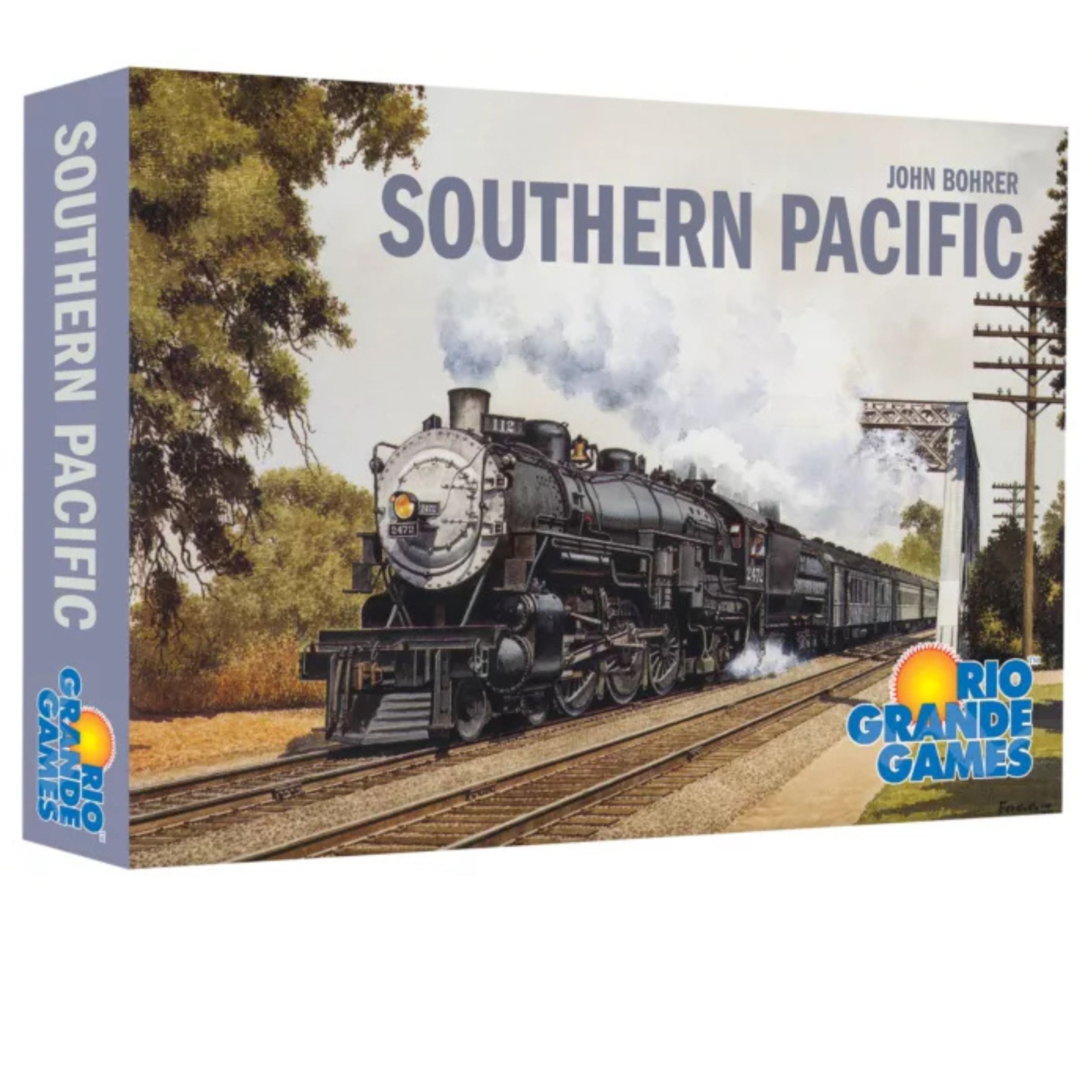
Southern Pacific
🐸 Dettagli da BoardGameGeek
Consiglio BGG sul numero di giocatori
Categorie
Meccaniche
Design & Art
Lingua




Si abbina bene con
The FroGames Sheet
You just bid $12 for a stock worth $8. The president smiles: he knows you need that railway more than he needs that money. And now it's up to you to decide whether to pay dividends or build tracks.
WHAT IT'S ABOUT
Six railway companies crossing Texas, one auction at a time
Southern Pacific is a cube rail game designed by John Bohrer and published by Winsome Games in 2018, then reissued by Rio Grande. We are in post-Civil War Texas: six railways (Louisiana & Texas, International Great Northern, Galveston Harrisburg & San Antonio, Missouri Kansas & Texas, Houston & Texas Central, Texas & Pacific) start from Louisiana, Arkansas, and Oklahoma to conquer Texan territory. Graphically essential, signed by Todd Sanders: map, cubes, actions.
At the table, you are an investor. You buy shares through reverse-role auctions (the president puts them up for sale, you bid), you control the companies whose shares you own most of, you decide whether to expand the network or pay dividends. Shares are worthless at the end of the game: only the money in hand counts. The game ends when a railway completes all its tracks or all shares have been purchased. Whoever has the most cash wins.
What they say abroad
"A cutthroat economic puzzle where every dollar matters and timing is everything."
A cutthroat economic puzzle where every dollar matters and timing is everything.
— Meeple Mountain
This is a first read. Southern Pacific still has limited BGG numbers: we are studying it. The sheet will be updated with feedback from players who bring it to the table.
— FroGames

Southern Pacific
FrogScore · FroGames editorial rating · based on rules, international reviews and play sessionsThe components
What's inside the box
Map of Texas
Point-to-point board with cities (circles) and connections. Each railway starts from an edge (north, east, west) and advances towards the center. More central cities are worth more for dividends.
Share certificates
Each railway has a pool of shares. The president auctions some of them each turn. Whoever has the most shares of a company becomes its president and controls it until someone takes control away from them.
Railway cubes
One color per company. They are placed on connections to build the network. When a railway's cubes run out, the game ends immediately.
Money
Personal cash and company treasury. During your turn, you can pay dividends (distribute money from the company to shareholders) or reinvest in the network. At the end of the game, only personal cash counts.
Recommended sleeves 31 cards in 1 size ▼
If you play often, we recommend protecting your cards with transparent sleeves to make them last a long time.
| Size | Quantity |
|---|---|
| 59 × 91 mm | 31 |
| Total cards | 31 |
Come si gioca
Video dimostrativo di gameplay.
🎲How to PlayRules in four steps▼
How to Play
The Flow of Each Round
Each round has a fixed structure: presidents put shares up for sale, players buy them at auction, companies act in priority order, and the bull market closes the round.
The president of each railway decides how many shares to put up for sale and the minimum price. Other players, in turn order, can buy at that price or pass. Whoever buys more shares than the current president becomes the new president. The auction is reverse-role: the seller is the one controlling the company, not the bank.
Each railway, in priority track order, acts once. The president decides whether to: (A) build tracks spending from the company's treasury, or (B) pay dividends, distributing money to shareholders based on the network built. Dividends enrich players, while tracks increase future value.
All unsold shares from regular auctions go to the bull market auction. Each player bids simultaneously for one or more shares. The highest bidder wins. These auctions can overturn company controls in a single blow.
If a railway has built all its tracks, the game ends immediately. Alternatively, if all shares have been purchased, it ends equally. Only the money in players' hands is counted; shares are worthless. The player with the most cash wins.
⏱️Your First GameMoment by moment account▼
A Game in Five Moments
What Happens at the Table
Not the rules. The experience.
First Auctions, Low Prices
The president of the Louisiana & Texas puts 2 shares up for sale at 5 dollars each. You buy. You become president. Now it's up to you to decide: build tracks towards Dallas or pay dividends to recover liquidity? Others watch you. They know that whatever you do, they will benefit.
The First Takeover
Someone buys three shares of your railway in an aggressive auction. They overtake you. Now they control the company you financed with your money. They can decide to pay huge dividends (and you cash in, but they cash in more) or to expand the network without giving you a penny.
The Bull Market
End of the round: bull market auction. All unsold shares go to the simultaneous auction. Prices skyrocket. Someone spends 18 dollars for a share worth 6 in dividends, but they need control. You watch your cash dwindle and understand that every dollar spent now is a dollar you won't have at the end of the game.
The Race for Tracks
A railway has placed 18 out of 20 cubes. If it completes the network, the game ends immediately. Whoever has the most cash at that moment wins. Everyone looks at the map. You calculate how many turns are left. You decide whether to block the expansion by buying control and paying dividends instead of building. He outbids you. He builds. Again.
Final Count
Someone places the last cube. Game over. The shares on the table are worthless: beautiful, useless. Only cash counts. You have 47 dollars. The winner has 52. You built half of Texas, owned four companies, collected dividends for three rounds. But you spent 5 dollars too much in an auction you shouldn't have won.
🐸Good to Know BeforehandThree honest things, from friends▼
Good to Know Beforehand
Three Things a Friend Would Tell You
Shares are Worthless at the End of the Game
Every dollar spent in auctions is a dollar you won't have in the final count. You can own half of Texas and lose to someone who collected dividends for five rounds. The game rewards those who accumulate cash, not those who build empires. This rule reverses the logic of many classic railway games.
Loses Momentum with 3 Players
The game is balanced for 4-5 players. With 3, there's less competition for company control, less pressure in auctions, less tension on timing. A full table is where Southern Pacific shines. If you often play in pairs or trios, this is not the right cube rail game.
Steep Learning Curve
The rules can be explained in 20 minutes. Understanding when to buy, when to sell, when to pay dividends requires 2-3 games. The first time, almost everyone spends too much in auctions and ends up with little cash. That's normal. The second game is when you understand the game.
🏆Victory and DefeatWhat the ending rewards▼
How it Ends
How to Win and How to Lose
The game ends in two ways: a railway completes all its tracks, or all shares have been purchased. In both cases, only personal cash is counted.
Victory
- You have more money in hand than anyone else at the table when the game ends
- You have balanced spending in auctions, collecting dividends, and controlling the right companies at the right time
- You avoided spending too much on shares of companies that then did not pay sufficient dividends
Defeat
- You spent too much in aggressive auctions and ended up with many shares but little final cash
- You lost control of profitable companies and someone else collected the dividends instead of you
- You built an enormous network but did not convert that growth into personal liquidity
Southern Pacific doesn't forgive miscalculations. But when you read the table and finish with a 3-dollar advantage, you know you've played better than the others.
💬Frequently Asked QuestionsQuick answers before checkout▼
Frequently Asked Questions
FAQ about Southern Pacific
What mechanics does Southern Pacific use?
Auction/Bidding (with a reverse-role variant: the president sells), Network and Route Building (build point-to-point connections in Texas), Stock Holding (control companies based on shares owned). Zero luck, everything is deterministic and visible.
Are shares truly worthless at the end of the game?
Truly worthless. This is the rule that differentiates Southern Pacific from classic railway games. Only the cash in hand counts. Shares are used to control companies during the game and collect dividends, but in the final count, they are scrap paper. Whoever accumulates the most liquidity wins.
How does the bull market work?
At the end of each round, all shares that presidents failed to sell go to the simultaneous bull market auction. Each player bids secretly for one or more shares. The highest bidder wins. These auctions can overturn company controls in a single blow and cause prices to explode.
How much does the number of players matter?
A lot. With 4-5 players, the game is tense and competitive: auctions are ruthless, takeovers are frequent, timing is critical. With 3 players, it loses momentum: there's less competition for control, less pressure, less interaction. The box says 3-5, but the heart of the game beats at 4+.
Is it available in Italian?
No. Southern Pacific is available in an English edition (Rio Grande Games). Language dependence is minimal: there are 31 cards with names of railways and Texas cities, but the game is almost entirely iconic. Rules are in English.
The People Behind the Game
Who invented it, who designed it, who publishes it — and what else they've done.
Southern Pacific is a railway strategy game for 3-5 players, lasting 60-90 minutes, recommended for ages 12+. Designed by John Bohrer and published by Rio Grande Games, it is part of the Cube Rails Winsome family. Main mechanics: reverse-role auctions, network building, stock holding. Zero luck: every choice is calculable. The peculiarity: shares are worthless at the end of the game; only cash in hand counts. Available on FroGames.it.
Southern Pacific
Frequently Asked Questions
The answers you're looking for, no beating around the bush.
📸Do the images match the actual product?
The photos on the website often come from BoardGameGeek and are intended to give you an idea of the game. They may vary slightly from the version you receive. The content declared by the publisher is always binding.
📦Does the content of the box match what is indicated?
We always strive to provide the correct content, but minor variations are possible due to reprints or updates. The information comes directly from the publishers. If you have any questions, please contact us!
⏳How do pre-orders work?
Pre-order the game before release, payment is immediate, and the game is reserved for you. As soon as it arrives, we'll ship it right away! If there are any delays, we'll update you promptly.
🔒Can I trust buying here?
Absolutely! Secure payments, tracked shipments, and a team that loves board games as much as you do. If something goes wrong, we'll do our best to fix it.
🛠There's a problem with my order, what should I do?
Write to us now! Whether it's a missing part, damage, or an error, we'll help you resolve it as soon as possible. Your experience truly matters to us.