
Pampero: Project Verne
🐸 Dettagli da BoardGameGeek
Consiglio BGG sul numero di giocatori
Categorie
Meccaniche
Design & Art
Lingua
Pre-order - leggi i dettagli
🐸 Una rana saggia sa quando dividere l’ordine… e quando aspettare il salto giusto.

Si abbina bene con
The FroGames review
You've just placed the third power tower. Someone is already building the fourth. Green hydrogen is on the market, containers are leaving, and you have to decide whether to export or power the local fleet. Every card you play remains locked until you recover it. And meanwhile, the timer keeps ticking.
WHAT IT'S ABOUT
From clean energy to sustainable mobility: Uruguay completes its transition
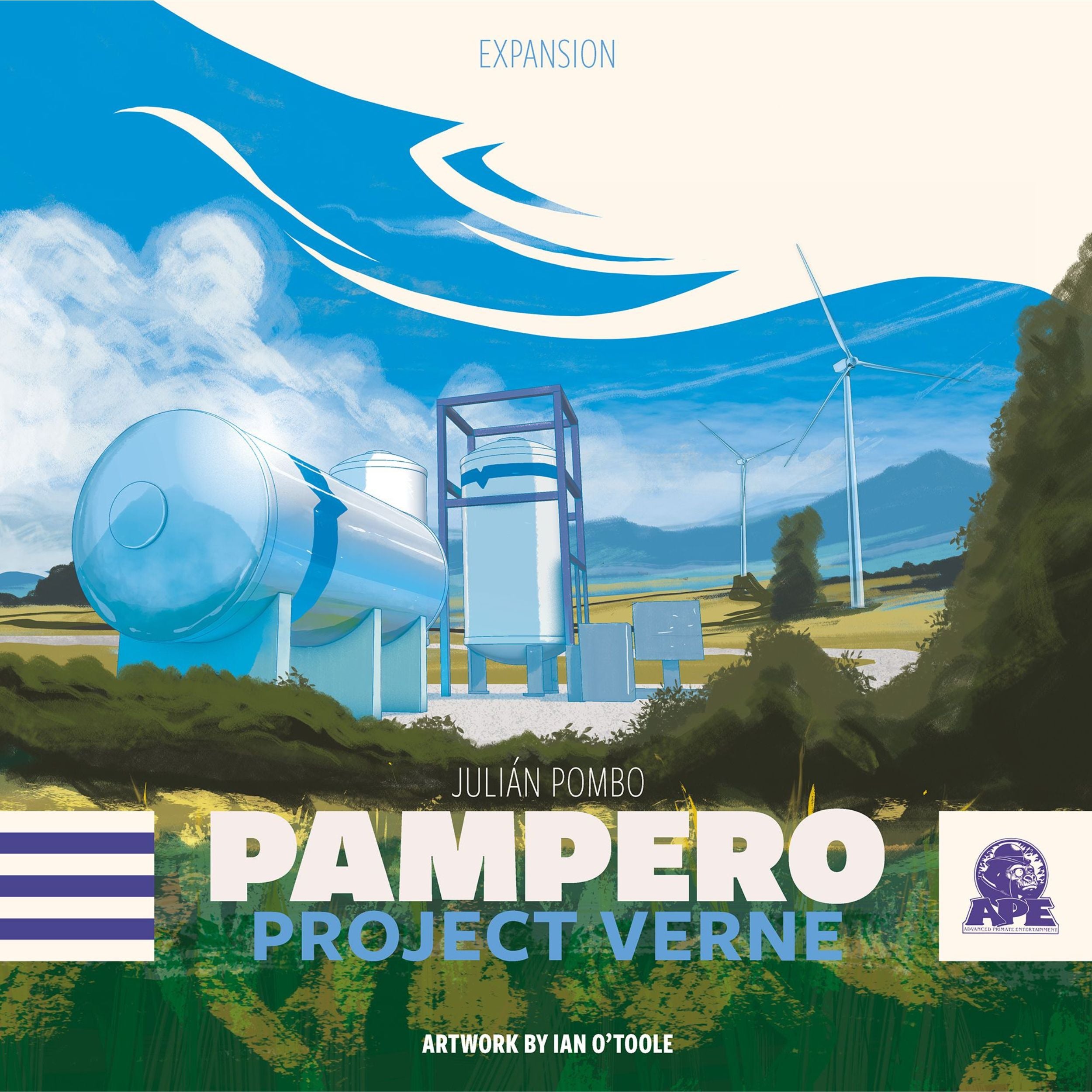
Project Verne is the major expansion of Pampero, the eurogame by Julián Pombo that won Best Euro Boardgame at UK Games Expo 2024. While the base game covers Uruguay's transition to renewable energy, this expansion focuses on transportation and heavy industry. Art by Ian O'Toole, modular design that integrates into the original box with dedicated GameTrayz.
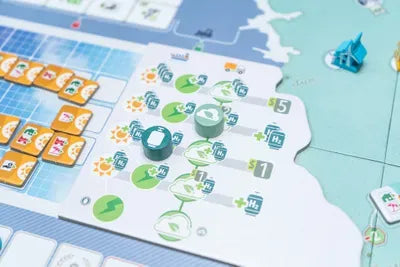
The expansion introduces systems for green hydrogen production and low-emission mobility. You integrate these technologies into the existing grid, balancing infrastructure, timing, and long-term planning. There are CO2 tokens to earn by building wind farms, to spend on power towers or bonuses after scoring. New scoring paths, events, innovations, freelancers, and low-tech towers that alter the board.
What they say abroad
"drives renewable energy deployment even further"
It pushes the implementation of renewables even further
— APE Games
This is a first reading: Project Verne has just closed its Kickstarter and is still in production. Data is scarce, reviews are not yet available. We are writing based on the official description and will update when the game is on the market.
— FroGames

Pampero: Project Verne
FrogScore · FroGames editorial rating · first reading: based on rulebook and official presentation, updated with first playsThe new systems
Four layers added to the base game
CO2 Tokens
Earn CO2 when you build wind farms, use them to pay for power towers or spend them after the first and second scoring for various bonuses. An additional resource that rewards green builders and speeds up certain actions.
H2 Production
Produce H2 fuel containers and deliver them to local markets or export them via tanker ships. A new scoring path that intertwines with the existing electrical grid: energy is needed to produce hydrogen.
Innovations and Freelancers
Hundreds of cards, wooden tokens, tiles. New bonus actions to combine to explore different strategies and create powerful combos. The layer that makes each game unique.
Events and Low-Tech Towers
Towers don't immediately go onto the bonus board but start outside: take pre-printed bonuses, then add permanent tiles. Events during the first and second scoring change the effects. The game evolves during play.
Recommended sleeves 41 cards in 1 size ▼
If you play often, we recommend protecting your cards with clear sleeves to make them last longer.
| Size | Quantity |
|---|---|
| 44 × 67 mm | 41 |
| Total cards | 41 |
🎲How to playThe rules in four steps▼
How to play
The flow of each round (same as base, with new actions)
Project Verne doesn't change the pace of Pampero: it's still hand management, progressive retrieval, and consolidation phase. It adds options, it doesn't replace them.
Choose a card from your hand, place it on the leftmost free slot of one of the two rows on your tableau. Activate the corresponding action. With modules: you can spend CO2, activate freelancers, use innovations.
If you don't want to play a card, take all cards from your tableau back into your hand. This unlocks blocked cards but you lose your turn. This is the heart of the game: when to retrieve? Too early wastes actions, too late leaves you with no options.
After three actions by any player: retrieve the rightmost card from a row, generate batteries from stored energy, collect income, advance the timer. With the expansion: you can spend CO2 here for bonuses, activate permanent effects from towers.
First and second scoring at mid-game and three-quarters mark. Final scoring at the end of the timer. Each scoring counts completed contracts, and with Project Verne also H2 delivered/exported, innovations, events, combos. Whoever has the most money wins.
⏱️Your first gameThe chronicle, moment by moment▼
A game in five moments
What happens at the table (rulebook hypothesis)
Not the rules. The experience.
Setup: choose modules
Before you even start, you need to decide: do you use only CO2, or do you also add H2? Do you want innovations, events, low-tech towers, all together or none? The table changes its appearance depending on what you bring into play. Those who know the base game well choose everything. Those trying it for the first time start light.
First turns: cards interlock
You play a card to the left of the top or bottom row, take the action. But each card remains locked until you retrieve the entire row. Now with CO2 tokens from wind farms you can pay part of the cost of electric towers. It's an economic relief in the early turns, but you must remember to build green to get them.
Mid-game: hydrogen comes into play
Produce H2 containers using energy from the grid, decide whether to deliver them locally or load them onto tanker ships for export. It's a second scoring path that competes with electricity contracts for your resources. Those who spread themselves too thin lose, those who ignore H2 leave points on the table.
First scoring: events change the board
The first scoring arrives and the event placed under that tile at the beginning of the game triggers. It could alter bonuses, give extra points for certain conditions, unlock actions. Did you spend CO2 tokens for bonuses? Did someone make combos with freelancers? Here you see who built broadly.
End: modules reward those who used them all
Second scoring, second event. Points from contracts, from exported H2, from completed innovations, from permanent towers, from freelancer combos. Those who managed to integrate the systems win. Those who played only one dimension fell behind. The table is a web of paths that now all count.
🐸What to know beforehandThree honest things, from friends▼
What to know beforehand
Three things you need to know before buying Project Verne
It's a mega-expansion, not a light add-on
Modular components = scalable complexity but a heavy manual
You need the base game and you need to have played it a lot
🏆Victory and defeatWhat the ending rewards▼
How it ends
How to win (expanded scoring criteria)
The game ends as in the base game when the timer reaches the last space. The player with the most money wins. Project Verne adds new ways to score points.
Sources of money (base + expansion)
- Completed electricity contracts (as in the base game)
- H2 containers delivered to local markets or exported via tanker ship (new)
- Bonuses from CO2 tokens spent after first and second scoring (new)
- Permanent effects from low-tech towers and innovation/freelancer cards (new)
- Events that reward specific conditions met (new)
Mistakes that cost victory
- Ignoring new scoring paths: those who only play contracts as in the base game leave points on the table
- Building wind farms without utilizing CO2 tokens: you lose a significant economic advantage
- Activating too many modules without control: you get lost among the options and play slowly and poorly
Project Verne is for those who want more Pampero: more depth, more combos, more paths. Not for those seeking accessibility. For that, there's the base game.
💬Frequently Asked QuestionsQuick answers before checkout▼
Frequently Asked Questions
FAQ about Pampero: Project Verne
Can I play Project Verne without the base game?
No. Project Verne is an expansion, it requires the Pampero base game to function. It is not standalone. It includes new modules, components, and rules that add to the original game, not replace it.
Do I have to use all expansion modules or can I choose only some?
The expansion is modular: you can use some or all modules. CO2 is the basic layer, H2 requires CO2, innovations/freelancers/events/low-tech towers are optional. The first game starts with CO2 alone, then you add others when you're ready. Each module has separate rules.
What mechanics does Pampero: Project Verne use?
Like the base: hand management, action selection (card-driven action selection), action retrieval (progressive retrieval of cards from the tableau). The expansion adds set collection (set of H2 containers), end game bonuses (bonuses from events and innovations), income (enhanced economy with CO2 tokens). It's deck/bag/pool building in the sense that you build your economic engine.
How much does it extend the playing time? The base game is already 60-150 minutes.
Project Verne adds setup, decisions, and interactions between modules. Expect +20-30 minutes compared to a base game with the same number of players, perhaps more if you use all modules together. It's not a quick expansion. First games with new modules can reach 3 hours with 4 players.
Is it available in Italian?
The edition sold on FroGames is in English. The Pampero base game exists in Italian (published by Cranio Creations), but at the moment there are no confirmations regarding an Italian localization of Project Verne. Language dependence: medium-high, there are many cards with text (innovations, events, freelancers).
The people behind the game
Who invented it, who designed it, who publishes it — and what else they've done.
Pampero: Project Verne is the major expansion for the Pampero base game by Julián Pombo (APE Games), winner of Best Euro Boardgame at UK Games Expo 2024. For 2-4 players, ages 14+, lasting 50-150 minutes. It introduces green hydrogen production, sustainable mobility, CO2 tokens, innovations, events, and low-tech towers. Modular components for scaling complexity: integrate new technologies into the existing network, balancing infrastructure and timing. Requires base game, modular design with GameTrayz insert that fits into the original box. Art by Ian O'Toole. Available on FroGames.it.
Pampero: Project Verne
Frequently Asked Questions
The answers you're looking for, no beating around the bush.
📸Do the images match the actual product?
The photos on the website often come from BoardGameGeek and are intended to give you an idea of the game. They may vary slightly from the version you receive. The content declared by the publisher is always binding.
📦Does the content of the box match what is indicated?
We always strive to provide the correct content, but minor variations are possible due to reprints or updates. The information comes directly from the publishers. If you have any questions, please contact us!
⏳How do pre-orders work?
Pre-order the game before release, payment is immediate, and the game is reserved for you. As soon as it arrives, we'll ship it right away! If there are any delays, we'll update you promptly.
🔒Can I trust buying here?
Absolutely! Secure payments, tracked shipments, and a team that loves board games as much as you do. If something goes wrong, we'll do our best to fix it.
🛠There's a problem with my order, what should I do?
Write to us now! Whether it's a missing part, damage, or an error, we'll help you resolve it as soon as possible. Your experience truly matters to us.