
Grape
🐸 Dettagli da BoardGameGeek
Consiglio BGG sul numero di giocatori
Categorie
Meccaniche
Design & Art
Lingua
Si abbina bene con
The FroGames Card
You rotate the zebra 90 degrees. The opponent's orangutan enters range. Do I capture or wait? He rotates the vampire, your line breaks. You had a plan, now you need another one.
WHAT IT IS ABOUT
When chess meets Tetris and strangely shaped animals are born
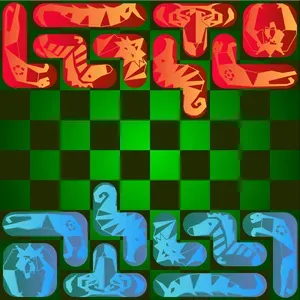
Brad Spellman designed Grape as an experiment in pure mechanics: what would happen if the pieces of an abstract game didn't move linearly but instead rotated around themselves? The result is a 10×10 grid duel where each piece is tetromino-shaped and depicts a different animal: zebras, orangutans, tigers, vampires. The aesthetic is minimalist, almost like an illustrated prototype.
On your turn, you choose one of your pieces and rotate it 90 degrees around one of the four squares it occupies. The rotation can capture opponent's pieces that end up under your profile. You win if you eliminate the opponent's orangutan or if you move your orangutan to the center of the grid. Two paths, infinite trajectories. The game promises balance: the starting player has no systematic advantage, every mistake is recoverable.
What they say abroad
Grape presents itself as an abstract game that combines the depth of chess with the spatial geometry of Tetris. It's a design experiment, not a title with years of playtesting behind it. The card will be updated when we have field data.
— FroGames
"A chess-like game of foresight with a spatial puzzle twist."
A chess-like game of foresight with a spatial puzzle twist.
— Brad Spellman AB

Grape
FrogScore · FroGames editorial rating · first reading: based on rules and official presentation, updated with initial playsThe pieces on the field
Four shapes, four roles
Zebra
L-shaped tetromino piece. Occupies four squares, rotates quickly. Ideal for diagonal captures and closing corridors. Sacrificable.
Crowned Orangutan
The king. If you lose it, you lose the game. If you bring it to the center of the grid, you win. Compact shape, limited mobility, mandatory protection.
Vampire
Z or S tetromino. Asymmetrical, perfect for lateral interlocking. Can rotate in tight spaces and surprise from unexpected angles.
Tiger
Elongated shape (I-piece). Covers entire lines when rotating. Double-edged sword: powerful in open field, blocked in corners.
🎲How to playThe rules in four steps▼
How to play
The flow of each turn
Alternate turns, one rotation at a time, until someone wins.
Any tetromino piece you control. Zebra, orangutan, vampire, tiger. You cannot pass your turn.
The piece occupies four squares. Choose one of those four as the pivot. The rest of the piece will rotate 90 degrees around that point.
The piece rotates. If it lands on an opponent's piece, you capture and eliminate it. If the rotation is illegal (off-grid or overlapping one of your pieces), you cannot do it.
If you have eliminated the opponent's orangutan, you win immediately. If your orangutan is in the exact center of the grid, you win immediately. Otherwise, it's the next player's turn.
⏱️Your first gameMoment by moment account▼
A game in five moments
What happens at the table
Not the rules. The experience.
The grid is empty, the pieces are set up
Symmetrical setup, four animals per side. You choose who moves first. The zebra? The vampire? Your opponent watches you, trying to understand your strategy. Nobody knows yet where it will lead.
The first rotations draw territories
Each piece rotates and covers new squares. You try to push towards the center, he blocks with the tiger. A zebra is captured. The board fills up, free spaces shrink.
The orangutan moves, risk increases
You can no longer keep it still: either you move it towards the center or you risk him getting there first. One wrong rotation and it ends up under his vampire. Tension rises, moves shorten.
A capture changes everything
You rotate the tiger, the opponent's orangutan ends up trapped. Or yours falls. The game turns around in one turn. Whoever loses the orangutan loses. Whoever survives gains time for the assault on the center.
Victory by elimination or conquest
The orangutan reaches the center or the last key piece is captured. End. Put the pieces back in the box, ask for a rematch. The game lasted twenty minutes or two hours, depending on how much you thought.
🐸Good to know beforehandThree honest things, from friends▼
Good to know beforehand
Three things you need to know
Spatial reasoning required
If you struggle to visualize three-dimensional rotations or to imagine shapes changing orientation, this game will challenge you. It's not a rule problem, it's a mental geometry problem. Those with experience in Tetris or spatial puzzles have an advantage.
Unpredictable duration
The box says 20-120 minutes. That's not a mistake. Aggressive games end in twenty minutes, defensive games can stretch beyond an hour if both avoid risks. There's no timer: if you play with someone who thinks five minutes per move, be prepared.
No setup variability
Identical setup every time, no cards, no dice, no initial asymmetry. Replayability comes only from your choices and your opponent's. If you're looking for scenario variety or surprise effect, this is not the right game.
🏆Victory and defeatWhat the end rewards▼
How it ends
How to win and how to lose
Two win conditions, only one loss condition. You can win by elimination or by territorial conquest.
Victory
- You capture the opponent's crowned orangutan with a rotation
- You move your crowned orangutan to the exact center of the 10×10 grid
- The opponent surrenders (optional, not provided by official rules)
Defeat
- Your crowned orangutan is captured by an opponent's rotation
- The opponent's orangutan reaches the center before yours
- You have no legal moves available (stalemate, rule to be confirmed)
Grape is an abstract design experiment that brings rotation mechanics into pure competitive territory. If you're looking for a cerebral duel with new rules and calculated risks, it's worth trying.
💬Frequently asked questionsQuick answers before checkout▼
Frequently asked questions
Grape FAQ
How long does it take to learn to play?
Rules in five minutes: you rotate, you capture, you win if you eliminate the orangutan or reach the center. The difficulty is not in the rules but in spatial reasoning: visualizing rotations and predicting captures requires practice. The first game is slow, from the second you'll go faster.
Is it balanced or does the first player win?
The designer states that the game is balanced and that the first player does not have a systematic advantage. There is no tournament data or public statistics to verify this: Grape only has three votes on BoardGameGeek and no active community. Balance is a promise, not a tested fact.
What mechanics does Grape use?
Grid movement, king of the hill (center conquest), tetromino piece rotation, capture by overlap. It's a pure combinatorial abstract game: no dice, no cards, no variable setup.
Do you need experience with abstract games to enjoy it?
No, but you need comfort with spatial geometry. If you've played chess, Go, Hive or puzzle games like Tetris, you'll feel at home. If abstract games bore you or give you analysis paralysis, Grape might not be for you.
Is it available in Italian?
No. Grape is published by Brad Spellman AB in English. The game is almost language-independent: the pieces have animal illustrations, the rules are read only once. No continuous text references are needed during the game.
The people behind the game
Who invented it, who designed it, who publishes it — and what else they've done.
Grape is an abstract game for 2 players designed by Brad Spellman, featuring tetromino-shaped piece rotation on a 10×10 grid. Variable duration 20-120 minutes, recommended age 14+. Each player controls four animal pieces (zebras, orangutans, vampires, tigers) and wins by eliminating the opponent's orangutan or by moving their own to the center of the grid. Mechanics: grid movement, king of the hill, capture by overlap. Published by Brad Spellman AB in 2025. Medium weight (2.0/5), suitable for those seeking abstract duels with a geometric twist. Available on FroGames.it.
Grape
Frequently Asked Questions
The answers you're looking for, no beating around the bush.
📸Do the images match the actual product?
The photos on the website often come from BoardGameGeek and are intended to give you an idea of the game. They may vary slightly from the version you receive. The content declared by the publisher is always binding.
📦Does the content of the box match what is indicated?
We always strive to provide the correct content, but minor variations are possible due to reprints or updates. The information comes directly from the publishers. If you have any questions, please contact us!
⏳How do pre-orders work?
Pre-order the game before release, payment is immediate, and the game is reserved for you. As soon as it arrives, we'll ship it right away! If there are any delays, we'll update you promptly.
🔒Can I trust buying here?
Absolutely! Secure payments, tracked shipments, and a team that loves board games as much as you do. If something goes wrong, we'll do our best to fix it.
🛠There's a problem with my order, what should I do?
Write to us now! Whether it's a missing part, damage, or an error, we'll help you resolve it as soon as possible. Your experience truly matters to us.