
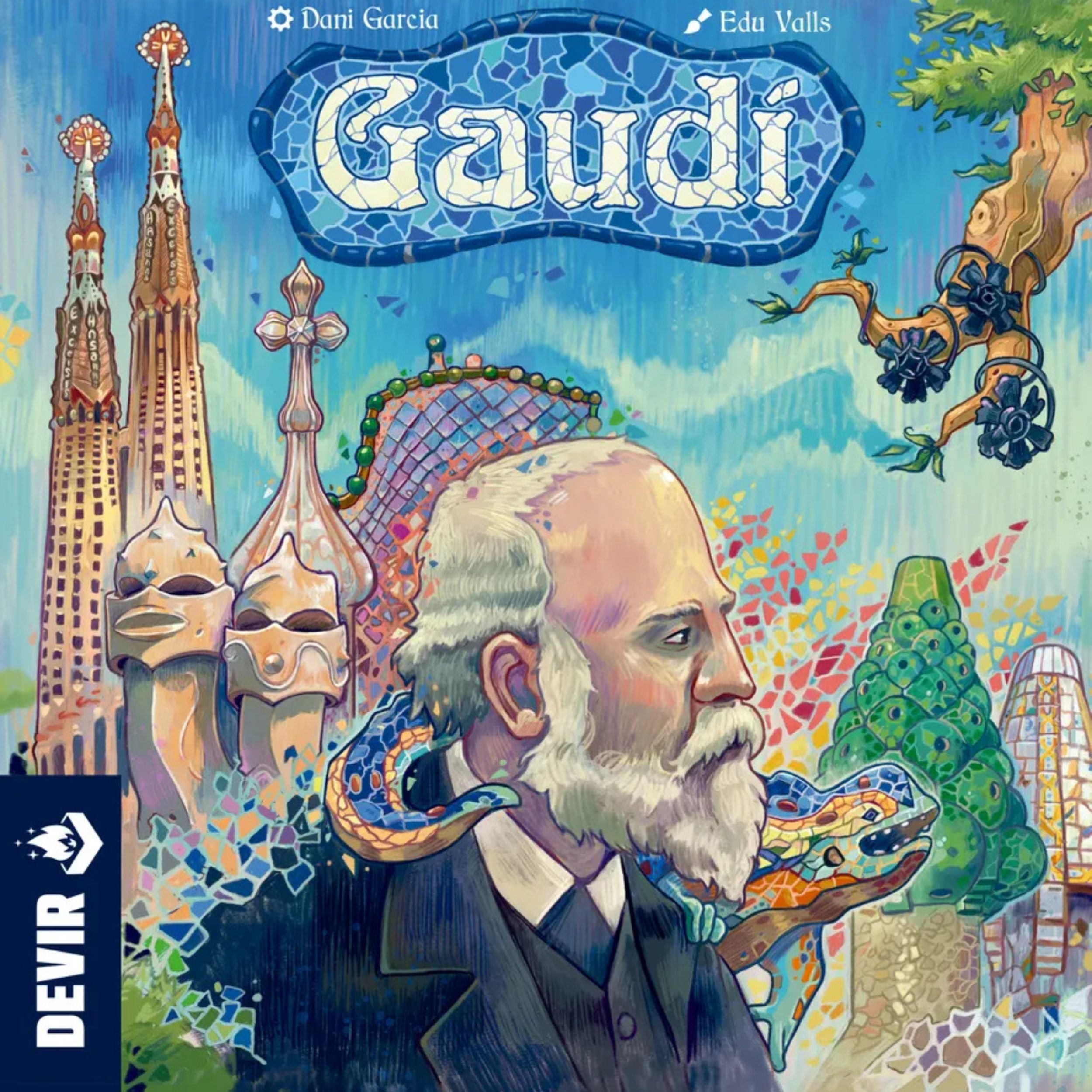
Gaudí
🐸 Dettagli da BoardGameGeek
Consiglio BGG sul numero di giocatori
Categorie
Meccaniche
Design & Art
Lingua
Pre-order - leggi i dettagli
🐸 Una rana saggia sa quando dividere l’ordine… e quando aspettare il salto giusto.
Si abbina bene con
The FroGames Card
You built a masterpiece on the Nature pillar. Religion is solid. But Catalonia? You ignored that. And in the end, when only the two lowest scores count, you find that your masterpiece is worth nothing.
WHAT IT'S ABOUT
A journey into the three pillars of visionary architecture
Antoni Gaudí (1852-1926) was a Catalan architect who merged Gothic and Art Nouveau into forms that still defy gravity today. Dani Garcia (Barcelona, Windmill Valley) brings that universe of shattered mosaics, organic nature, and spirituality to the table, with illustrations by Edu Valls that capture the light of his buildings.
In Gaudí, you collect cards and trencadís tiles (the colored fragmented mosaics typical of the master), play them on your personal board, and climb along the Chimneys, progressing in three thematic pillars: Nature, Catalonia, Religion. Each pillar awards points differently. But beware: at the end of the game, only the two lowest scores count. Those who specialize too much lose. Those who balance win.
What they say abroad
"This is Devir's most-anticipated release of the year."
This is Devir's most anticipated release of the year.
— Devir
A newly released game, with very few ratings on BGG and no full reviews available yet. We are writing this card based on official materials and the community's first impressions. We will update it in the coming months, when we have played enough games to say something truly useful.
— FroGames

Gaudí
The game features an official solo mode from the base rulebook. Without having played yet, we hypothesize a classic bot/artificial opponent system. We will have to verify how much the solo experience maintains the tension of balancing the three pillars.
FrogScore · FroGames editorial rating · first read: based on rulebook and official presentation, updated with first playsThe game elements
What you use to build your masterpiece
Nature, Catalonia, Religion Cards
Each card represents a fragment of Gaudí's work. You play them from your hand to accumulate points in the corresponding pillar. Nature gives points immediately, Catalonia at the end of the round, Religion at the end of the game.
Trencadís Tiles
The colored fragmented mosaics that Gaudí used to decorate his buildings. You collect them from the central board and place them on your personal board to create patterns and unlock actions.
Central Chandelier
The central board around which you move each turn. Each position offers different resources: cards, tiles, special actions. Where you stop determines what you can do.
Personal Chimneys
The progress tracks on your board. You climb along the Chimneys by playing cards and tiles, unlocking bonuses and getting closer to victory. But remember: only balance counts.
🎲How to playThe rules in four steps▼
How to play
The flow of each round
Each round consists of a full rotation around the central Chandelier. When everyone has had a turn, the round ends.
Choose where to stop on the central board. Each space offers different resources: cards to draw, trencadís tiles to collect, special actions. You cannot stop where someone else already is.
Take the resources from the space where you stopped. Draw cards, collect various types of tiles, get bonuses. These resources will fuel your next moves.
Use the collected resources to play cards from your hand onto your personal board and place trencadís tiles to create patterns. Each card and tile helps your Chimneys rise in the three pillars.
At the end of the round, Catalunya awards victory points based on your position on the Chimney. Nature awards points from cards played during the round. Religion waits until the end. Then it starts again.
⏱️Your first gameThe chronicle, moment by moment▼
A game in five moments
What happens at the table
Not the rules. The experience.
Position selection
You move around the central Chandelier, observing the available resources. Others go before you, taking the best tiles. You have to decide: stop now or risk another round? The first move sets the tone for the game.
First cards played
You start building. A Nature card here, a trencadís tile there. Patterns on your board take shape. Others are focusing on Religion, you on Catalunya. But is it the right choice?
End of the first round
First count. Those who focused on Catalunya score immediately, those who invested in Religion are still waiting. Nature gives points from cards. You look at your three pillars: one is strong, one weak, one in the middle. It's time to adjust.
Race to balance
Second and third rounds. The tension rises. Everyone has realized that specialization kills. Those who ignored a pillar must now catch up. The tiles you need disappear before your turn. Every move matters.
Final scoring
End of the third rotation. Everyone reveals their scores in the three pillars. You have 25 Nature, 18 Catalunya, 14 Religion. Only the two lowest count: 18+14=32. Your opponent has 22, 20, 19: 20+19=39. He won. Your masterpiece in Nature? It was useless.
🐸What to know before you playThree honest things, from friends▼
What to know before you play
Three things to keep in mind
Balance is everything
The scoring system using the two lowest pillars overturns classical logic. It's not about excelling in one thing, but about successfully maintaining all three areas without collapses. If you ignore a pillar, that will be your dead weight. Specialization doesn't pay off.
Asymmetric pillar scores
Each pillar scores differently: Nature primarily from played cards, Catalunya at the end of each round, Religion concentrated at the end. This means you need to plan on three different timelines simultaneously. It's not straightforward.
Strong theme, but it's an eurogame
The setting is elegant and Edu Valls' art truly evokes Gaudí. But beneath, Gaudí is an eurogame of optimization and resource management. If you're looking for deep narrative or thematic immersion, look elsewhere. This is a strategic puzzle in beautiful clothing.
🏆Victory and defeatWhat the ending rewards▼
How it ends
How to win (and how to lose)
At the end of the third round, each player sums the scores of their two lowest pillars. The one with the highest sum wins.
Victory
- You balanced the three pillars well: none lagged too far behind
- Your two lowest scores are still high enough to beat the others
- You managed the timing of cards and tiles well to climb the Chimneys at the right moment
Defeat
- You specialized too much in one pillar, ignoring the other two
- One of your pillars remained stagnant while the others progressed, and that dragged down your total score
- You underestimated the importance of balance and discovered too late that your masterpiece counted for nothing
Gaudí promises to overturn the classic approach to eurogames: here you don't win by excelling, but by not failing. It's a paradigm shift we want to test.
💬Frequently Asked QuestionsQuick answers before checkout▼
Frequently Asked Questions
FAQ about Gaudí
What mechanics does Gaudí use?
Gaudí combines tile placement (trencadís tile placement), hand management (card management for the three pillars), set collection (resource collection from the Chandelier), and track movement (progression on the Chimneys). The core of the game is the two-lowest-pillar scoring system, which rewards balance instead of specialization.
Is it a heavy or accessible game?
Gaudí falls into the medium weight category. The basic rules are accessible (move, collect, play resources), but managing the balance between three pillars with different timings requires planning. Recommended age 10+, ideal for experienced families and intermediate players. It's not a pure gateway game, but not a heavy game either.
How does the two-lowest-pillar scoring system work?
During the game, you accumulate points in three pillars: Nature, Catalunya, Religion. At the end of the game, you look at your three scores and only sum the two lowest. The pillar in which you performed best does not count. This means that specializing is useless: if you have 40 Nature points but only 5 Catalunya and 8 Religion, your total will be 5+8=13. Devastating.
Does it scale well for all player counts?
Gaudí plays 1 to 4 players. Solo mode is official (with a bot/AI opponent system, presumably). With 2-4 players, interaction is indirect: competition over central Chandelier resources. Without having played, we hypothesize that it works best at medium counts (2-3), where resource tension is balanced without becoming chaotic.
Is it available in Italian?
The edition sold on FroGames is in English. The game has text on the cards (names of works, thematic references to the three pillars), so basic English knowledge is necessary. No Italian editions have been announced or official translations made available at the moment.
The people behind the game
Who invented it, who designed it, who published it — and what else they've done.
Gaudí is a strategic board game for 1-4 players, designed by Dani Garcia and published by Devir in 2026. Set in the visionary world of Catalan architect Antoni Gaudí, the game lasts 60-100 minutes and is recommended for ages 10 and up. The main mechanic is tile placement (trencadís tile placement) combined with card management and progression on three thematic pillars: Nature, Catalunya, Religion. The distinctive feature of Gaudí is its final scoring system, which only counts the two lowest pillars instead of the total: this overturns the logic of specialization and rewards balance. With illustrations by Edu Valls that evoke the mosaics and organic forms of the modernist master, Gaudí appeals to experienced families and intermediate players looking for an elegant and accessible eurogame. Available on FroGames.it.
Frequently Asked Questions
The answers you're looking for, no beating around the bush.
📸Do the images match the actual product?
The photos on the website often come from BoardGameGeek and are intended to give you an idea of the game. They may vary slightly from the version you receive. The content declared by the publisher is always binding.
📦Does the content of the box match what is indicated?
We always strive to provide the correct content, but minor variations are possible due to reprints or updates. The information comes directly from the publishers. If you have any questions, please contact us!
⏳How do pre-orders work?
Pre-order the game before release, payment is immediate, and the game is reserved for you. As soon as it arrives, we'll ship it right away! If there are any delays, we'll update you promptly.
🔒Can I trust buying here?
Absolutely! Secure payments, tracked shipments, and a team that loves board games as much as you do. If something goes wrong, we'll do our best to fix it.
🛠There's a problem with my order, what should I do?
Write to us now! Whether it's a missing part, damage, or an error, we'll help you resolve it as soon as possible. Your experience truly matters to us.