
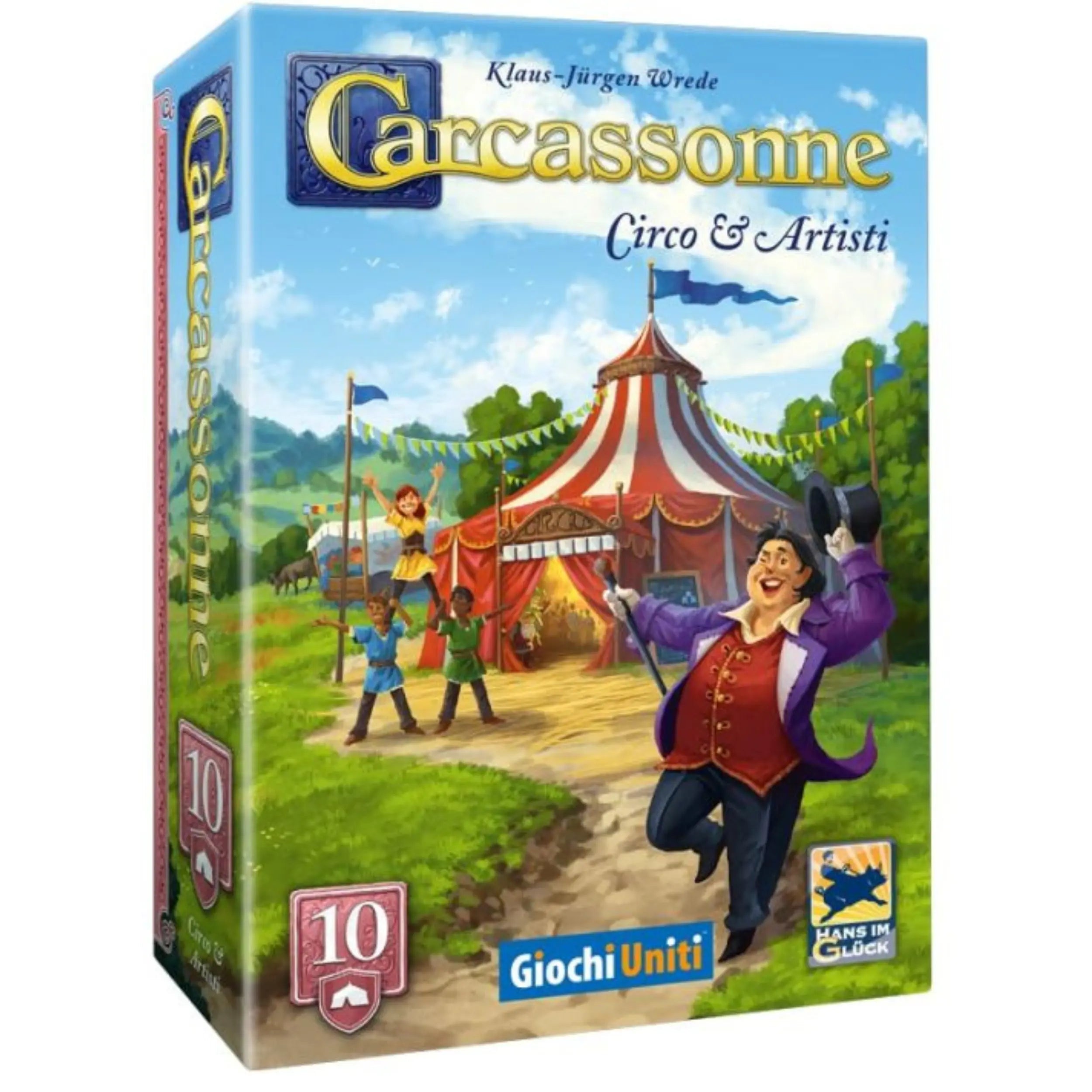
Carcassonne - Circo & Artisti - Espansione 10
🐸 Dettagli da BoardGameGeek
Consiglio BGG sul numero di giocatori
Categorie
Meccaniche
Design & Art
Lingua
Si abbina bene con
The FroGames card
You place a circus tile. Blue builds a human pyramid. Red places the big top exactly where you needed it. And you look at the meeple in your hand wondering if it's worth the risk.
WHAT IT'S ABOUT
The circus comes to Carcassonne with acrobats, big tops, and new strategies
Carcassonne - Circus & Artists is the tenth official expansion for Carcassonne, once again designed by Klaus-Jürgen Wrede. Published in 2017 (originally Under the Big Top), it introduces a new thematic element to the base game: the itinerant circus travelling through medieval French countryside. The illustrations by Marcel Gröber, Anne Pätzke, and Chris Quilliams introduce big tops, acrobats, and the ringmaster.
At the table, you build human pyramids by stacking your meeples on circus tiles, attract visitors with big tops to multiply points, and face new tactical choices on when to close your features. The mechanics of tile placement and area majority remain identical, but the circus adds layers of scoring and timing that change mid-game priorities.
What they say abroad
"The circus adds a welcome layer of scoring decisions without complicating the core."
The circus adds a welcome layer of scoring decisions without complicating the core.
— Meeple Mountain
This expansion works best if you play Carcassonne often: pyramids require multi-turn planning and a table that understands the timing of the base game. If you're looking for light variety, other expansions might be more immediate.
— FroGames

Carcassonne - Circo & Artisti - Espansione 10 (Carcassonne: Circus & Artists)
FrogScore · FroGames.it editorial rating · based on rules, international reviews and play sessionsWhat you'll find in the box
The new elements that enter the game
20 circus tiles
They are shuffled into the base deck. Some have dedicated spaces for human pyramids, others host the ringmaster's big top. Recognizable by illustrations with acrobats and visitors.
Human pyramids
Stack your meeples on circus tiles: the second meeple on top of the first multiplies the points of the completed feature. You need at least two meeples of the same color, and you must close the city or road before others block you.
Big top and ringmaster
The big top attracts visitors: each adjacent meeple (yours or others') in the same feature earns extra points when you close it. The ringmaster is a special pawn you can place to better control the big tops.
Visitor tokens
Represent the circus audience. You place them near the big top and they count as multipliers at the end of the feature. More visitors = more points, but you must close before others.
Recommended sleeves 20 cards in 1 size ▼
If you play often, we recommend protecting your cards with clear sleeves to make them last longer.
| Size | Quantity |
|---|---|
| 46 × 46 mm | 20 |
| Total cards | 20 |
Come si gioca
Video dimostrativo di gameplay.
🎲How to PlayThe rules in four steps▼
How to Play
The flow of each round
Carcassonne - Circus & Artists does not change the basic turn structure: draw, place, meeple, score. It only adds new options when you draw circus tiles.
Take the next tile from the deck (now mixed with the 20 circus tiles). If it's a circus tile, it will have spaces for human pyramids, big tops, or visitors. Otherwise, it's a classic Carcassonne tile.
You place the tile according to standard rules. If it's a circus tile and you already have a meeple on that feature, you can place a second meeple ON TOP of the first one (human pyramid). Or you place the ringmaster or a visitor next to the big top.
Place a meeple on the newly placed tile, as always. Or, if the tile has a pyramid space and you already have a meeple there, stack the second one on top. The pyramid doubles the feature's points when you complete it, but locks up two meeples until then.
When you complete a city, road, or cloister, you score points. If there's a human pyramid (two stacked meeples), you double the base score. If there's an adjacent big top, you add points for each visitor. You retrieve your meeples. Incomplete pyramids at the end of the game score zero.
⏱️Your First GameThe chronicle, moment by moment▼
A game in five moments
What happens at the table
Not the rules. The experience.
The first circus tiles appear
You're playing Carcassonne as usual, then you draw a tile with the big top. You place it, but you don't know yet whether to invest a meeple there. Others look at the big top and calculate if it's worth getting closer. The circus has arrived, but no one has yet understood how much it matters.
Someone builds the first pyramid
Red places a second meeple on top of the first, on a city with three tiles. The pyramid promises double points, but the city is still open. You have a tile in hand that could complete it, but it would also be useful for your road. Choose. The table slows down: everyone is calculating.
The big top becomes a battleground
A big top tile ends up between two cities, one yours and one belonging to blue. The big top attracts visitors, and each adjacent meeple is worth extra points. You have three meeples there, blue has two. But who completes it first? And if you complete it, does blue still get points? The game has become a matter of timing.
The pyramid collapses (or triumphs)
Green completes the city with the human pyramid: two stacked meeples, four tiles, adjacent big top. Scores points: 8 base × 2 for the pyramid + visitors. Or someone blocks him from completing it, and the two meeples remain trapped until the end of the game. In that case, green mutters curses.
Final scoring with big tops
End of the deck. Incomplete features are scored, but uncompleted pyramids score zero. Big tops also give points for incomplete features, and that's where the game is played: whoever left meeples near the circus scores points, whoever invested everything in incomplete pyramids loses. A three-point difference, as often happens in Carcassonne.
🐸What to Know BeforehandThree honest things, from friends▼
What to Know Beforehand
Three things you need to consider
Building a human pyramid means investing two of your seven meeples in a single feature. If the feature remains open until the end of the game, those meeples never return, and the pyramid is worth zero points. It's a gamble: you either double your points or lose two pawns for the entire game. It works best with experienced players who know how to calculate the chances of completion.
Circus tiles are a minority in the total deck (the base game has 72). In quick or unlucky games, few circus tiles might come out, and the expansion feels minimal. The circus shines in longer games or when playing with multiple expansions mixed in, where the deck is larger and circus tiles are distributed better.
If you are learning Carcassonne for the first time, this expansion adds unnecessary complexity. Pyramids and big tops only work well if you already know the completion times for features and when it's worth investing meeples. For new players, the risk is blocking two meeples in pyramids that never complete.
🏆Victory and DefeatWhat the ending rewards▼
How it ends
How to win and how to lose
The game ends when the tile deck runs out. The player with the most points after the final scoring wins.
Victory
- Complete cities and roads with human pyramids: double the base points and retrieve meeples for new moves
- Place meeples near big tops and complete features before others: each adjacent visitor multiplies the score
- Manage your seven meeples well: don't block too many in uncompleted pyramids and stay flexible for the last tiles
Defeat
- Build human pyramids on features you never complete: at the end of the game they are worth zero points, and you've lost two meeples for the entire game
- Opponents complete features with big tops before you do: visitors give them points too, and you're left with blocked meeples
- Invest too much in the circus and neglect classic cities and roads: there are few circus tiles, and if they don't appear, you've wasted turns
Carcassonne - Circus & Artists takes the tile placement you know and adds vertical timing choices: building up instead of out, completing early or waiting for the right big top. For those who have played Carcassonne fifty times and are looking for a reason to play fifty more.
💬Frequently Asked QuestionsQuick answers before checkout▼
Frequently Asked Questions
FAQ about Carcassonne - Circus & Artists - Expansion 10 (Carcassonne: Circus & Artists)
Can I play Circus & Artists without the base game?
No. This is an expansion: you need the tiles, meeples, and scoring board from Carcassonne second edition. The 20 circus tiles are mixed into the base deck. It is not a standalone game.
Do human pyramids work on all features?
Yes, you can build pyramids on cities, roads, and cloisters, but only if the circus tile has an indicated pyramid space. You need to already have a meeple on the feature in the previous turn: then you stack the second one. Points only double if you complete the feature; incomplete pyramids at the end of the game score zero.
Do big tops give points to opponents as well?
Yes. Every meeple adjacent to the big top (even of a different color) scores extra points when someone completes the feature. If you and blue both have meeples near the big top, both of you score visitor points. This creates tactical situations: sometimes it's better to complete immediately, other times to wait for the opponent to get too close and complete before them.
What mechanics does Carcassonne - Circus & Artists use?
Tile placement, area majority, and limited meeple management. The expansion adds stacking (stacking meeples) for human pyramids and score multipliers related to big tops and visitors. The weight remains low (1.9/5): these are two new rules, not a complex system.
Is this expansion available in Italian?
Yes. The edition sold on FroGames is in Italian, published by Giochi Uniti. It includes translated rules and localized components. Compatible only with Carcassonne second edition (the box with updated graphics published from 2014 onwards).
The people behind the game
Who invented it, who designed it, who publishes it — and what else they've done.
Carcassonne - Circus & Artists is the tenth official expansion for Carcassonne, for 2-6 players, games lasting 45 minutes, ages 7+. It introduces human pyramids (meeple stacking that doubles points), circus big tops, and visitors that multiply the score of completed features. Designed by Klaus-Jürgen Wrede, published by Giochi Uniti in Italian. Mechanics: tile placement, area control, resource management. Requires the Carcassonne second edition base game. Available on FroGames.it with fast shipping throughout Italy.
Carcassonne - Circo & Artisti - Espansione 10
Frequently Asked Questions
The answers you're looking for, no beating around the bush.
📸Do the images match the actual product?
The photos on the website often come from BoardGameGeek and are intended to give you an idea of the game. They may vary slightly from the version you receive. The content declared by the publisher is always binding.
📦Does the content of the box match what is indicated?
We always strive to provide the correct content, but minor variations are possible due to reprints or updates. The information comes directly from the publishers. If you have any questions, please contact us!
⏳How do pre-orders work?
Pre-order the game before release, payment is immediate, and the game is reserved for you. As soon as it arrives, we'll ship it right away! If there are any delays, we'll update you promptly.
🔒Can I trust buying here?
Absolutely! Secure payments, tracked shipments, and a team that loves board games as much as you do. If something goes wrong, we'll do our best to fix it.
🛠There's a problem with my order, what should I do?
Write to us now! Whether it's a missing part, damage, or an error, we'll help you resolve it as soon as possible. Your experience truly matters to us.