
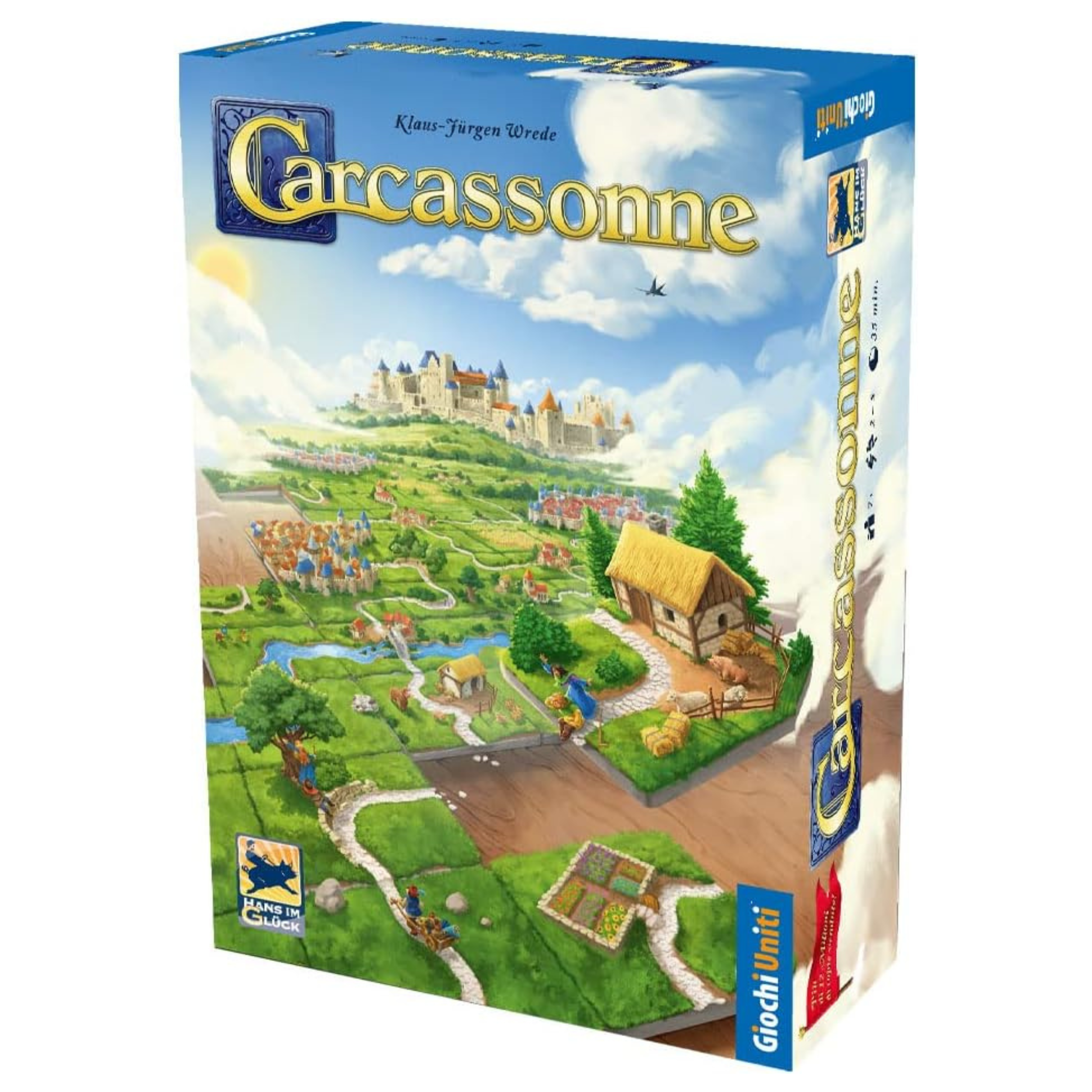
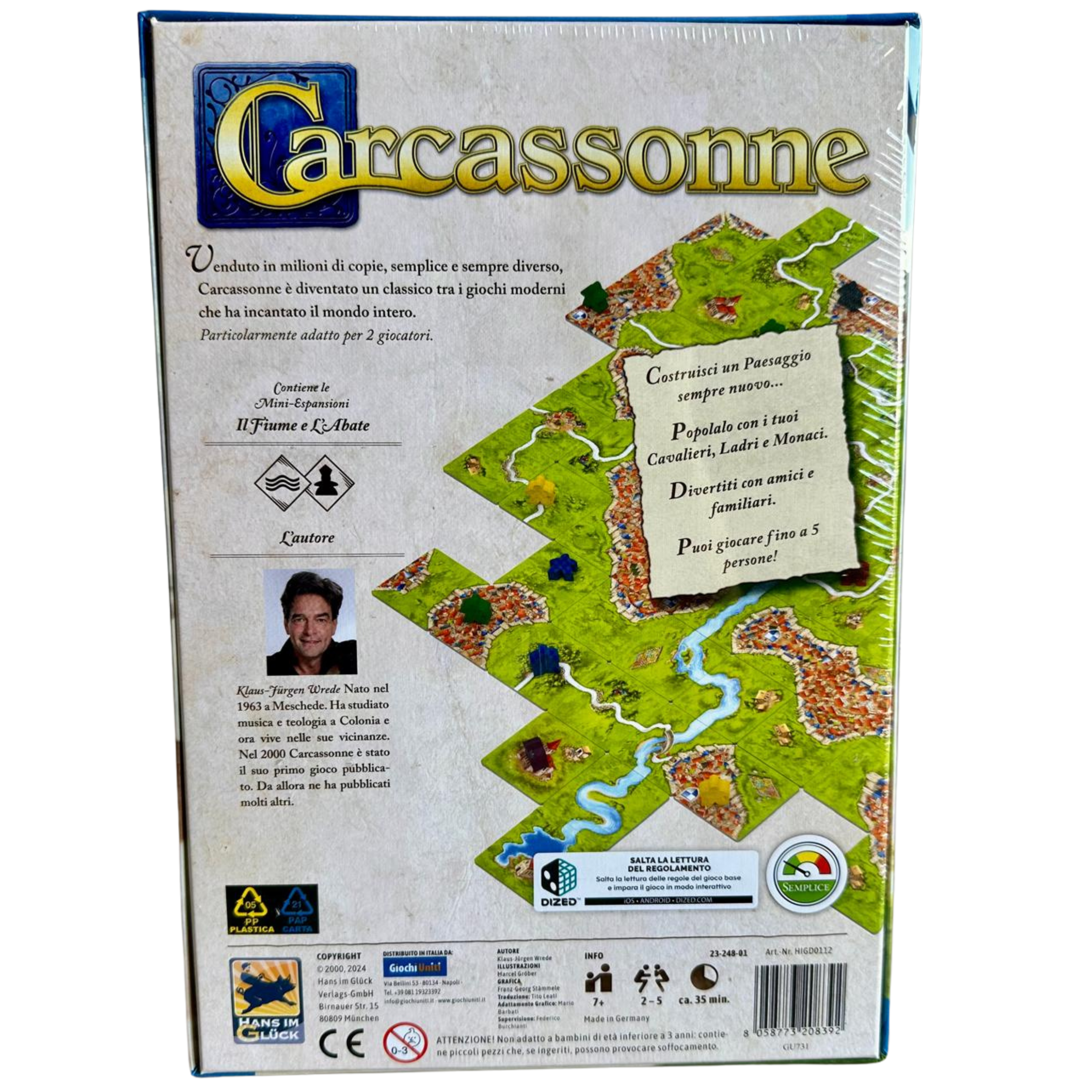
Carcassonne
🐸 Dettagli da BoardGameGeek
Consiglio BGG sul numero di giocatori
Categorie
Meccaniche
Design & Art
Lingua
Si abbina bene con
The FroGames Card
You place a road tile. He completes your city and places a knight in it. You close his abbey before he runs out of meeples. In the end, no one remembers the score, everyone remembers that field.
WHAT IT'S ABOUT
The game that invented the meeple
Designed by Klaus-Jürgen Wrede in 2000, Carcassonne won the Spiel des Jahres and sold millions of copies worldwide. Named after the fortified city in southern France, it lets you build the medieval landscape tile by tile. It introduced meeples — the colorful wooden figures you find everywhere today — and made them iconic.
Each turn you draw a tile, place it next to others (city with city, roads with roads) and decide whether to place one of your meeples on it: as a knight in a city, as a robber on a road, as a monk in an abbey or as a farmer in the fields. When you complete a structure, you score points and take back your meeple. Farmers, however, remain there until the end and are scored based on the cities their fields touch. Simple to explain, difficult to master.
What they say abroad
"The gateway game that defined a generation."
The gateway game that defined a generation.
— The Dice Tower
Every game builds a different map. Every decision seems small until you close that city everyone wanted.
— FroGames

Carcassonne
FrogScore · FroGames editorial rating · based on rules, international reviews and play sessionsWhat's inside
Few pieces, infinite games
72 territory tiles
Walled cities, winding roads, isolated abbeys, open fields. Each tile has unique combinations of these elements. You will draw randomly and build the map turn by turn, matching compatible edges.
40 wooden meeples
Eight pawns for each color (5 colors). They are your limited resource: when you place them, they stay there until you complete the structure. Once you run out of meeples, you can only draw and place tiles.
Score track
A path from 0 to 50 where you move your marker each time you close cities, roads, or abbeys. Farmers do not give immediate points: you will count them only at the end of the game based on the cities in their fields.
Illustrated rulebook
Four pages. It explains how to place tiles (compatible sides), where to place meeples (on unoccupied areas), and how to score points (each completed element has a fixed value).
Recommended sleeves 234 cards in 1 size ▼
If you play often, we recommend protecting your cards with clear sleeves to make them last longer.
| Size | Quantity |
|---|---|
| 46 × 46 mm | 234 |
| Total cards | 234 |
🎲How to playThe rules in four steps▼
How to play
The flow of each turn
A turn lasts thirty seconds. Four actions in sequence, no hidden phases.
Take the first face-down tile from the stack. Look at what it represents: city, road, cloister, field, or a combination. You don't choose what to draw, but you choose everything else.
You place it on the table adjacent to at least one already present tile. The edges must match: city with city, field with field, road with road. You cannot rotate it to force a fit; you must find a legal spot.
If you have meeples available, you can place one on the newly placed tile: as a knight in a city, a robber on a road, a monk in a cloister, or a farmer in a field. You cannot place it on a structure already occupied by another meeple (yours or someone else's).
If the newly placed tile completes a city, road, or cloister, you score points immediately: 2 points per city tile (plus shields), 1 point per road tile, 9 points for a cloister. Take back your meeples from completed structures. Farmers always remain in fields until the end of the game.
⏱️Your first gameThe play-by-play, moment by moment▼
A game in five moments
What happens on the table
Not the rules. The experience.
The starting tile
There's only one tile on the table: the starting tile. You draw, see what you got — maybe a large city with a road — and decide where to place it. You place a meeple as a knight in the city. Others watch and understand that you want that city.
The first blocked meeple
You've placed three meeples. Five remain. You draw a perfect tile to complete your road, but the robber is still on another road that isn't closing. You have to choose: close immediately and get points back, or expand and risk running out of meeples. You choose to expand. Maybe it's a mistake.
The contested city
He places a city tile next to yours and puts a knight on it. Now there are two of you in the same city. If someone completes it, whoever has more meeples gets all the points. You have one, he has one. The game becomes a race: who places the second meeple there, or who completes it first?
The forgotten field
Mid-game. Someone places the first farmer in a field. Others look at him puzzled: that meeple will never come back, it will stay there until the end. It seems like a waste. But that field already touches two completed cities, and others are growing. In the end, it could be worth 15 points.
The last tile
Stack empty. Fields are counted: whoever placed farmers in the right areas flips the score. Those who ignored them bite their nails. The final map is an asymmetrical mosaic, full of half-cities and roads leading nowhere. But it's beautiful.
🐸To know beforehandThree honest things, from friends▼
To know beforehand
Three things you need to know
You never have enough meeples
You have eight. It seems like a lot, but you place them quickly and retrieve them slowly. If you waste them all in the first few turns, you'll spend the rest of the game drawing and placing tiles without being able to mark territory. Meeple management IS the game: you need to know when to commit them and when to wait.
Farmers are a twist, not an obligation
In your first game, play without them. Farmers stay in fields until the end and score points based on completed cities touching their fields. They seem like an advanced rule, but after two games, they become natural. They change priorities: large fields are worth gold.
With 5 players, it slows down
With two or three, it's perfect: fast turns, compact map, continuous interaction. With five, downtime lengthens and the map expands too much, reducing clashes. It works, but the best experience is with 2-4 players.
🏆Victory and defeatWhat the ending rewards▼
How it ends
How to win
The game ends when the tiles run out. The player with the most points after the final count wins.
Victory
- Sum the points accumulated during the game (completed cities, roads, cloisters)
- Add points for incomplete structures (they are worth less, but they are worth something)
- Count the farmers: each completed city in their fields is worth 3 points per farmer (whoever has more farmers in a field takes everything)
Common mistakes that cost victory
- Wasting meeples on small structures instead of aiming for large cities
- Ignoring farmers: those who place them well can overturn games lost by 20 points
- Not blocking others' expansions: you let huge cities grow that you then can't complete first
Carcassonne is not the most complex game in the world. But it's one that works with everyone, every time, for 25 years. There's a reason for that.
💬Frequently asked questionsQuick answers before checkout▼
Frequently asked questions
Carcassonne FAQ
What mechanics does Carcassonne use?
Tile placement, area majority (territory control with meeples), pattern building (map construction), square grid. Simple mechanics elegantly intertwined: you draw, you place, you decide whether to invest a meeple.
Is it true that farmers are hard to understand?
For the first game, yes: the rule is counter-intuitive (meeples getting stuck until the end). But after a 2-minute explanation and a test game, they become the most interesting part. Recommendation: play the first time without them, the second with them. Problem solved.
Does it work well with two players?
Very well. In fact, many prefer Carcassonne with two players: zero downtime, more compact map, every move counts. It loses some of the multiplayer chaos but gains in control and tactics. It's one of the best gateway games even for couples.
How long does a real game last?
According to BGG data: 30-45 minutes. In reality: 35 minutes with two-three players, 50 with four, 60 with five (if everyone knows how to play). The first game with explanation takes about 50-60 minutes, but from the second one, it flows quickly.
Is the Italian edition complete?
Yes. Giochi Uniti Italian edition, with translated rules and components identical to the international edition. Includes 72 tiles, 40 wooden meeples, scoring track. Does not include expansions (these are bought separately).
The people behind the game
Who invented it, who designed it, who publishes it — and what else they've done.
Carcassonne is a tile placement board game for 2-5 players, lasting 30-45 minutes, recommended age 7+. Designed by Klaus-Jürgen Wrede, winner of the 2001 Spiel des Jahres, it uses tile placement and area control mechanics with the famous wooden meeples. Each turn you draw a medieval landscape tile and add it to the shared map, deciding whether to place one of your meeples as a knight, robber, monk, or farmer. Published by Giochi Uniti in Italian edition. Available on FroGames.it with fast shipping.
Carcassonne
Frequently Asked Questions
The answers you're looking for, no beating around the bush.
📸Do the images match the actual product?
The photos on the website often come from BoardGameGeek and are intended to give you an idea of the game. They may vary slightly from the version you receive. The content declared by the publisher is always binding.
📦Does the content of the box match what is indicated?
We always strive to provide the correct content, but minor variations are possible due to reprints or updates. The information comes directly from the publishers. If you have any questions, please contact us!
⏳How do pre-orders work?
Pre-order the game before release, payment is immediate, and the game is reserved for you. As soon as it arrives, we'll ship it right away! If there are any delays, we'll update you promptly.
🔒Can I trust buying here?
Absolutely! Secure payments, tracked shipments, and a team that loves board games as much as you do. If something goes wrong, we'll do our best to fix it.
🛠There's a problem with my order, what should I do?
Write to us now! Whether it's a missing part, damage, or an error, we'll help you resolve it as soon as possible. Your experience truly matters to us.