
Entropy ITA
🐸 Dettagli da BoardGameGeek
Consiglio BGG sul numero di giocatori
Categorie
Meccaniche
Design & Art
Lingua


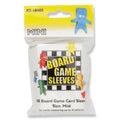
Si abbina bene con
The FroGames info card
Move your scientist, choose an action, play a card. Do you build a star or spend it for research? In half an hour, you'll have a solar system unlike any other, and you'll realize that every card burned was a sacrifice.
WHAT IT'S ABOUT
A final exam to become a scientist: creating a universe
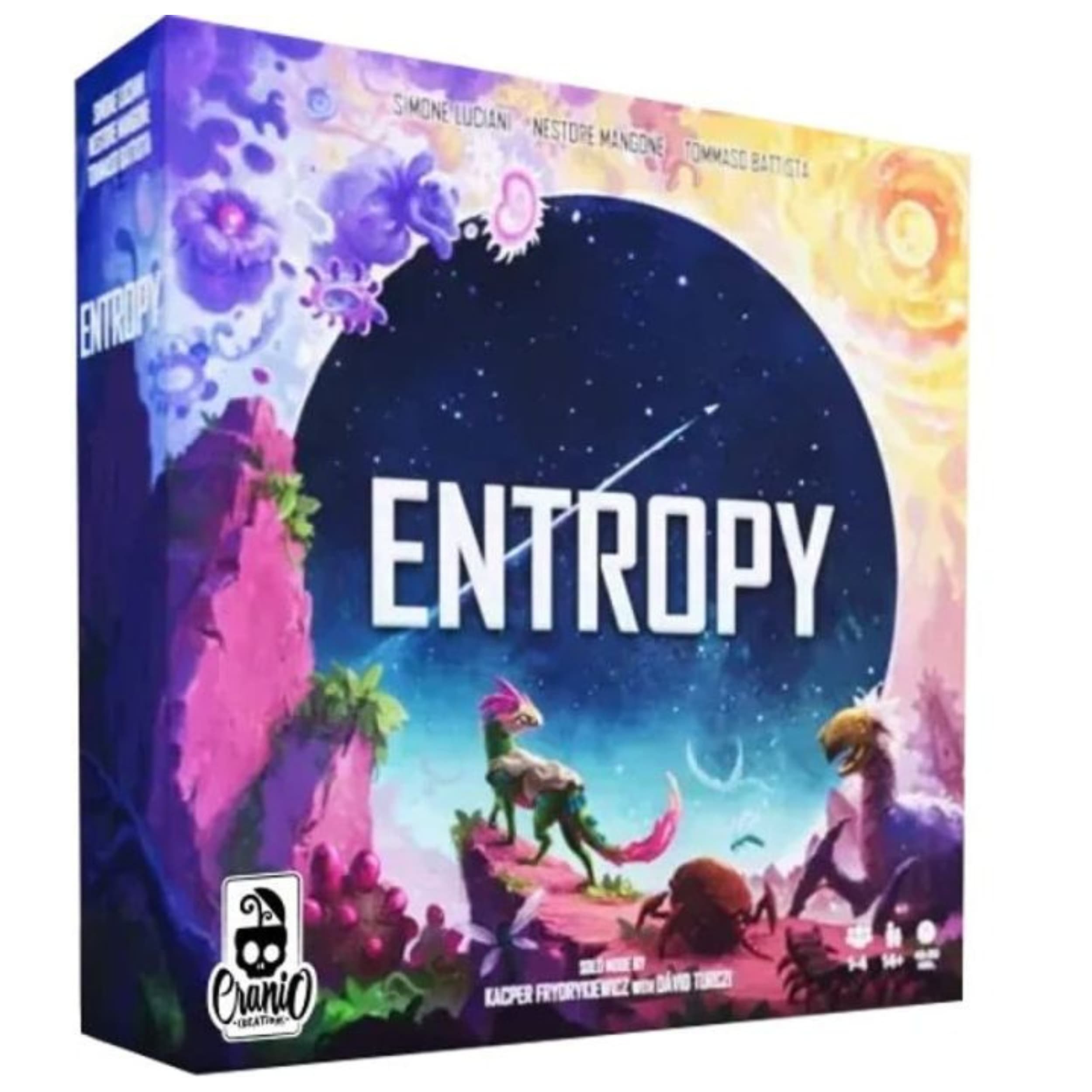
Entropy comes from the minds of Simone Luciani (Barrage, Golem, Tzolk'in), Tommaso Battista and Nestore Mangone, with illustrations by Piotr Orleański and Zbigniew Umgelter for Board&Dice. It is set in a future where humanity has learned to bend entropy: your task is to pass the final test to enter the caste of scientists, proving you can create solar systems, stars, planets, biomes, and finally life. All within a simulation, but the tension is real: only one will be promoted.
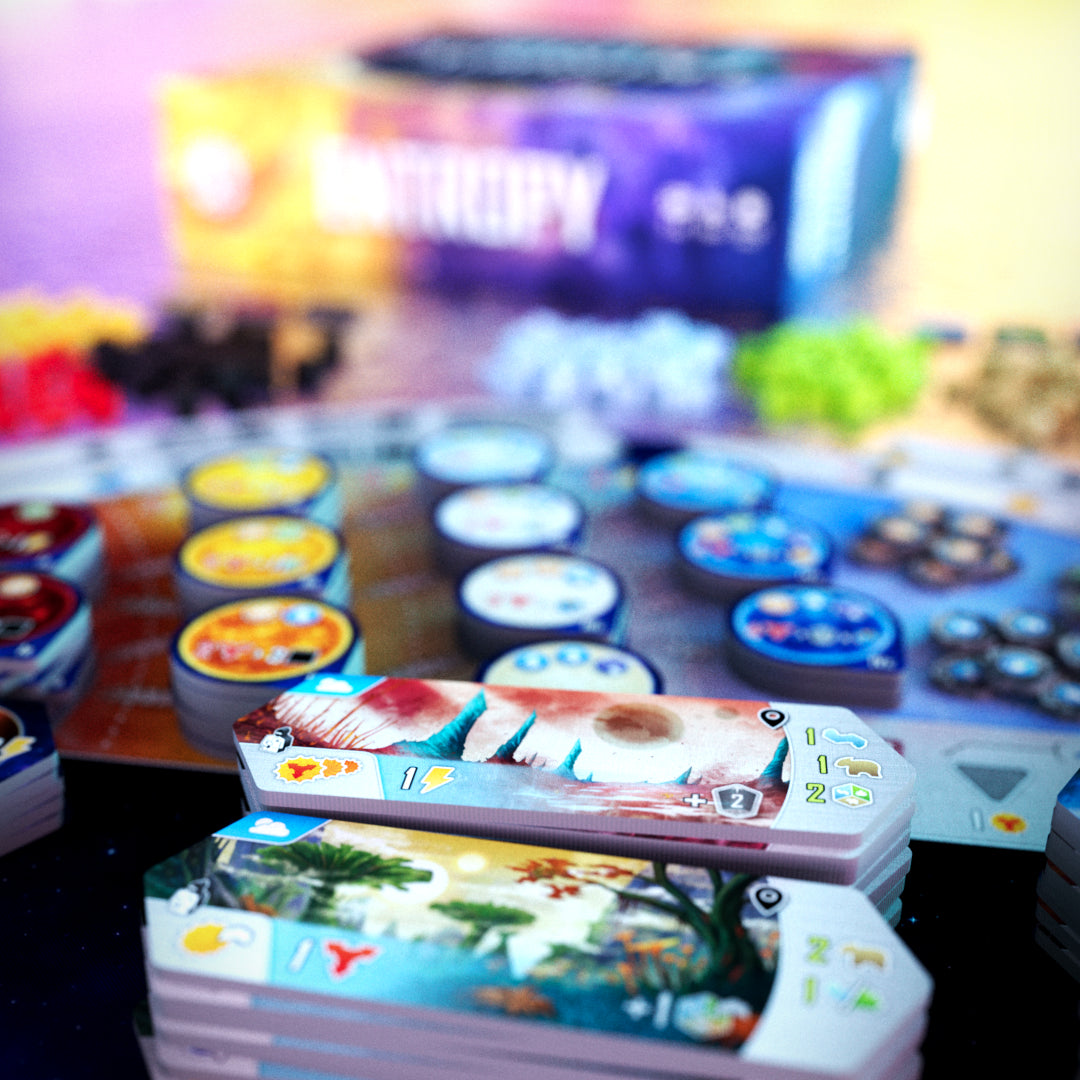
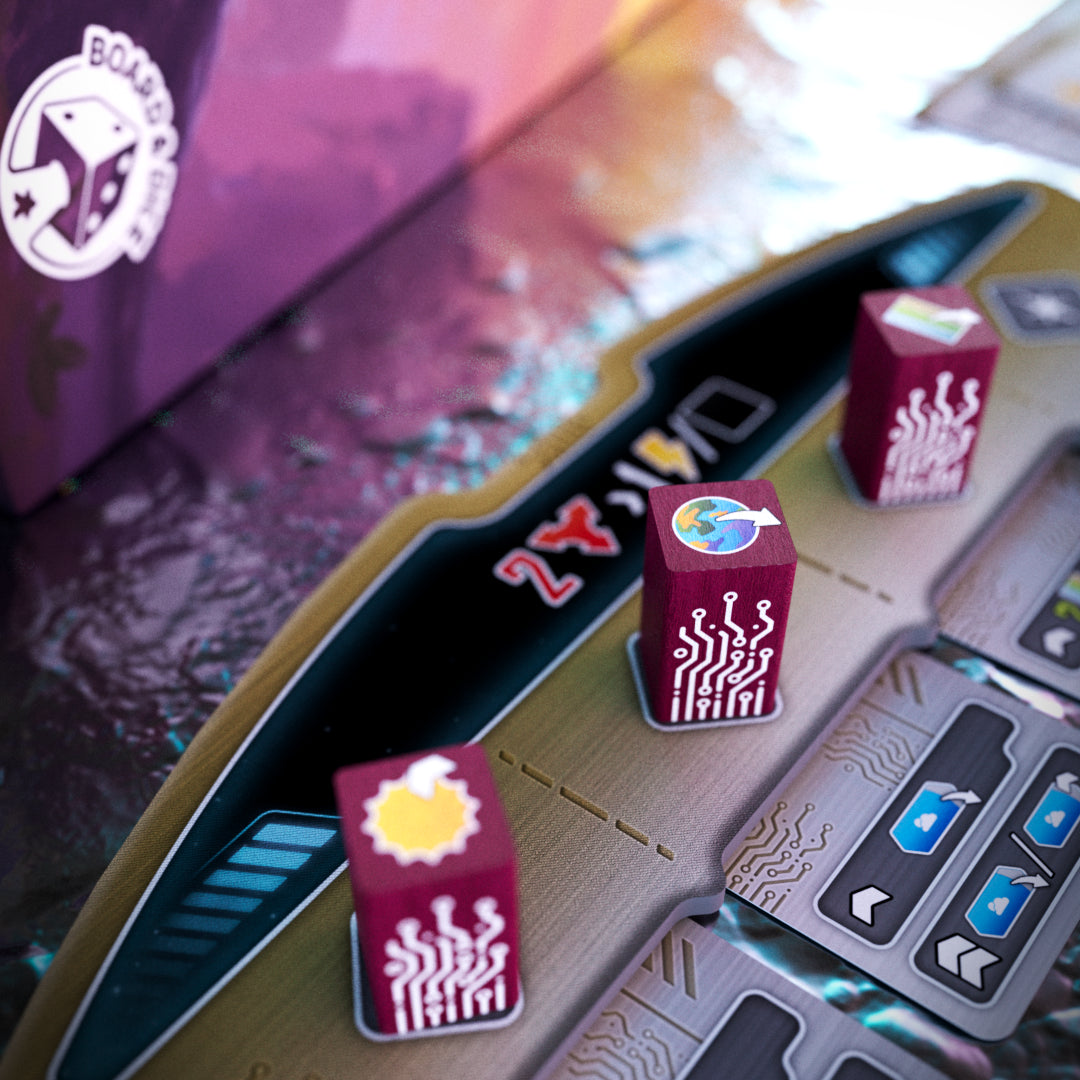
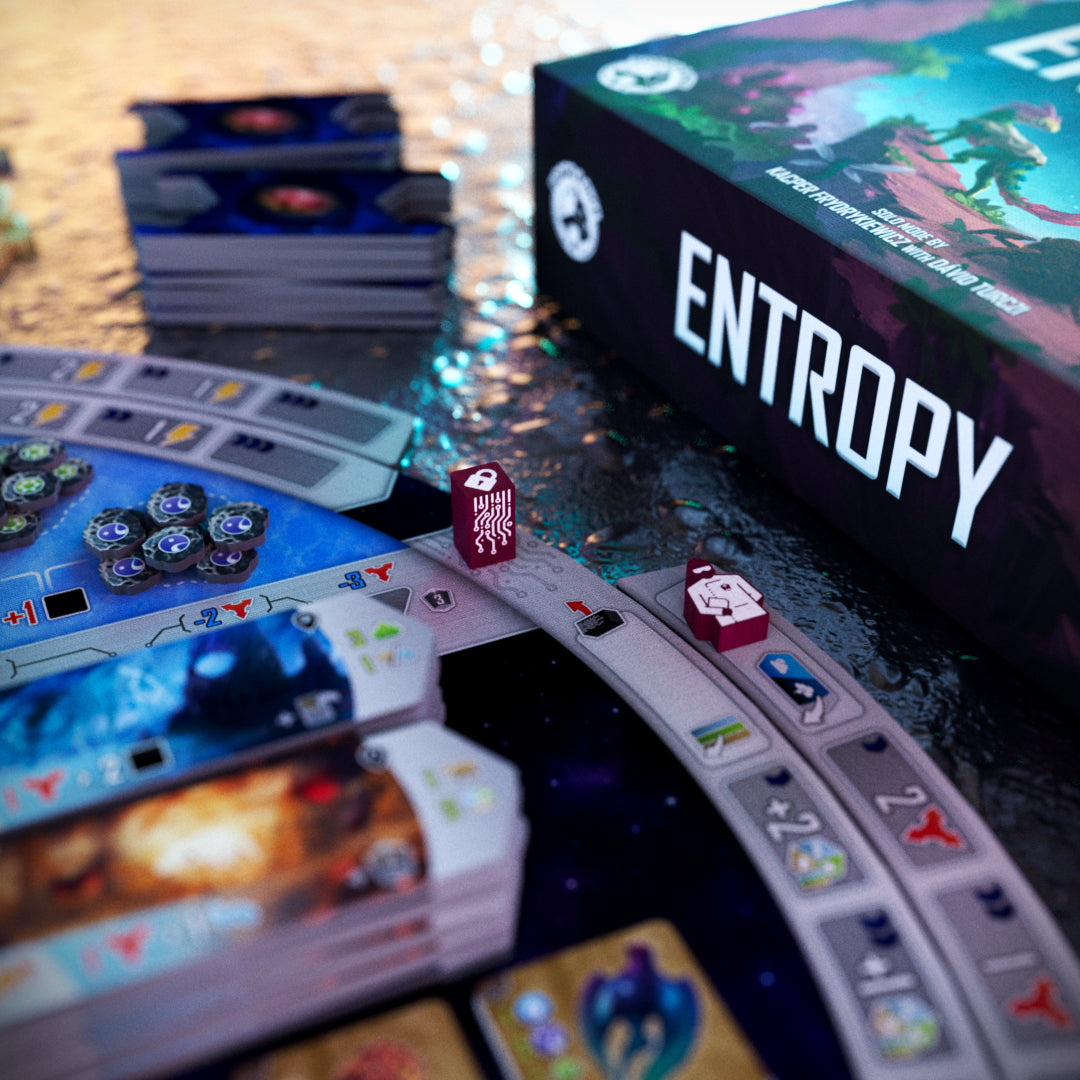
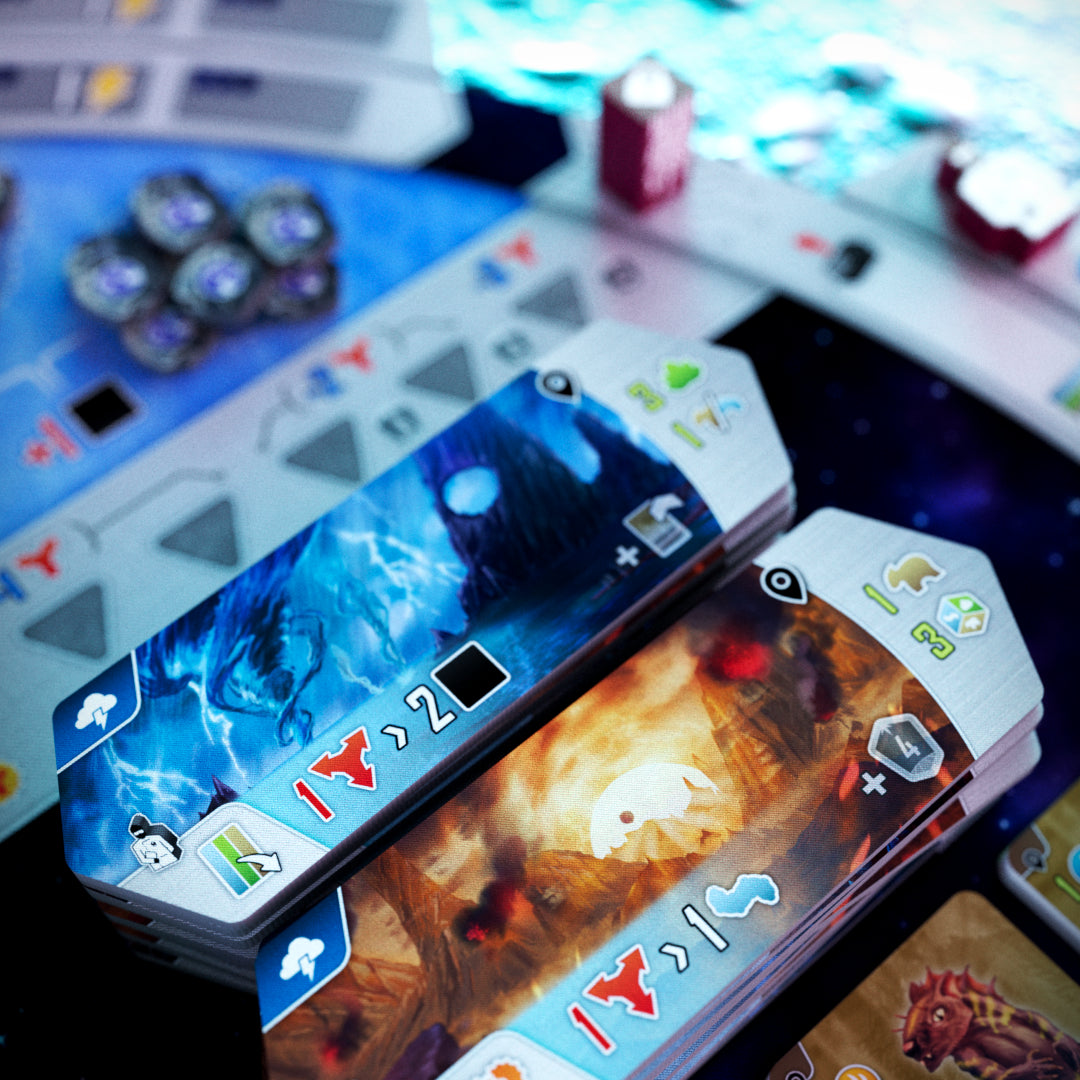
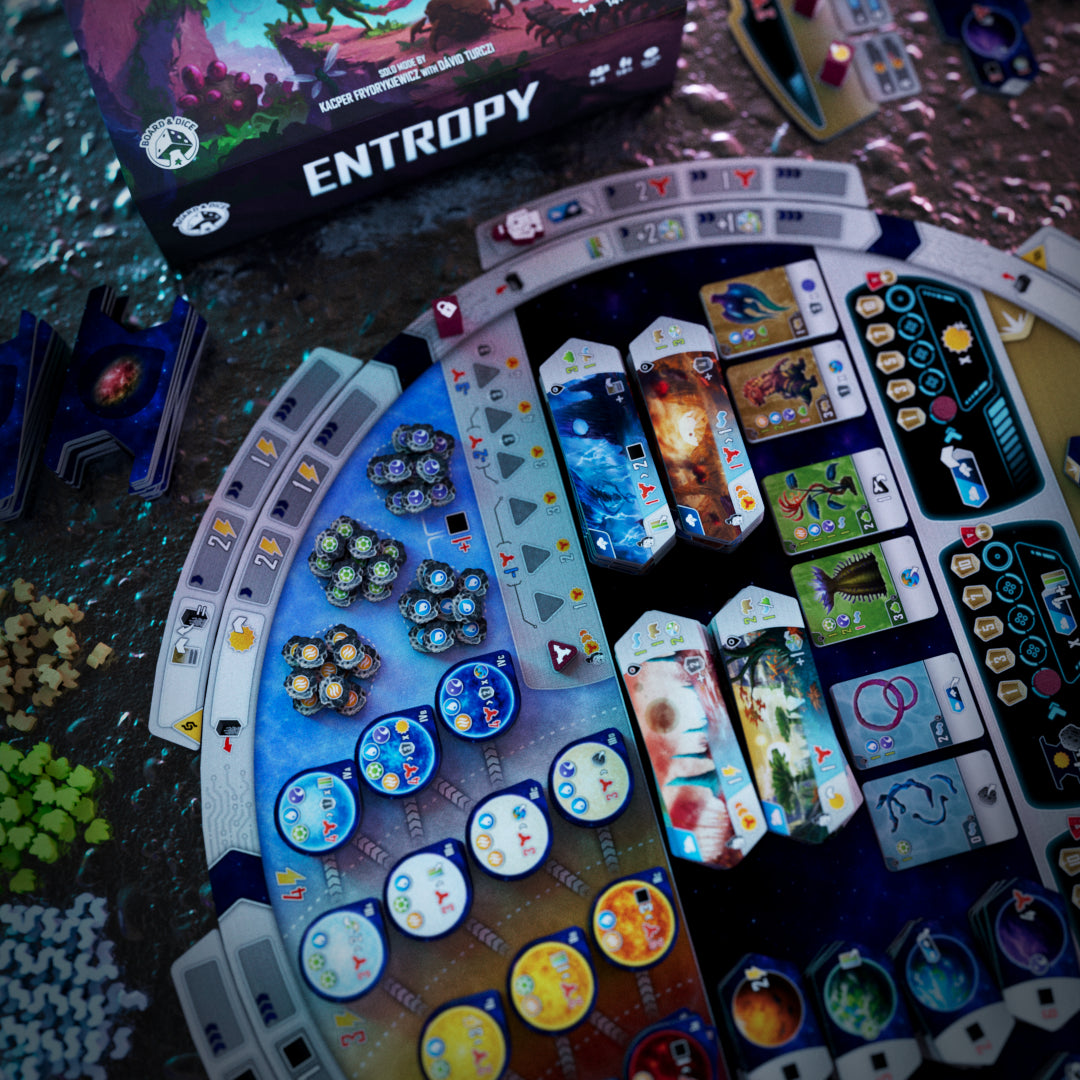
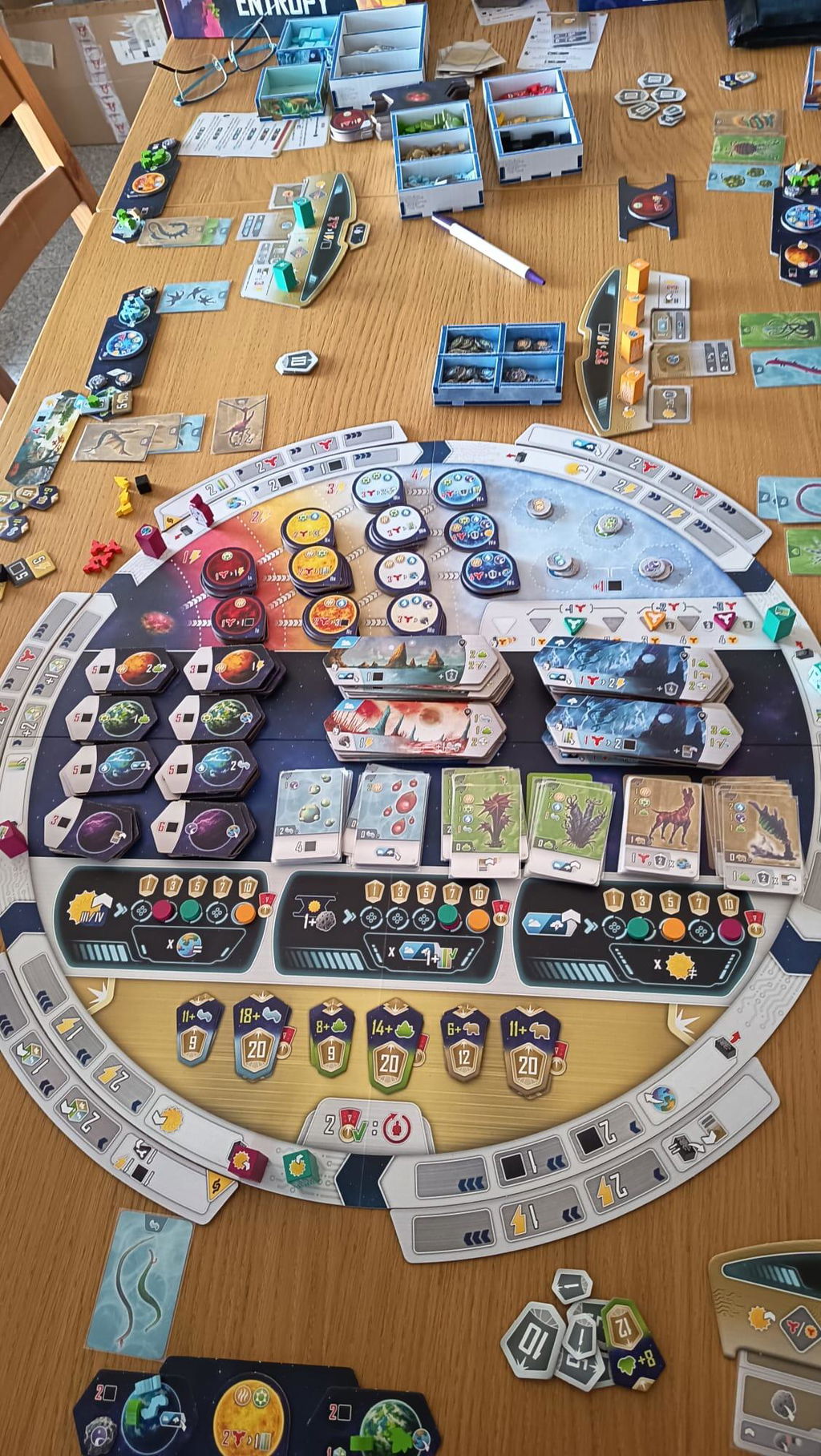
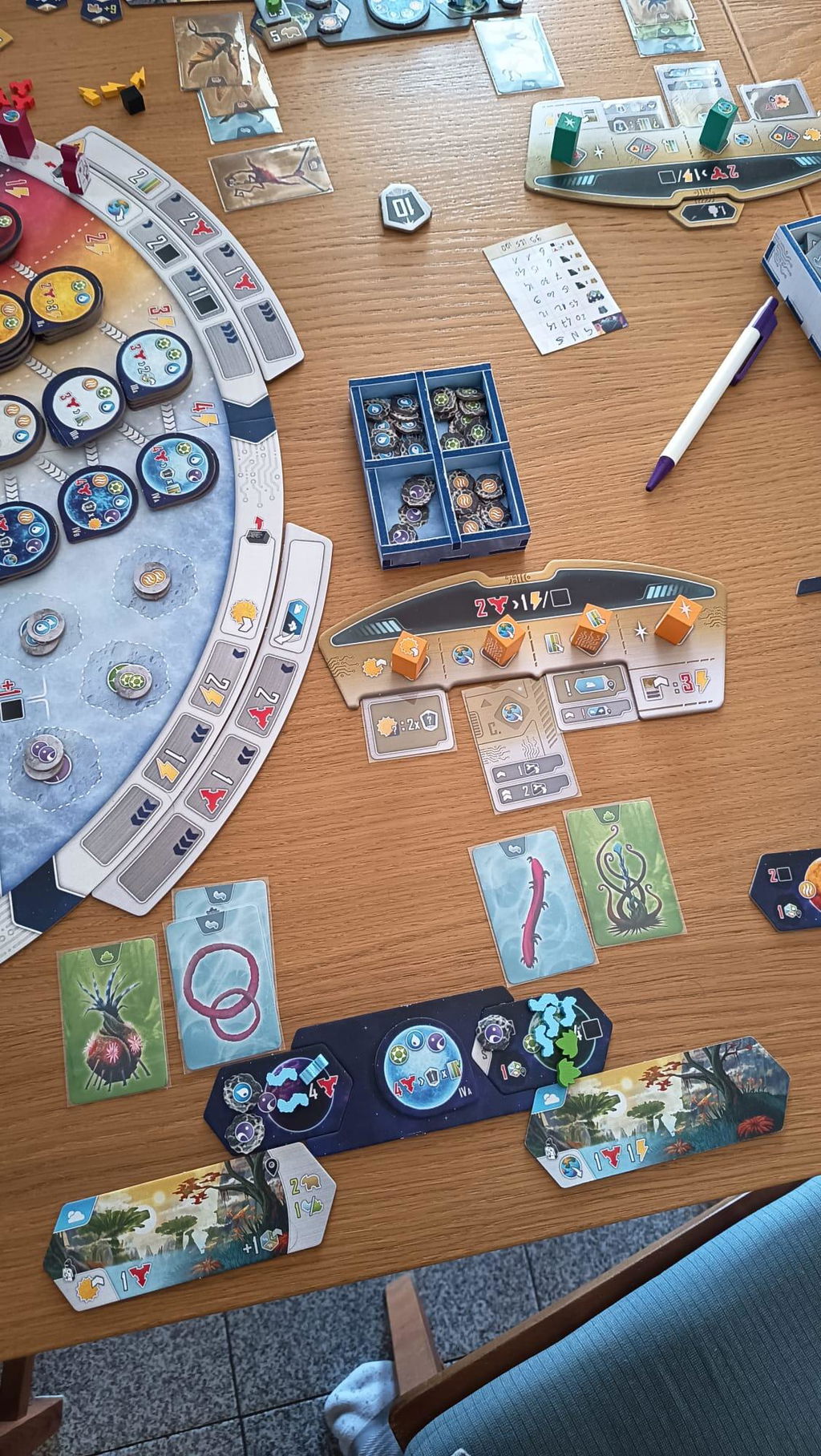
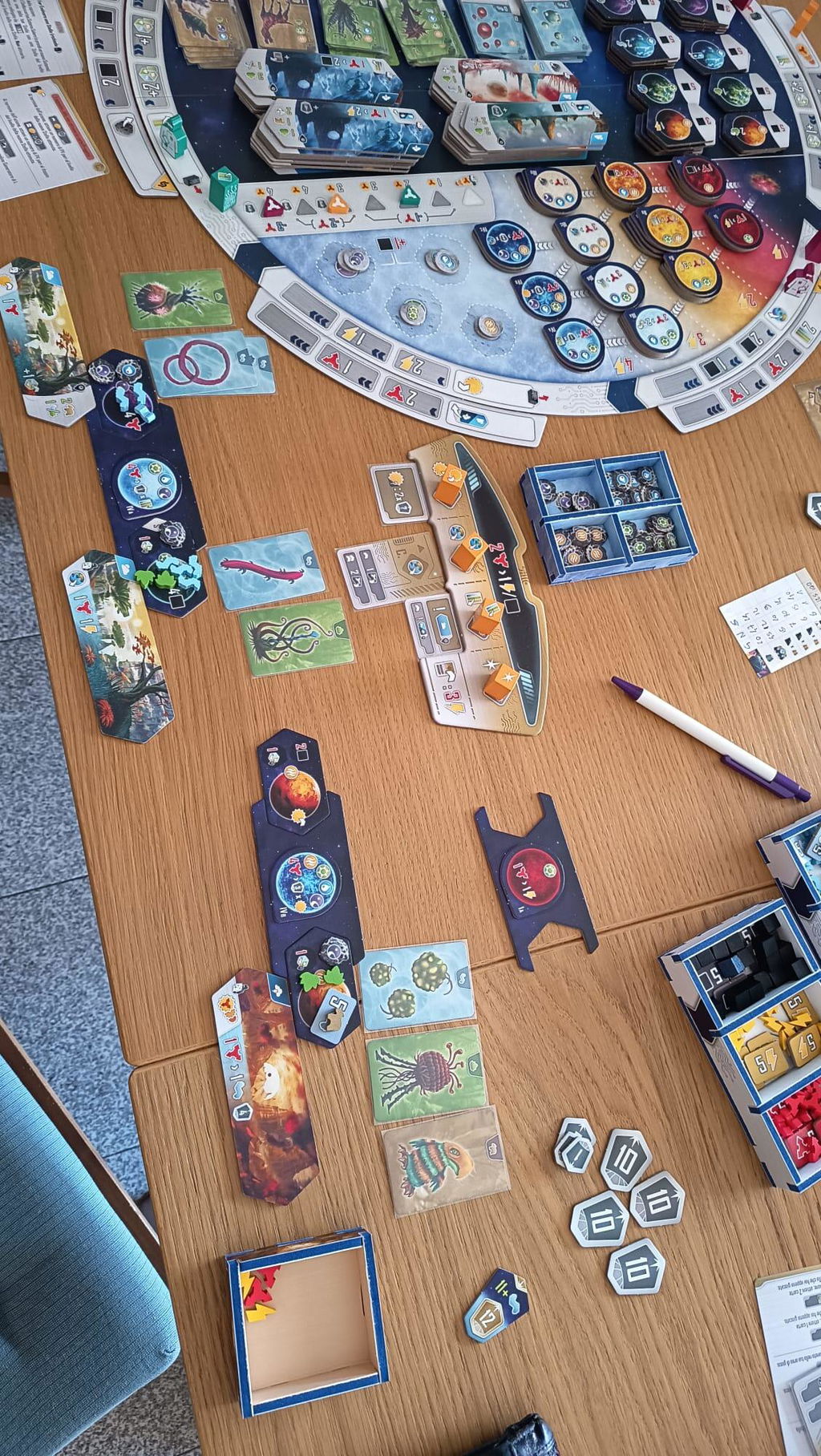
At the table, you build your personal tableau by playing multi-use cards: each card can become a star, a planet, an asteroid, or a resource spent to do something else. You move on a central rondel that dictates which actions you can take, and each turn you choose how far to advance (1 to 3 spaces) knowing that your position will influence the next round. The engine is optimization: you build constellations that trigger bonuses, complete public objectives, and upgrade your console to unlock special abilities. When 2 of the 6 main objectives are completed, the game ends and points are tallied.
What they say abroad
"For aeons, entropy was an inescapable force of nature."
— Board&Dice
Luciani returns to pure economic management: tough choices, burning cards, unforgiving rondel.
— FroGames

Entropy
The game includes official solo rules already in the base manual. You play against objectives to complete and a timer simulated by the deck's progression. The experience is complete and the puzzle remains intact, but you obviously lose the competitive race for public objectives that creates tension in multiplayer.
FrogScore · editorial rating FroGames · based on rules, international reviews and play sessionsThe scientist's tools
What you build (and what you sacrifice)
Stars
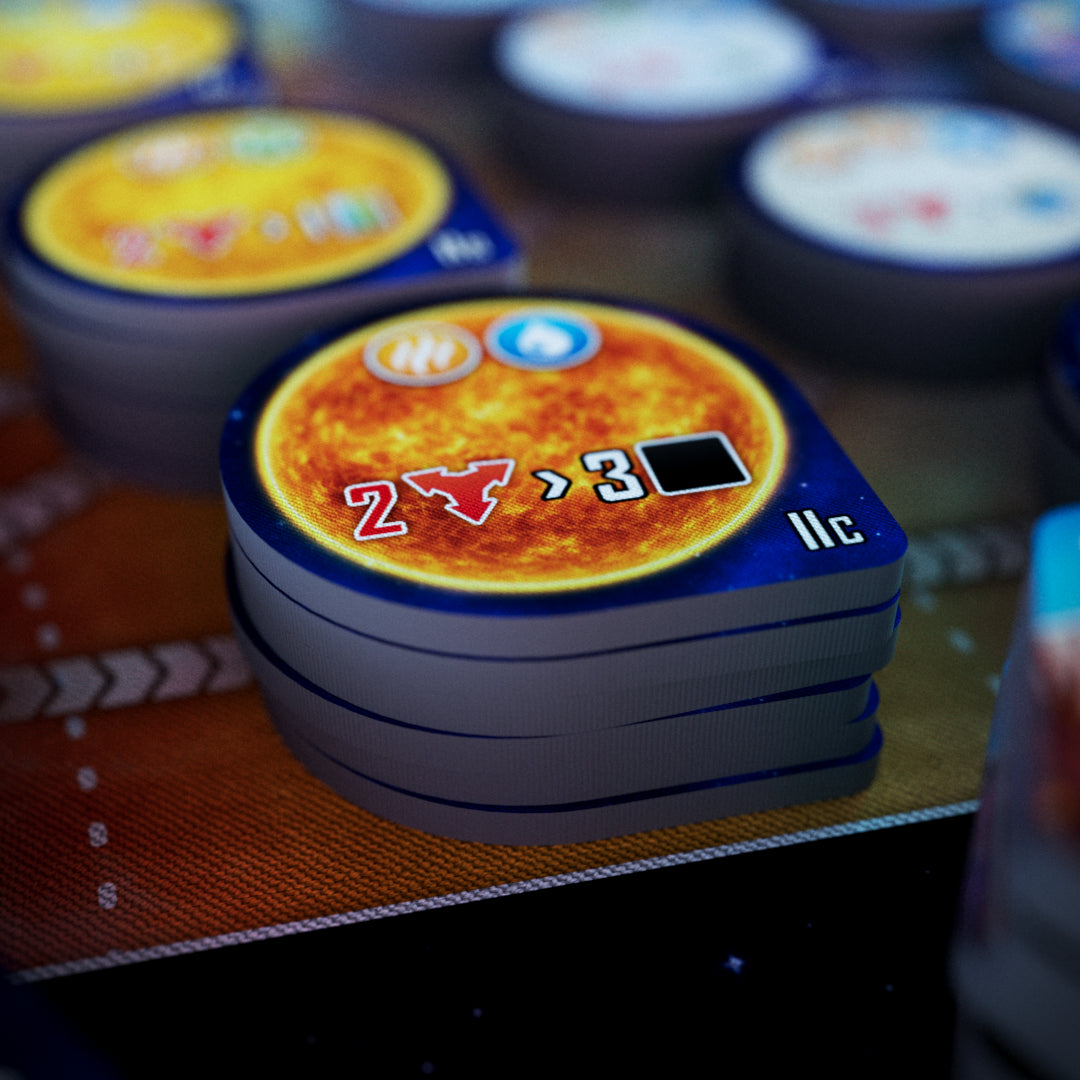
The heart of every solar system. Each star has a type (red giant, white dwarf...) that dictates which planets can orbit it. Playing them costs cards, but unlocks space to build.
Planets and Asteroids
You place them around stars, each with distance and type requirements. Planets host biomes and life, asteroids provide immediate resources. Arrangement matters for chain bonuses.
Biomes
Oceans, forests, deserts: add them to planets to unlock permanent abilities and prepare them for life. Each biome has a cost and a unique effect. Unlocking the right biome at the right time can turn the game around.
Life
The ultimate goal: sowing life forms on planets. Requires suitable biomes and accumulated resources. Each life form is worth points and can complete objectives. It is the phase that crowns your universe.
Recommended sleeves 129 cards in 2 sizes ▼
If you play often, we recommend protecting your cards with transparent sleeves to make them last longer.
| Size | Quantity |
|---|---|
| 41 × 63 mm | 121 |
| 80 × 120 mm | 8 |
| Total cards | 129 |
🎯 COME SI GIOCA
📦 CONTENUTO DELLA SCATOLA
Come si gioca
Video dimostrativo di gameplay.
🎲How to PlayThe rules in four steps▼
How to Play
The flow of each turn
Each turn is a strict sequence: move, choose, execute, pass.
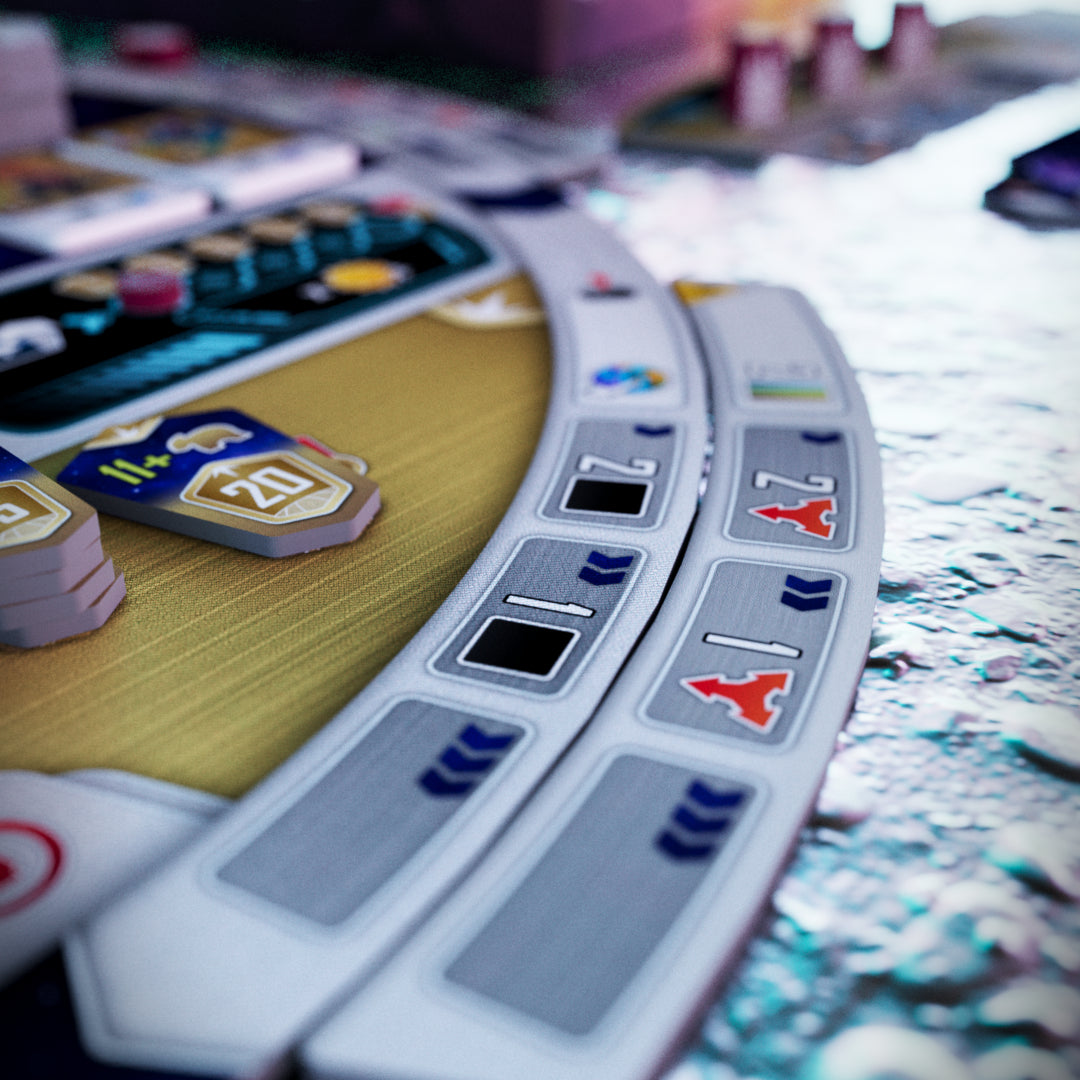
Advance your pawn on the rondel 1 to 3 spaces clockwise. You cannot go backward. Where you stop dictates which action you can take this turn. Moving little gives you frequent but limited actions; moving a lot skips spaces but gets you where you need to be.
The space where you stopped has a main board action (e.g., "Build star") or allows you to use one of the external action tiles. Choose what to do based on your strategy and the hand you have.
Resolve the action: play cards from your hand, pay resources, place components on your tableau. Many cards are multi-use: you can play them as an element (star, planet) or discard them for their resource value. Every choice is a sacrifice.
Draw up to your hand limit (if provided by the action), activate any effects triggered by what you have built (biomes, console upgrades), and pass to the next player. When 2 main objectives are completed, the game ends immediately.
⏱️Your first gameThe chronicle, moment by moment▼
A game in five moments
What happens at the table
Not the rules. The experience.
Setup and first moves
Distribute public objectives, everyone draws their starting hand and chooses their starting point on the rondel. The first turns are exploratory: everyone tries the movement, looks at the available actions, understands where they want to go. Some immediately play their first star, others accumulate resources.
Engines take shape
Personal tableaus begin to fill up: stars with planets around them, first biomes placed, some asteroids to make money. It becomes clear who is aiming for which scoring strategy (massive life, multiple objectives, console upgrades). The rondel starts to bite: where you stop now affects where you will arrive later.
The race for objectives
Someone is close to completing the first main objective. Others accelerate or change course. Players begin to sacrifice valuable cards to take out-of-turn actions or buy console upgrades. Every choice of where to stop on the rondel becomes a three-variable calculation.
The first objective falls
First objective completed: the countdown to the end has begun. Someone places the first form of complex life, others rush to complete constellations for final bonuses. Hands empty quickly, the rondel spins wildly. It's clear who is in the lead, but the margins are tight.
End of game and scoring
Second objective completed, game over. Points are counted: life sown, public and secret objectives, bonuses from biomes and constellations. Someone discovers they lost by one missing planet, someone else wins thanks to a last-minute console upgrade. Players look back at their tableaus and reflect on what could have been done better.
🐸What to know beforehandThree honest things, from friends▼
What to know beforehand
Three things you need to know
Downtime with 4 players
With a full table, games easily extend beyond 2.5 hours. Each player must plan their move on the rondel, evaluate cards, calculate bonuses. If the group isn't cohesive or someone suffers from analysis paralysis, downtime becomes noticeable. With 2-3 players, it's smoother.
Steep learning curve
Weight 3.6 on BGG doesn't lie: dense iconography, interactions between biomes and objectives to learn, rondel to internalize. The first game is slow and full of doubts. Expect to consult the rulebook often in the first two rounds. It's not a gateway game and not for families.
Limited interaction
There is no direct attack, sabotage, or take-that. All interaction is indirect competition: you race for the same public objectives, occupy spaces on the rondel that others wanted, take biomes before opponents. If you're looking for confrontation or negotiation, it's not here.
🏆Victory and defeatWhat the ending rewards▼
How it ends
Victory and defeat
The game ends immediately when 2 of the 6 main objectives are completed. Then points are counted.
Victory
- Points from completed public objectives (main and secondary)
- Points from life forms sown on planets
- Points from end-game bonuses related to biomes, constellations, and console upgrades
- Points from personal secret objectives (if applicable)
Defeat
- You don't complete enough objectives and fall behind in scoring
- You build an inefficient engine and waste too much time on low-value actions
- You focus on only one strategy and don't diversify your point sources
- You misplan your movement on the rondel and miss key turns
Entropy is pure optimization: if you love management games where every resource counts and every discarded card is a burden on your conscience, this is your final exam.
📦In the boxComponents and materials▼
- 1 Main Board, 6 Action Tiles, 20 Solar System Tiles, 55 Star Tiles, 6 Starting Star Tiles, 44 Planet Tiles, 8 Starting Planet Tiles, 36 Biome Tiles, 40 Asteroid Tiles, 3 Alternate Objective Tiles, 12 Mission Cards, 66 Life Cards, 12 Focus Cards, 140 Wooden Life Form Tokens, 60 Wooden Resource Tokens, 48 Life Form and Resource Tokens, 15 Life Form Objective Tokens, 70 Victory Point Tokens, 1 First Player Token, 4 Player Boards (Console), 4 Scientist Pawns, 4 Generator Pawns, 16 Creation Pawns, 12 Objective Tokens, Solo Play Components
💬Frequently Asked QuestionsQuick answers before checkout▼
Frequently Asked Questions
FAQ about Entropy
What mechanics does Entropy use?
The core is the rondel (obligated circular movement) combined with multi-use cards (each card can be played as a component or discarded for resources) and tableau building (you build your personal space by adding stars, planets, biomes). There is also set collection for objectives and variable powers from the upgradable console.
Is it suitable for those unfamiliar with Barrage or other Luciani games?
No, it has a weight of 3.6 and requires experience with complex management games. If you have never played heavy eurogames, start with something more accessible (Lorenzo il Magnifico, Marco Polo). If you have already played Barrage or Tzolk'in and enjoyed them, Entropy is the next step.
How long does a real game last?
With 2 experienced players, it's about 90-120 minutes. With 3, it extends to 120-150. With 4, especially with new players or those prone to analysis paralysis, it easily reaches 150-180 minutes. The declared duration is optimistic: allow an extra half hour to be safe.
Is the universe theme just aesthetic or is it felt?
It is well integrated: building stars before planets makes narrative sense, biomes prepare life, star types influence which planets you can orbit. It is not an abstract game with a space skin. That said, it remains a eurogame: the theme won't save you if you don't like optimizing engines.
Is it available in Italian?
Yes, this is the Italian edition published by Cranio Creations. Rulebook, cards, and components are fully localized. No language issues.
The people behind the game
Who invented it, who designed it, who publishes it - and what else they've done.
Entropy is a strategic board game for 1-4 players, 90-150 minutes, ages 14+, designed by Simone Luciani, Tommaso Battista, and Nestore Mangone, published by Cranio Creations in an Italian edition. It uses a central rondel for movement, multi-use cards for tableau construction, and tableau building to create solar systems, stars, planets, biomes, and life forms. Weight 3.6/5 on BGG, perfect for experienced players who love pure management optimization and tough choices. Includes an official solo mode with dedicated rules. Available on FroGames.it with immediate shipping.
Frequently Asked Questions
The answers you're looking for, no beating around the bush.
📸Do the images match the actual product?
The photos on the website often come from BoardGameGeek and are intended to give you an idea of the game. They may vary slightly from the version you receive. The content declared by the publisher is always binding.
📦Does the content of the box match what is indicated?
We always strive to provide the correct content, but minor variations are possible due to reprints or updates. The information comes directly from the publishers. If you have any questions, please contact us!
⏳How do pre-orders work?
Pre-order the game before release, payment is immediate, and the game is reserved for you. As soon as it arrives, we'll ship it right away! If there are any delays, we'll update you promptly.
🔒Can I trust buying here?
Absolutely! Secure payments, tracked shipments, and a team that loves board games as much as you do. If something goes wrong, we'll do our best to fix it.
🛠There's a problem with my order, what should I do?
Write to us now! Whether it's a missing part, damage, or an error, we'll help you resolve it as soon as possible. Your experience truly matters to us.